Copy of Ground State Diagrams and Electron Configs - Models (5/28/2026)
star
star
star
star
star
Last updated 3 months ago
16 Nsɛmmisa
3
2
3
4
1
5
3
3
1
3
3
2
2
2
3
3
The electron structure of an atom is very important. Scientists use the electronic structure of atoms to predict bonding in molecules, the charge(s) an atom might have, and the physical properties of elements. In order for scientists to describe the electron structure in an atom, they give the electrons “addresses.” Just like your address might include your house number, street, city, and state, an electron’s “address” has multiple parts. In this activity, you will learn how the electrons fill up the available spaces in an atom and how their “addresses” or configurations are assigned.
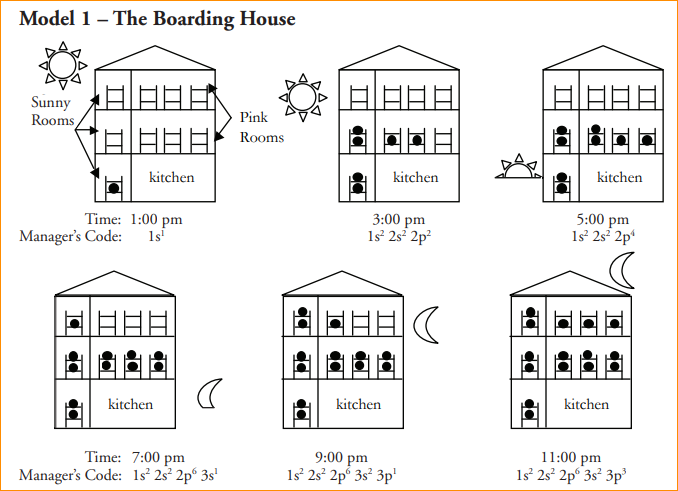
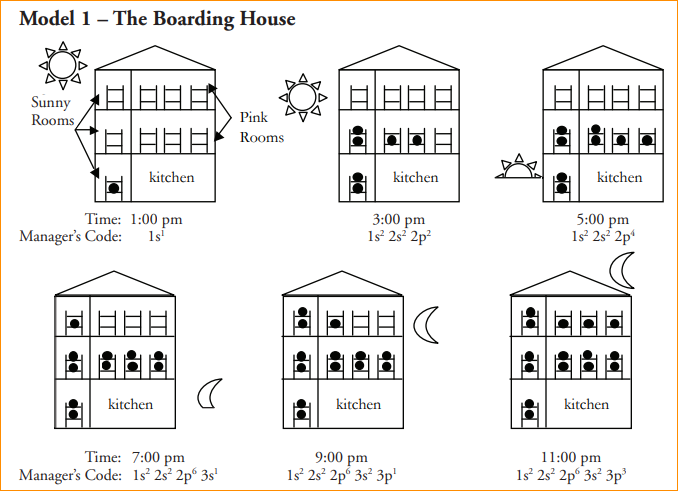
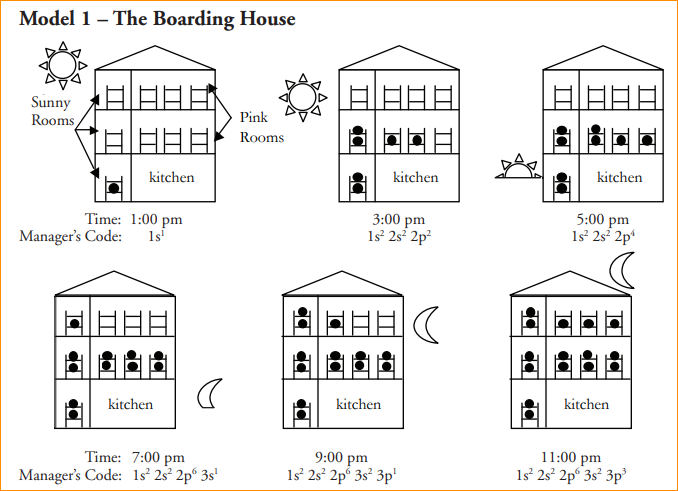
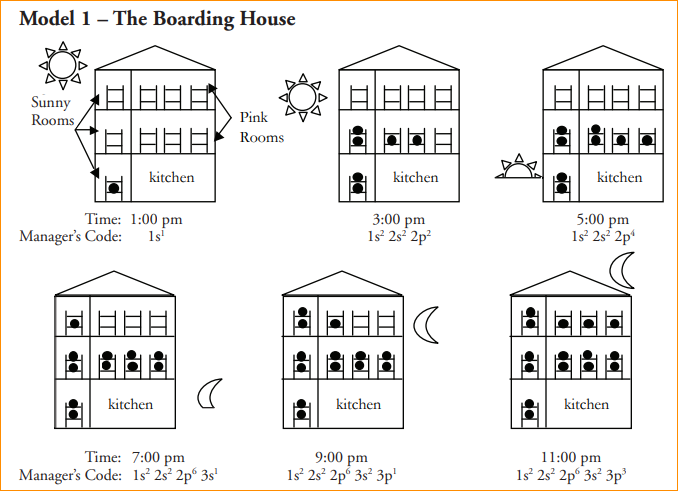
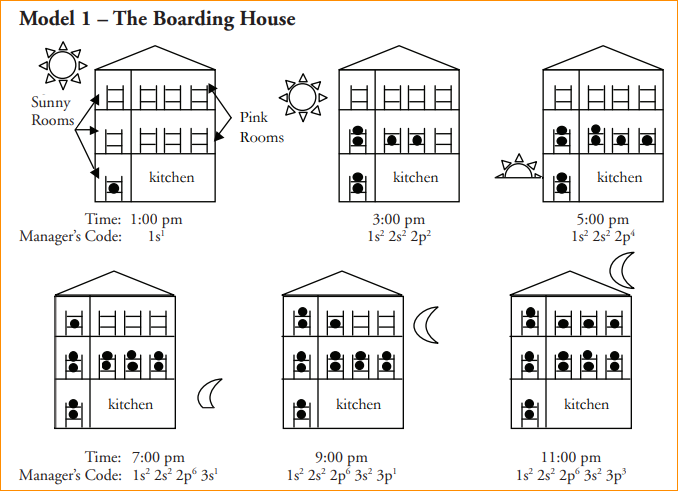
Examine the boarding room diagrams in Model 1, match the symbol with its likely meaning.
Bunkbed
Manager's code for the number of boarder in the house and their room assignment.
Boarder (someone paying to sleep somewhere).
a.) How many boarders were in the house at 5:00 pm?
b.) Describe how you determined your answer to a.
Examine each diagram in model 1 and the manager's code.
Using the tools in the "Show Your Work" window, look at the code provided under model 1 and...
a.) Underline all floor numbers.
b.) Circle all of the types of rooms.
c.) Box around the numbers of boarders?
The manager of the boarding house has some very strict rules on how beds will be rented out for the night. Examine the diagrams in Model 1 and the statements below to determine the phrase that best describes the manager’s set of rules.
a.) The boarding house will rent out beds on the floor first.
b.) Boarders are only allowed to double up in a bunkbed when .
c.) The next floor of rooms will be opened for boarders only when on the floor below are occupied.
d.) The pink room on a floor will be opened for boarders only when .
Provide a manager’s code showing 12 boarders present.
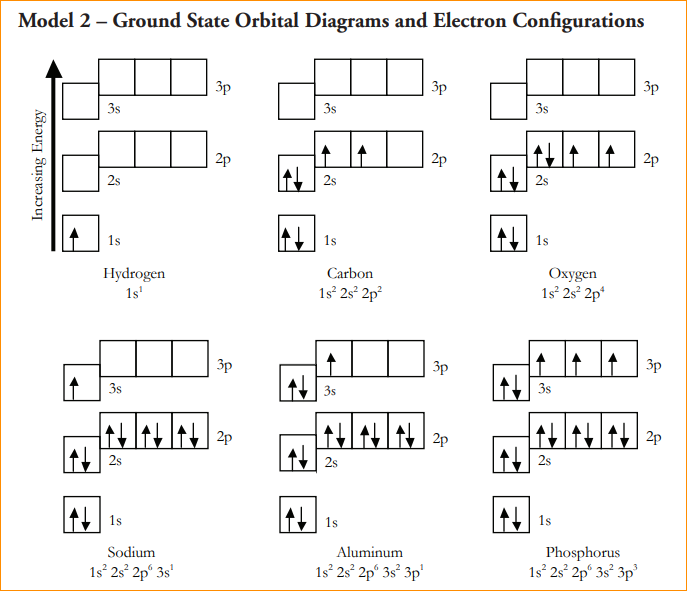
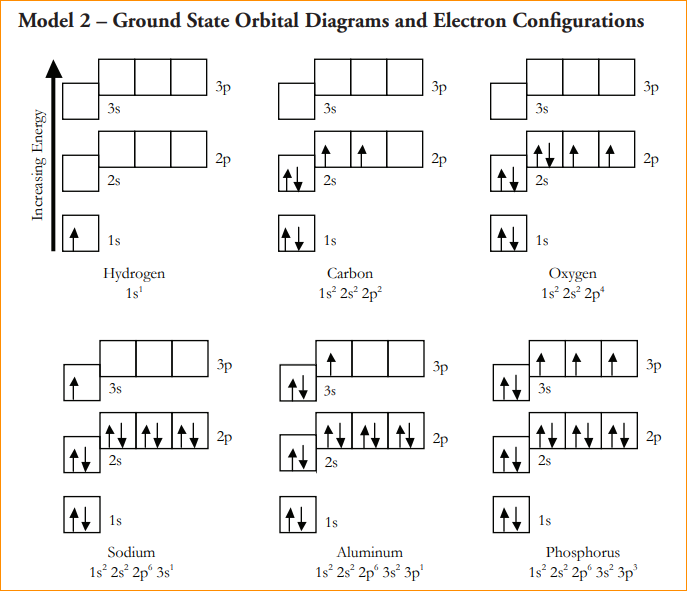
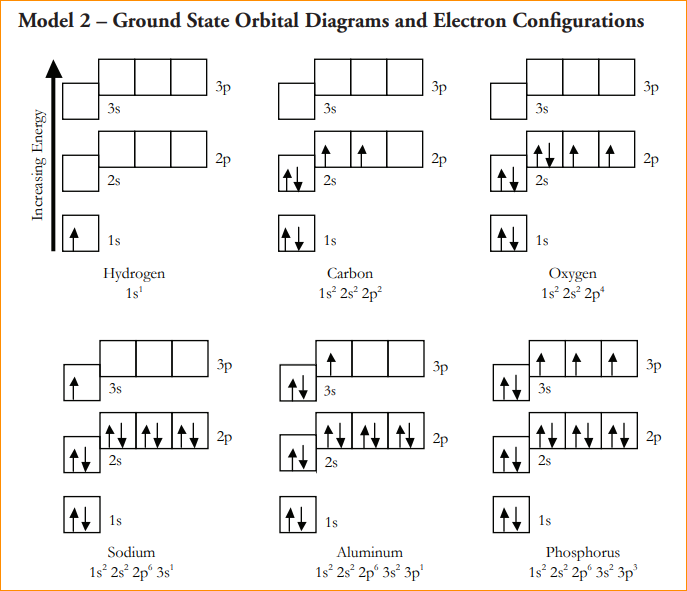
Examine the orbital diagrams and electron configurations in Model 2. Match each symbol below with its meaning.
Single electron
Pair of electrons with opposite spins
Atomic orbital (region of space where an electron or a pair of electrons are likely to be found)
Orbital (sublevel) - set of orbitals having equivalent energy
Electron configuration
Examine the orbital diagram for oxygen.
a.) How many electrons are present in the orbital diagram?
b.) How did you determine this?
c.) What does each individual arrow represent?
Using the following electron configuration: 1s2 2s2 2p4
a.) Underline the energy levels.
b.) Circle the orbitals (sublevels).
c.) Box in the electrons.
The 2s and 2p orbitals (sublevels) are very close in energy, as are the 3s and 3p orbitals (sublevels). Explain how the orbital diagram for sodium confirms that the 3s orbital (sublevel) is lower in energy than the 3p orbital (sublevel).
The lowest potential energy arrangement of electrons in an atom is called the ground state. Ground state electron configurations can be predicted by a strict set of rules known as the Aufbau principle (“Aufbau” means filling up). Examine the diagrams in Model 2 and the statements below to determine the phrase that best describes each rule.
a.) Based on where a single electron is placed, the lowest potential energy electron in an atom is found in the sublevel.
b.) Electrons will occupy a p-orbital only after .
c.) Electrons can begin to occupy energy levels with the next highest integer designation (e.g., 2 vs. 1, 3 vs. 2) only after on the energy level below it are occupied.
The Pauli exclusion principle describes the restriction on the placement of electrons into the same orbital.
Hund’s rule describes how electrons are distributed among orbitals of the same sublevel when there is more than one way to distribute them.
a.) The Pauli exclusion principle can be expressed as: “If two electrons occupy the same orbital, they must have .”
Using Hund's rule and Model 2, answer the following:
b.) Electrons will pair up in an orbital only when .
c.) When single electrons occupy different orbitals of the same sublevel, .
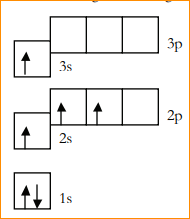
This is incorrect; explain what the errors are.
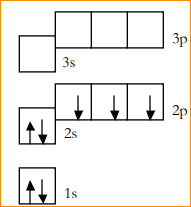
This is incorrect; explain what the errors are.
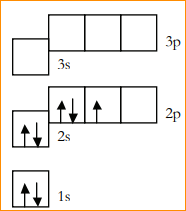
This is incorrect; explain what the errors are.
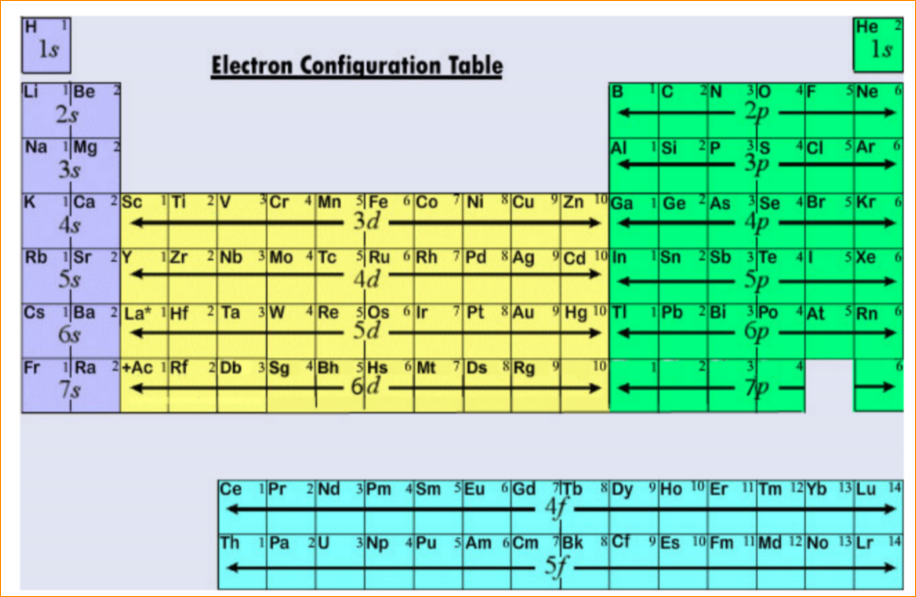
Use a periodic table to help you construct electron configurations for the following:
a.) Sulfur (S)
b.) Silicon (Si)
c.) Neon (Ne)
Complete the ground state orbital diagrams for the atoms from question 15 (drawing arrows to represent electrons) - be sure to follow the Pauli exclusion principle and Hund's rule.