Log in
Sign up for FREE
arrow_back
Library

Copy of Valence Electrons Intro (5/28/2026)

star
star
star
star
star
Last updated about 2 hours ago
15 questions
Learning Goals
Untitled Section
1
Untitled Section
Valence Electrons and Lewis Dot Structures
1
Video
1
Practice Questions -
1
1
3
1
1
1
1
1
1
Exit Ticket
Required
0
Required
0
Learning Goals:
  • Define valence electrons.
  • Show how to represent valence electrons with Lewis Dot structures.
  • Describe variation in valence electrons on the periodic table.
  • Relate valence electrons to reactivity and conductivity of elements.
Question: How do valence electrons interact with elements in chemical reactions?
Next, you will demonstrate the electron configuration for various elements. Follow all directions.

Click the green "Launch" button to begin the interactive, below.
Question 1
1.

Following the interactive exercise, how do you think the number of electrons affects an element’s reactivity?

Go Fish!

Have you ever played the card game called, "Go Fish"?

Players try to form groups of cards of the same value, such as four sevens, with the card that they are dealt or by getting cards from other players or from the deck.

This give and take of cards is a simple analogy for the way atoms give and take valence electrons during chemical reactions.

Reading

Next, you are going to read some information that will provide you a deeper understanding of valence electrons. As you read, you will complete short tasks to help you understand what you have read.

You goal is to collect evidence that will help you accomplish the learning goals.

You will be provided with an area to take notes as you read - you will want to do this.
1
Question 2
2.

This space is for you to record notes as you read the information on the left.

Question 3
3.

Click on the "Show Your Work" button and construct a Lewis Dot Structure for Nitrogen (N).
Click on the "Scribble" tool to add the necessary number of dots around the element symbol for nitrogen (N).

Tip - add one dot at a time in each side (there are four sides - remember the invisible box around the element symbol) before you attempt to pair the dots up.

Watch the following video and consider what you have learned and covered at this point in this activity.
Question 4
4.

Provide one specific thing that you still have questions about or are still confused about.

Do not put anything related to "everything".

Next, you will complete a series of question to display why you have learned from this lesson.

If you need to refer to anything prior to this, you may do so - this is not a quiz (do not look up information on the internet).
Question 5
5.
The maximum number of valence electrons that an element may have is _______ electrons.
Question 6
6.
Fluorine has _______ valence electrons.

Question 7
7.
Sodium (Na) has the following electron configuration (1s2 2s2 2p6 3s1). Use it to determine how many valence electrons that Na has: _______.

Calcium (Ca) has the following electron configuration (1s2 2s2 2p6 3s2 3p6 4s2).
Ca has _______ valence electrons.

Nitrogen (N) has the following electron configuration (1s2 2s2 2p3).
N has _______ valence electrons.
Question 8
8.
Here are some elements and their electron configurations:
He 1s2
Be 1s2 2s2
C 1s2 2s2 2p2
Mg 1s2 2s2 2p6 3s2
Si 1s2 2s2 2p6 3s2 3p2
Ca 1s2 2s2 2p6 3s2 3p6 4s2

How many elements above have two (2) valence electrons? _______
Question 9
9.
A diagram that shows the valence electrons of atom is referred to as a _______ diagram.
Question 10
10.
When a group 1 element reacts, it donates (gives up) _______.
Question 11
11.

Question 12
12.

Question 13
13.

Click on the "Show Your Work" button.
Use the "scribble" tool to draw an arrow showing what you would anticipate in this interaction between Na and Cl.

Hint - one of these will donate an electron and the other will accept one electron.

Question 14
14.

Provide one or two things that you may have learned in this activity.

Question 15
15.

What are Valence Electrons?

Valence electrons are the electrons in the outer energy level of an atom that can participate in interactions with other atoms. Valence electrons are generally the electrons that are the furtherest from the nucleus. Another way of thinking about them is to say that they are the outermost electrons in an atom. As a result of their physical position, they may be attracted as much as , or more than, the nucleus of another atom as they are the nucleus of their own atom.

Lewis Dot Structures

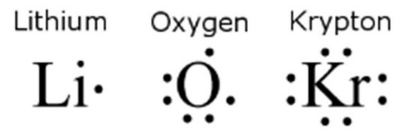
Because valence electrons are so important, atoms are often represented by simplistic diagrams that only show their valence electrons. These diagrams are referred to as "Lewis Dot Structures." Three of these diagrams are display just below. In this type of a diagram, an element's chemical abbreviation (located on the periodic table) is surrounded by a set of dots that represent the valence electrons. Each dot represents one electron.

Typically, the dots are drawn as if there was an invisible square surrounding the element symbol. Each side of this invisible square is able to hold up to two (2) electrons. An element symbol will never have more than eight (8) valence electrons represented as dots. See the examples, below.


Valence Electrons and the Periodic Table

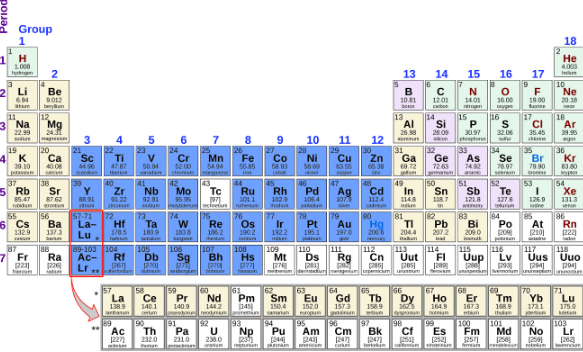
The number of valence electrons in an atom is reflected by its position on the periodic table. In this section, we will only be using a group of elements that are referred to as the "Representative Elements." These are the elements that have s and p orbitals, only. This will exclude the transition metals (those in the d-orbital block) and as well as the lanthanides and actinides (those in the f-orbital block).

Periodic Table of Elements:


Representative Elements:
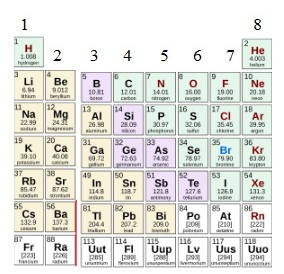

The number of dots in a Lewis Dot structure corresponds to the number of valence electrons, this also corresponds to the representative element group number (the number above each group in the representative element table).

When atoms react they can either give up electrons to another atom, accept electrons from another atom, or share electrons with one or more other atoms. Elements within representative groups 1-3 are more likely to give up electrons. Elements within representative groups 5-7 are more likely to accept electrons. Elements within representative group 8 are not likely to give up or accept any electrons, as their valence orbital is completely filled with electrons and they are chemically stable and generally nonreactive.

The number of electrons that can be given up or accepted can be predicted using the periodic table. Group 1 elements can give up one electron, group 2 elements can give up two electrons, and group 3 elements can give up three electrons. Group 5 elements can accept three electrons. Group 6 elements can accept two electrons. Group 7 elements can accept one electron.
Which of the following statements about valence electrons and the periodic table is true (select all that apply)?
The number of valence electrons increases from the top to the bottom of each group.
The number of valence electrons decreases from the left to the right across each period.
Elements with the most valence electrons are representative group 8.
All of the elements in group 9 have nine valence electrons.
Elements with the least valence electrons are in representative group 1.
Which of the following is true (select all that apply)?
Rubidium (Rb) has three valence electrons.
Tin (Sn) has four valence electrons.
Fluorine has seven valence electrons.
The number of valence electrons in an atom corresponds to the representative group number.
The element with the most number of valence electrons is Radon (Rn).
After having completed this activity, how has your confidence regarding it changed?
Significantly increased
Moderately increased
Somewhat increased
Stayed the same
Somewhat decreased
Moderately decreased
Significantly decreased