Valence Electrons and the Periodic Table
Representative Elements
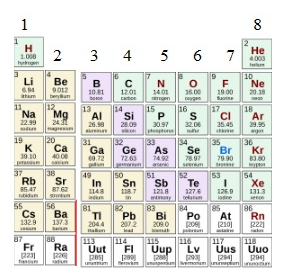
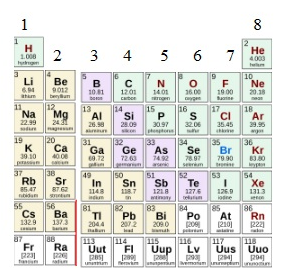
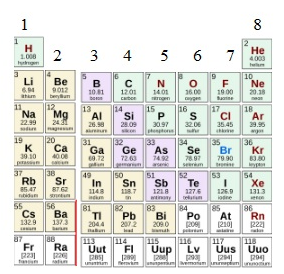
Only includes the elements that exist in the s and p orbital blocks. We will not be using the transition metals (d-orbital block) or the lanthanides and actinides (f-orbital block).
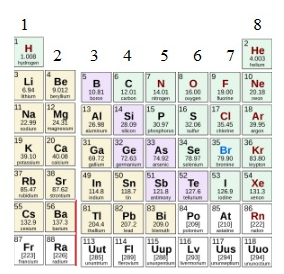
The number of dots in a Lewis Dot structure corresponds to the number of valence electrons, this also corresponds to the representative element group number (the number above each group in the representative element table).
When Atoms React (Losing, Accepting, Sharing Electrons)
When atoms react they can either give up electrons to another atom, accept electrons from another atom, or share electrons with one or more other atoms. Elements within representative groups 1-3 are more likely to give up electrons. Elements within representative groups 5-7 are more likely to accept electrons. Elements within representative group 8 are not likely to give up or accept any electrons, as their valence orbital is completely filled with electrons and they are chemically stable and generally nonreactive.
The number of electrons that can be given up or accepted can be predicted using the periodic table. Group 1 elements can give up one electron, group 2 elements can give up two electrons, and group 3 elements can give up three electrons. Group 4 elements can either accept or donate 4 electrons. Group 5 elements can accept three electrons. Group 6 elements can accept two electrons. Group 7 elements can accept one electron.
Determining the Charge of an Atom after it Gains or Loses Electrons
Electrons carry a negative charge (1 electron = 1-negative charge). Therefore, whenever an atom gains or loses electrons the overall charge of the atom is changed according to the number of electrons gained or lost. If an atom gains electrons, they are gaining more negative charge and thus carry a negative charge themselves. If an atom donates (loses) electrons, it is losing negative charge and becomes more positively-charged.
Group 1-3 elements all donate electrons and will all have a positive-charge according to the number of electrons that they lose. For instance, group 1 elements will lose one electron, therefore they are losing a 1- charge, and their charge becomes 1+. Group 2 elements will lose two electrons, which means they will lose a 2- charge, and their charge becomes 2+. Group 3 elements will lose three electrons and their charge becomes 3+.
Group 5-7 elements will all accept electrons and will all have a negative-charge according to the number of electrons that they gain. Group 5 elements will accept three electrons, meaning they are gaining more negative charge, and their charge becomes 3-. Group 6 elements will accept two electrons, therefore their charge becomes 2-. Group 7 elements will gain one electron and their charge will become 1-.
Group 4 and group 8 elements act differently than to above two groups of elements. Group 4 elements will either donate or gain four electrons; if they donate electrons, their charge becomes 4+; if they accept electrons, their charge becomes 4-. Group 8 elements will neither gain or donate electrons because their valence energy level is full of electrons and they are stable; their charge will always be 0 (which is neutral).