Log in
Sign up for FREE
arrow_back
Library

Copy of Valence, Lewis Dot Structures, and the Octet Rule Reading (5/28/2026)

star
star
star
star
star
Last updated about 2 hours ago
3 questions
Text
02:29
keyboard_arrow_down
Versión en español de la lectura

https://docs.google.com/document/d/1SjccnOG41706l6yMskQbXfI85sVWlVlssI_C71ngwaY/edit?usp=sharing
Valence Electrons

What makes a particular element very reactive and another element non-reactive?

A chemical reaction involves either electron removal, electron addition, or electron sharing. The path a specific element will take depends on where the electrons are in the atom and how many there are.
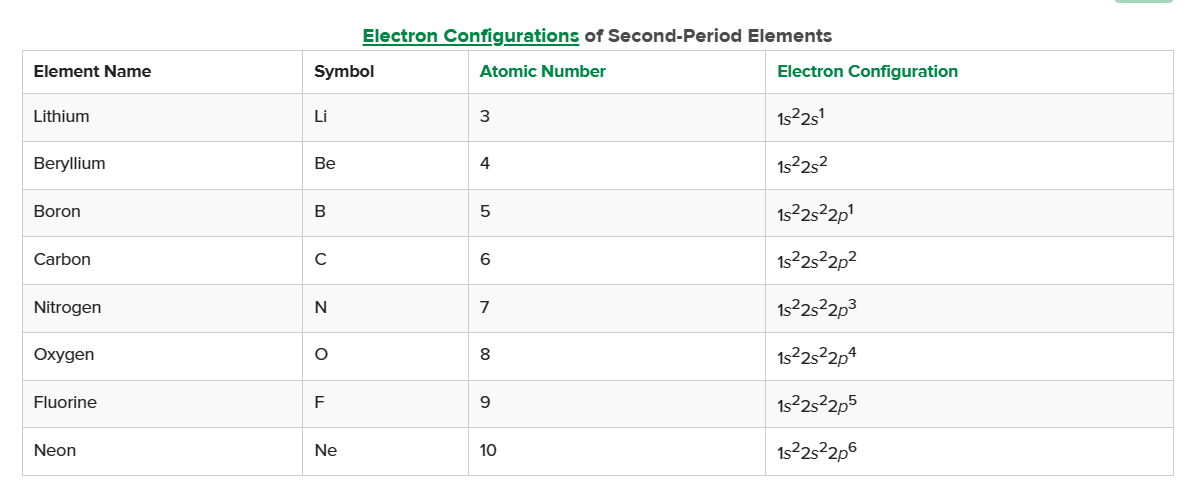

In the study of chemical reactivity, we will find that the electrons in the outermost principal energy level are very important and so they are given a special name. Valence electrons are the electrons in the highest occupied principal energy level of an atom. In the second period elements listed above, the two electrons in the 1s sublevel are called inner-shell electrons and are not involved directly in the element’s reactivity or in the formation of compounds. Lithium has a single electron in the second principal energy level and so we say that lithium has one valence electron. Beryllium has two valence electrons. How many valence electrons does boron have? You must recognize that the second principal energy level consists of both the 2s and the 2p sublevels and so the answer is three. In fact, the number of valence electrons goes up by one for each step across a period until the last element is reached. Neon, with its configuration ending in s2p6, has eight valence electrons.
9
You can stop the video here.
10
Question 2
2.
6
Question 3
3.
Question 1
1.
a. ) Valence electrons are the electrons in the _______ principal energy level of an atom.

b.) Lithium has a single electron in the second principal energy level and so we say that lithium has _______ valence electron.

c.) Beryllium has _______ valence electrons.

d.) How many valence electrons does boron have? _______

e.) Neon has its configuration ending in s2p6, and has _______ valence electrons.

f.) The number of valence electrons goes up by one for each step across a _______ until the last element is reached.

g.) Inner-shell electrons are not involved directly in the element’s _______ or in the formation of compounds.

h.) A chemical reaction involves either electron removal, electron addition, or _______ sharing.
Lewis Dot Diagrams


How do we show electrons in atoms?

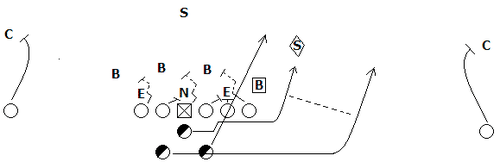
Diagrams contain a lot of helpful information in a compact format.  What does the diagram above tell us? The football play, diagrammed above, describes the lineup of each player on the team and describes how they will move when the ball is snapped.  Diagrams of electrons give similar information about where certain electrons are.  We can mark these electrons and indicate what happens to them when an element reacts.

Electron Dot Diagrams

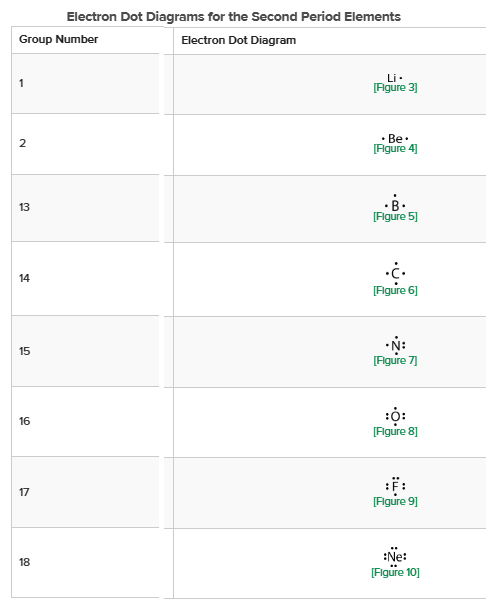
Recall that the valence electrons of an atom are the electrons located in the highest occupied principal energy level.  Valence electrons are primarily responsible for the chemical properties of elements.  The number of valence electrons can be easily determined from the electron configuration.  Several examples from the second-period elements are shown in the Table below.


In each case, valence electrons are those in the second principal energy level.  As one proceeds left to right across a period, the number of valence electrons increases by one.  In the s block, Group 1 elements have one valence electron, while Group 2 elements have two valence electrons.  In the p block, the number of valence electrons is equal to the group number minus ten. Group 13 has three valence electrons, Group 14 has four, up through Group 18 with eight.  The eight valence electrons, a full outer s and p sublevel, give the noble gases their special stability.

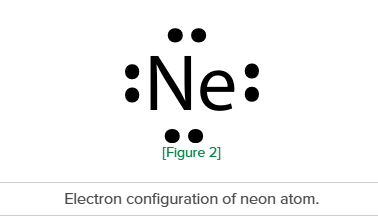
When examining chemical bonding, it is necessary to keep track of the valence electrons of each atom.  Lewis dot diagrams are diagrams in which the valence electrons of an atom are shown as dots distributed around the element’s symbol.  A beryllium atom, with two valence electrons, would have the electron dot diagram below.


Since electrons repel each other, the dots for a given atom are distributed evenly around the symbol before they are paired. The Table below shows the electron dot diagrams for the entire second period.


Lewis dot diagrams would be the same for each element in the representative element groups.  Most transition elements have two valence electrons, though some that have unusual electron configurations have only one.
a.) Valence electrons are primarily responsible for the _______ of elements.

b.) The number of valence electrons can be easily determined from the _______ .

c.) As one proceeds left to right across a period, the number of valence electrons _______ by _______ .

d.) In the s block, Group 1 elements have one valence electron, while Group 2 elements have _______ valence electrons.

e.) The eight valence electrons, a full outer s and p sublevel, give the noble gases their _______ .

f.) Lewis dot diagrams are diagrams in which the valence electrons of an atom are shown as _______ distributed around the element’s _______ .

g.) Since electrons repel each other, the dots for a given atom are distributed _______ around the symbol before they are _______ .
Octet Rule


How are electrons organized in atoms?

Graduations are exciting events in one's life.  The processional, the ceremonies, even the speeches can be handled because this marks the end of a stage of life and the beginning of another one. The ceremony itself is challenging for those organizing it.  There are just enough seats on the stage for the graduates.  How do you avoid getting too many people in a row and not enough in the next row? Someone is stationed at the end of the row to count the students as they enter.  Only so many are allowed to go into a row, and then you begin to fill the next row.  Electrons in atoms behave the same way.  There are rules that determine where electrons go in compounds.

Octet Rule

The noble gases are unreactive because of their electron configurations.  The noble gas neon has the electron configuration of 1s2 2s2 2p6.  It has a full outer shell and cannot incorporate any more electrons into the valence shell. The other noble gases have the same outer shell electron configuration even though they have different numbers of inner-shell electrons.


American chemist Gilbert Lewis (1875-1946) used this observation to explain the types of ions and molecules that are formed by other elements.  He called his explanation the octet rule.  The octet rule states that atoms tend to form compounds in ways that give them eight valence electrons and thus the electron configuration of a noble gas.  An exception to an octet of electrons is in the case of the first noble gas, helium, which only has two valence electrons.  This primarily affects the element hydrogen, which forms stable compounds by achieving two valence electrons. Lithium, an alkali metal with three electrons, is also an exception to the octet rule. Lithium tends to lose one electron to take on the electron configuration of the nearest noble gas, helium, leaving it with two valence electrons.

There are two ways in which atoms can satisfy the octet rule.  One way is by sharing their valence electrons with other atoms.  The second way is by transferring valence electrons from one atom to another.  Atoms of metals tend to lose all of their valence electrons, which leaves them with an octet from the next lowest principal energy level.  Atoms of nonmetals tend to gain electrons in order to fill their outermost principal energy level with an octet.

Video: Watch the following video to learn how to use the octet rule to predict the charge of an ion.
a.) The octet rule states that atoms tend to form compounds in ways that give them _______ and thus the electron configuration of a _______ .

b.) An exception to an octet of electrons is in the case of the first noble gas, _______ (do not use the abbreviation), which only has two valence electrons.

c.) There are two ways in which atoms can satisfy the octet rule. One way is by _______ their valence electrons with other atoms.

d.) Atoms of metals tend to _______ all of their valence electrons, which leaves them with an octet from the next lowest principal energy level.

e.) Atoms of nonmetals tend to _______ electrons to completely fill their valence energy level.