Copy of Ionic Bonding Intro (reading) (5/28/2026)
star
star
star
star
star
Last updated 3 months ago
33 Nsɛmmisa
1
1
1
1
1
1
1
1
1
1
1
1
1
How are electrons organized in atoms?
Graduations are exciting events in one's life. The processional, the ceremonies, even the speeches can be handled because this marks the end of a stage of life and the beginning of another one. The ceremony itself is challenging for those organizing it. There are just enough seats on the stage for the graduates. How do you avoid getting too many people in a row and not enough in the next row? Someone is stationed at the end of the row to count the students as they enter. Only so many are allowed to go into a row, and then you begin to fill the next row. Electrons in atoms behave the same way. There are rules that determine where electrons go in compounds.
Cations are
The most commonly formed cations of the representative elements involve the loss of all of the
What is the maximum number of electrons that most representative metal atoms can lose when forming an ion?
What charge does a cation have?
Group 1 elements tend to
An atom with the electron configuration of 1s2 2s1 will lose
How does an atom form a cation?
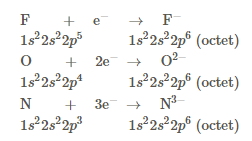
Anions are the negatively-charged ions formed from the gain of one or more electrons. When nonmetal atoms gain electrons, they often do so until their outermost (valence) energy level achieves an octet. This process is illustrated below for the elements fluorine, oxygen, and nitrogen.
All of these anions are isoelectronic with each other and with neon. They are also isoelectronic with the three cations from the previous section. Under typical conditions, three electrons is the maximum that will be gained in the formation of anions.
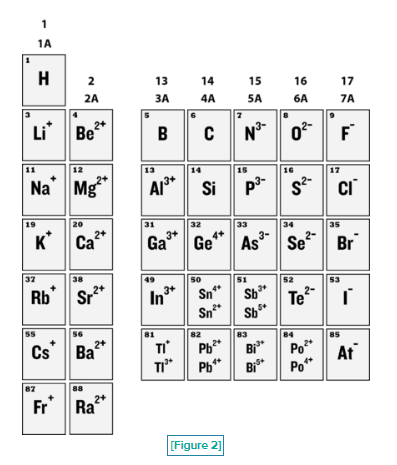
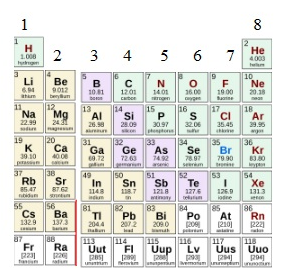
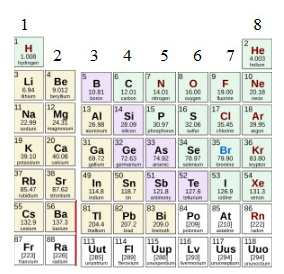
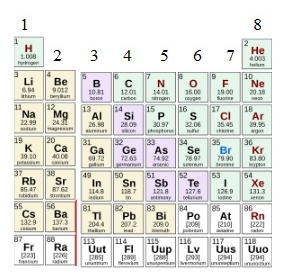
Outer electron configurations are constant within a group, so this pattern of ion formation repeats itself for Periods 3, 4, and following (see Figure below).
It is important not to misinterpret the concept of being isoelectronic. A sodium ion is very different from a neon atom because the nuclei of the two contain different numbers of protons. One is an essential ion that is a part of table salt, while the other is an unreactive gas that is a very small part of the atmosphere. Likewise, sodium ions are very different than magnesium ions, fluoride ions, and all the other members of this isoelectronic series (N3−, O2−, F−, Ne, Na+, Mg2+, Al3+).
If N gains two electrons, which of the following elements would it be isoelectronic with?
What is the maximum number of electrons that most nonmetal atoms can gain when forming an ion?
How many electrons do nonmetal atoms tend to gain when forming ions (this is not actually wanting a quantity or a number - they can accept them until, when)?
How are anions formed?
An atom with the electron configuration of 1s2 2s2 2p4 will gain
We can get common table salt from several sources. It can be mined in the solid form in salt mines or found as a solid in deposits. We can also get salt from the ocean, but it really does not exist as salt when in solution. The sodium ions and chloride ions are dissolved, but not combined into a structure until all the water is removed.
Most of the rocks and minerals that make up the Earth’s crust are composed of positive and negative ions held together by ionic bonding. An ionic compound is an electrically neutral compound consisting of positive and negative ions. You are very familiar with some ionic compounds such as sodium chloride (NaCl). A sodium chloride crystal consists of equal numbers of positive sodium ions (Na+) and negative chloride ions (Cl−).
Oppositely charged particles attract each other. This attractive force is often referred to as an electrostatic force. An ionic bond is the electrostatic force that holds ions together in an ionic compound. The strength of the ionic bond is directly dependent upon the quantity of the charges and inversely dependent on the distance between the charged particles. A cation with a 2+ charge will make a stronger ionic bond than a cation with a 1+ charge. A larger ion makes a weaker ionic bond because of the greater distance between its electrons and the nucleus of the oppositely charged ion.
Modeling Ionic Bonding with Lewis Dot Structures
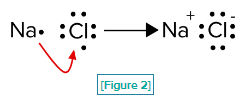
We will use sodium chloride as an example to demonstrate the nature of the ionic bond and how it forms. As you know, sodium is a metal and loses its one valence electron to become a cation. Chlorine is a nonmetal and gains one electron in becoming an anion. Both achieve a noble-gas electron configuration. However, electrons cannot be simply “lost” to nowhere in particular. A more accurate way to describe what is happening is that a single electron is transferred from the sodium atom to the chlorine atom as shown below.
The ionic bond is the attraction of the Na+ ion for the Cl− ion. It is conventional to show the cation without dots around the symbol to emphasize that the original energy level that contained the valence electron is now empty. The anion is now shown with a complete octet of electrons.
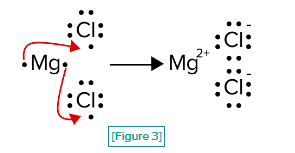
For a compound such as magnesium chloride, it is not quite as simple. Because magnesium has two valence electrons, it needs to lose both to achieve the noble-gas configuration. Therefore, two chlorine atoms will be needed.
The final formula for magnesium chloride is MgCl2.
Atoms of the element sodium “want” to give up an electron because sodium atoms have
What is an electrostatic force?
How do ionic bonds form?
Octet Rule
The noble gases are unreactive because of their electron configurations. The noble gas neon has the electron configuration of 1s2 2s2 2p6. It has a full outer shell and cannot incorporate any more electrons into the valence shell. The other noble gases have the same outer shell electron configuration even though they have different numbers of inner-shell electrons.
Lewis dot structure of neon atom.
American chemist Gilbert Lewis (1875-1946) used this observation to explain the types of ions and molecules that are formed by other elements. He called his explanation the octet rule. The octet rule states that atoms tend to form compounds in ways that give them eight valence electrons and thus the electron configuration of a noble gas. An exception to an octet of electrons is in the case of the first noble gas, helium, which only has two valence electrons. This primarily affects the element hydrogen, which forms stable compounds by achieving two valence electrons. Lithium, an alkali metal with three electrons, is also an exception to the octet rule. Lithium tends to lose one electron to take on the electron configuration of the nearest noble gas, helium, leaving it with two valence electrons.
There are two ways in which atoms can satisfy the octet rule. One way is by sharing their valence electrons with other atoms. The second way is by transferring valence electrons from one atom to another. Atoms of metals tend to lose all of their valence electrons, which leaves them with an octet from the next lowest principal energy level. Atoms of nonmetals tend to gain electrons in order to fill their outermost principal energy level with an octet.
The noble gases are
Neon has the electron configuration of
A full outer shell means that neon cannot incorporate any more electrons into its
Although the noble gases have different numbers of inner-shell electrons, they share the same
American chemist
The
Helium is an exception to the octet rule because it only has
The element
Lithium, which has three electrons, tends to lose one electron to take on the electron configuration of
Atoms can satisfy the octet rule by either
Metals typically
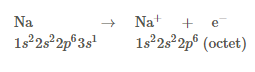
Cations are the positive ions formed by the loss of one or more electrons. The most commonly formed cations of the representative elements are those that involve the loss of all of the valence electrons. Consider the alkali metal sodium (Na). It has one valence electron in the third principal energy level. Upon losing that electron, the sodium ion now has an octet of electrons from the second principal energy level. The equation below illustrates this process.
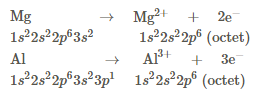
The electron configuration of the sodium ion is now the same as that of the noble gas neon. The term isoelectronic refers to an atom and an ion of a different atom (or two different ions) that have the same electron configuration. The sodium ion is isoelectronic with the neon atom. Consider a similar process with magnesium and with aluminum:
In this case, the magnesium atom loses its two valence electrons in order to achieve the same noble-gas configuration. The aluminum atom loses its three valence electrons. The Mg2+ ion, the Al3+ ion, the Na+ ion, and the Ne atom are all isoelectronic. For representative elements under typical conditions, three electrons is the maximum number that will be lost.
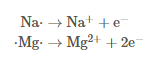
We can also show the loss of valence electron(s) with a Lewis dot diagram.
Sodium (Na) has one valence electron in the
Upon losing its valence electron, the sodium ion achieves an
The electron configuration of the sodium ion is the same as that of the noble gas
The term
The sodium ion is isoelectronic with the
The aluminum atom loses
The loss of valence electron(s) can also be illustrated using a