Log in
Sign up for FREE
arrow_back
Library

Copy of Change of State (5/28/2026)

star
star
star
star
star
Last updated about 2 hours ago
10 questions
1
2
1
2
1
1
1
1
2
1

Summary

  • A change of state occurs whenever matter changes from one state to another.
  • Changes of state are physical changes in matter. They are reversible changes that do not change matter’s chemical makeup or chemical properties.
  • Processes involved in changes of state include melting, freezing, sublimation, deposition, condensation, and evaporation.
  • Energy is always involved in changes of state. Particles of matter either absorb or lose energy when matter changes from one state to another.
Question 1
1.
_______ is the process in which matter changes from a gas to a solid.
Question 2
2.

Question 3
3.
The reverse of the process of sublimation is _______.
Question 4
4.

Question 5
5.

Question 6
6.

Question 7
7.

Question 8
8.

Question 9
9.

Question 10
10.

Learning Objectives:
  • Define change of state.
  • Identify processes that cause changes of state.
  • Explain the role of energy in changes of state.


Both of these photos show the famous Golden Gate Bridge near San Francisco, California. The pictures were taken from about the same point of view, but they look very different. In the picture on the left, the deck of the bridge is almost completely hidden by a thick layer of fog. In the picture on the right the fog has disappeared, and the deck of the bridge—as well as the water below it—is clearly visible. Fog consists of tiny droplets of liquid water. The fog in the picture is like a cloud at ground level. Where did the fog come from, and where did it go?

What Are Changes of State?

The water droplets of fog form from water vapor in the air. Fog disappears when the water droplets change back to water vapor. These changes are examples of changes of state. A change of state occurs whenever matter changes from one state to another. Common states of matter on Earth are solid, liquid, and gas. Matter may change back and forth between any two of these states.

Changes of state are physical changes in matter. They are reversible changes that do not change matter’s chemical makeup or chemical properties. For example, when fog changes to water vapor, it is still water and can change back to liquid water again.

Processes that Cause Changes of State

Several processes are involved in common changes of state. They include melting, freezing, sublimations, deposition, condensation, and evaporation. The Figure below shows how matter changes in each of these processes.
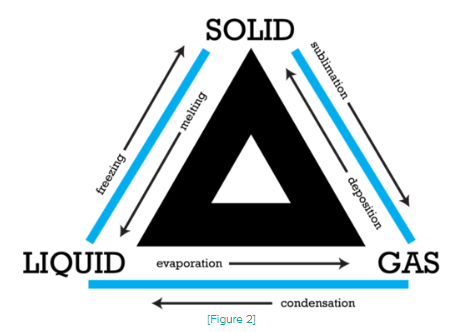
Q: Which two processes result in matter changing to the solid state?

A: The processes are deposition, in which matter changes from a gas to a solid, and freezing, in which matter changes from a liquid to a solid.

The Role of Energy in Changes of State

Suppose that you leave some squares of chocolate candy in the hot sun. A couple of hours later, you notice that the chocolate has turned into a puddle like the one pictured in the Figure below.
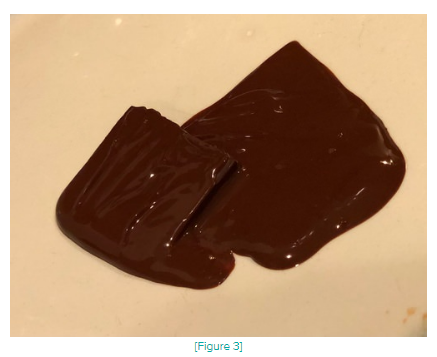
Q: What happened to the chocolate?

A: The chocolate melted. It changed from a solid to a liquid.
In order for solid chocolate to melt and change to a liquid, the particles of chocolate must gain energy. The chocolate pictured in the Figure above gained energy from sunlight. Energy is the ability to cause changes in matter, and it is always involved in changes of state. When matter changes from one state to another, it either absorbs energy—as when chocolate melts—or loses energy. For example, if you were to place the melted chocolate in a refrigerator, it would lose energy to the cold air inside the refrigerator. As a result, the liquid chocolate would change to a solid again.

Q: Why is energy always involved in changes of state?

A: The energy of particles of matter determines the matter's state. Particles of a gas have more energy than particles of a liquid, and particles of a liquid have more energy than particles of a solid. Therefore, in order for matter to change from a solid to a liquid or from a liquid to a gas, particles of matter must absorb energy. In order for matter to change from a gas to a liquid or from a liquid to a solid, particles of matter must lose energy.


Which change(s) of state require an increase in energy (select all that apply)?
sublimation
melting
evaporation
freezing
deposition
condensation
Which change(s) of state require an decrease in energy (select all that apply)?
freezing
evaporation
sublimation
deposition
condensation
melting
Which statement(s) is/are true about the process of boiling a sample of tap water.
The water is undergoing evaporation.
The water's change of state involves a loss of energy to the surroundings.
The water is undergoing sublimation.
The water's change of state requires an increase in energy.
Why is energy invovled in changes of state (select all that apply)?
Energy is always released when there is a change of state.
Particles of matter do not gain or lose energy when changing state.
Energy cannot be created nor destroyed, only converted into another form.
The energy of particles of matter determines the matter's state.
Energy is always absorbed when there is a change of state.
Why do molecules and atoms speed up when the amount of heat added increases?
The atoms and molecules speed up because they are giving off a tremendous amount of energy.
The atoms and molecules speed up due to the varrying temperature in the enclosed container.
The atoms and molecules speed up because energy is being added.
More pressure is being added, which causes the atoms and molecules to speed up.
The atoms and molecules rarely ever speed up.
Which of the following is an example of a change of state (select all that apply)?
combination
putrifying
combustion
sublimarine
dissolving
evaporating
tarnishing
When enjoying an icy cold beverage on a hot summer day, you notice that the outside of your glass gets very wet. What is occuring to make the glass wet on the outside (select all that apply)?
Ice in the glass is undergoing a phase change from solid to liquid, called melting, which accumulates on the walls of the glass.
Water vapor in the air undergoes a phase change from gas to liquid, called evaporation, when it touches the cold glass.
Liquid water is most likely leaking out of the glass.
Water vapor in the air undergoes a phase change from gas to liquid, called condensation, when it touches the cold glass.
Which process does not involve matter in the liquide state (select all that apply)?
melting
evaporation
sublimation
condensation