If a swimming pool and wading pool, both full of water at the same temperature were subjected to the same input of heat energy, the wading pool would certainly rise in temperature more quickly than the swimming pool. The heat capacity of an object depends both on its mass and its chemical composition. Because of its much larger mass, the swimming pool of water has a larger heat capacity than the bucket of water.
Heat capacity depends on two things - its
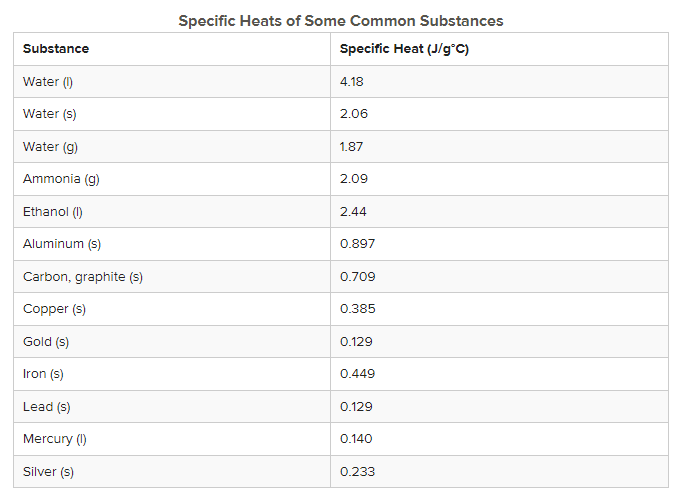
Different substances respond to heat in different ways. If a metal chair sits in the bright sun on a hot day, it may become quite hot to the touch. An equal mass of water in the same sun will not become nearly as hot. We would say that water has a high heat capacity (the amount of heat required to raise the temperature of an object by 1°C.) Water is very resistant to changes in temperature, while metals in general are not. The specific heat of a substance is the amount of energy required to raise the temperature of 1 gram of the substance by 1°C. Table below lists the specific heats of some common substances. The symbol for specific heat is cp, with the p subscript referring to the fact that specific heats are measured at constant pressure. The units for specific heat can either be joules per gram per degree (J/g°C) or calories per gram per degree (cal/g°C). This text will use J/g°C for specific heat.
Substances respond to
Water has a
Notice that water has a very high specific heat compared to most other substances. Water is commonly used as a coolant for machinery because it is able to absorb large quantities of heat (see Table above). Coastal climates are much more moderate than inland climates because of the presence of the ocean. Water in lakes or oceans absorbs heat from the air on hot days and releases it back into the air on cool days.
The specific heat of liquid water is
The specific heat of solid iron is
This means that
Because water has a high specific heat, it is able to absorb more heat than many other substances. Therefore, it is often used as a
Heat capacity is the amount of heat required to raise the temperature of an object by 1°C.
Specific heat is the amount of energy required to raise the temperature of 1 gram of a substance by 1°C.