States of Matter Background
There are four states of matter: three standard and one uncommon (plasma).
The standard states of matter include — solid, liquid, and gas.
All substances can exhibit all three of these states of matter.
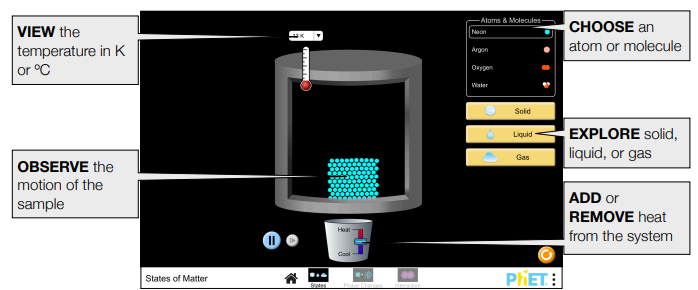
The state of matter is determined by the amount of energy a substance possesses.
As a substance gains energy, the atoms that make up the substance begin to vibrate; as the energy continues to increase, the motion of those atoms will also increase.
If the energy and motion of the atoms increase, eventually, the amount of space between the particles will increase, as well as the speed at which the atoms move.
The energy of a substance can be increased or decreased by changing its temperature.
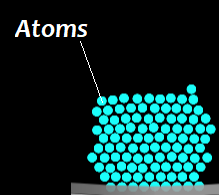
A solid is a state of matter in which all of the atoms in that substance are stacked up in an organized fashion; the particles, while not changing position, will vibrate in place.
A liquid is a state of matter in which the atoms exhibit more motion than those of a solid and are sliding by one another.
A gas is a state of matter in which the atoms exhibit more motion than those of a liquid and are now moving in very rapid, straight lines.
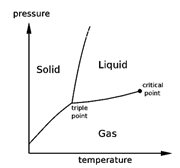
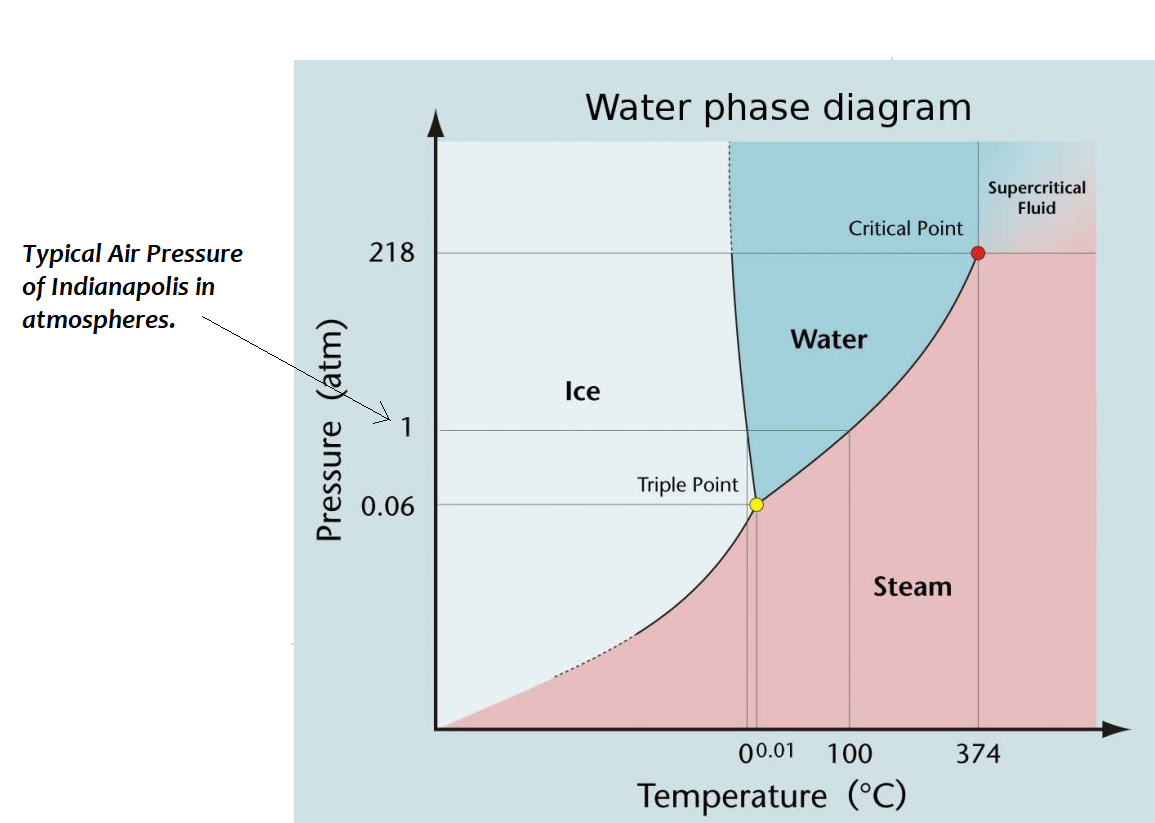
Triple Point Temperature - the temperature and pressure at which a single substance's three states of matter (gas, liquid, and solid) are simultaneously present.
Below is a phase diagram for water that displays the relationship between pressure and temperature with each state of matter of water; notice that at 0.06 atm and 0.01 oC, all three states of water are present, even in small amounts - this is the triple point for water.
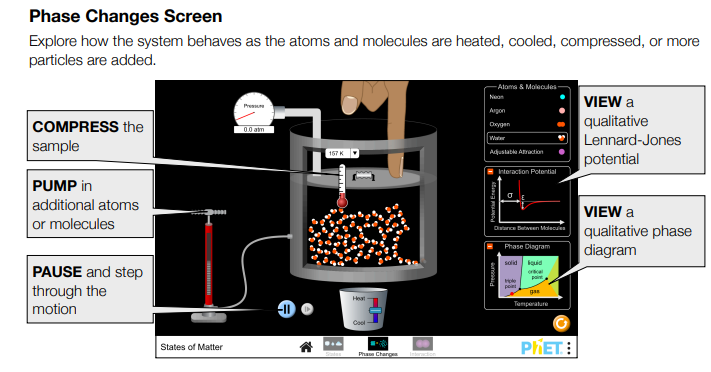
In this lab, we will explore the impact of increasing or decreasing the energy on certain substances. You will need to read through the instructions for each section of this virtual lab and use the simulations to collect data and observations.