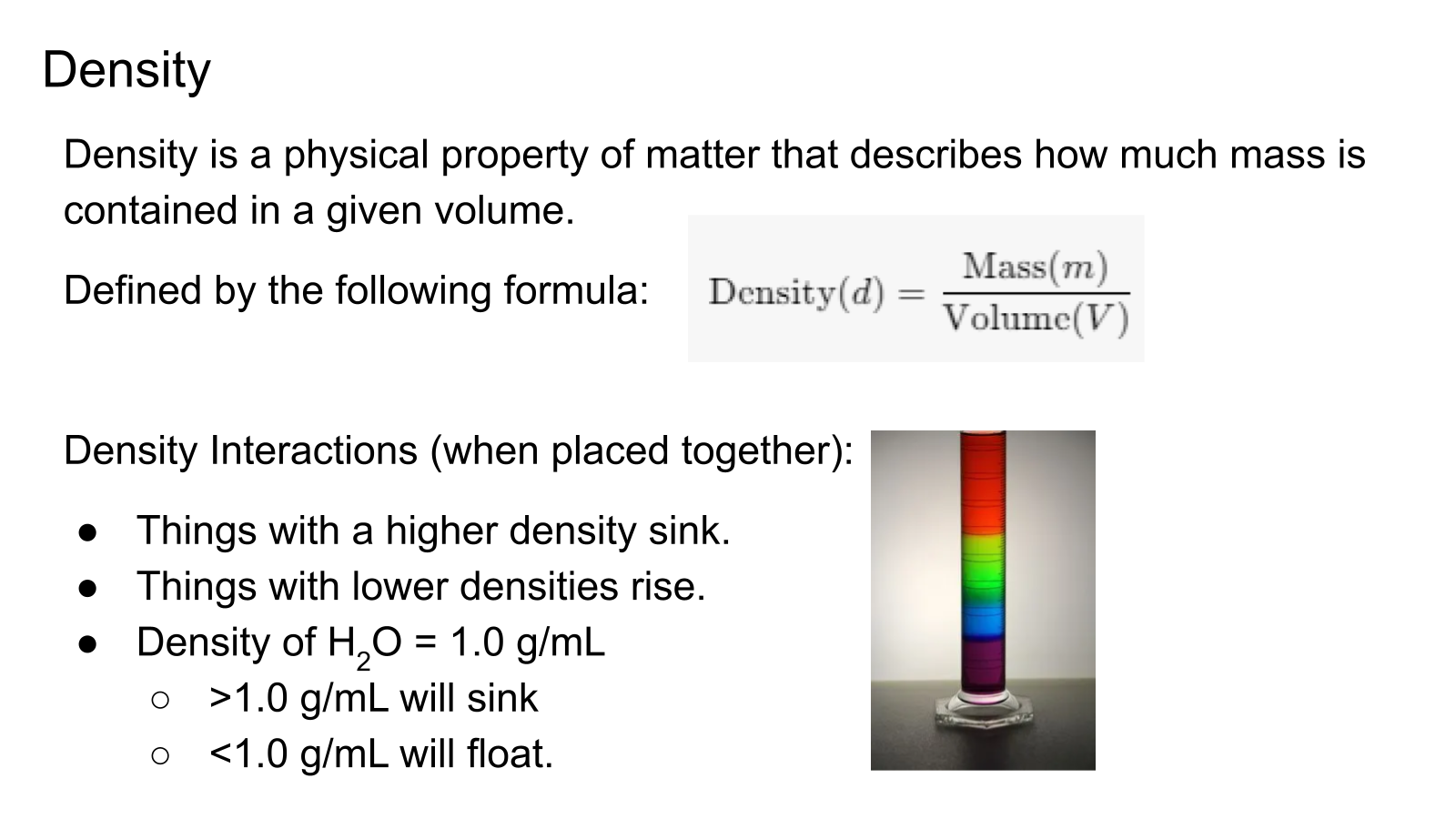
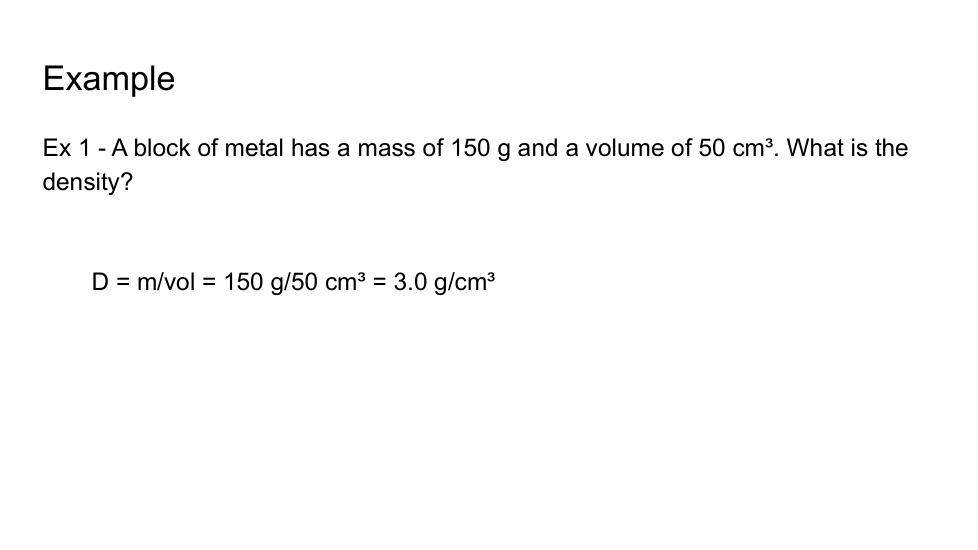
A metal cube has a mass of 80 g and a volume of 20 cm³. What is its density?
A liquid has a mass of 150 g and occupies a volume of 200 mL.
a.) What is the density of the liquid?
b.) Would it float or sink in water (density = 1 g/mL)?
Which substance is denser: a rock with a density of 2.5 g/cm³ or a piece of wood with a density of 0.9 g/cm³? Explain your answer.
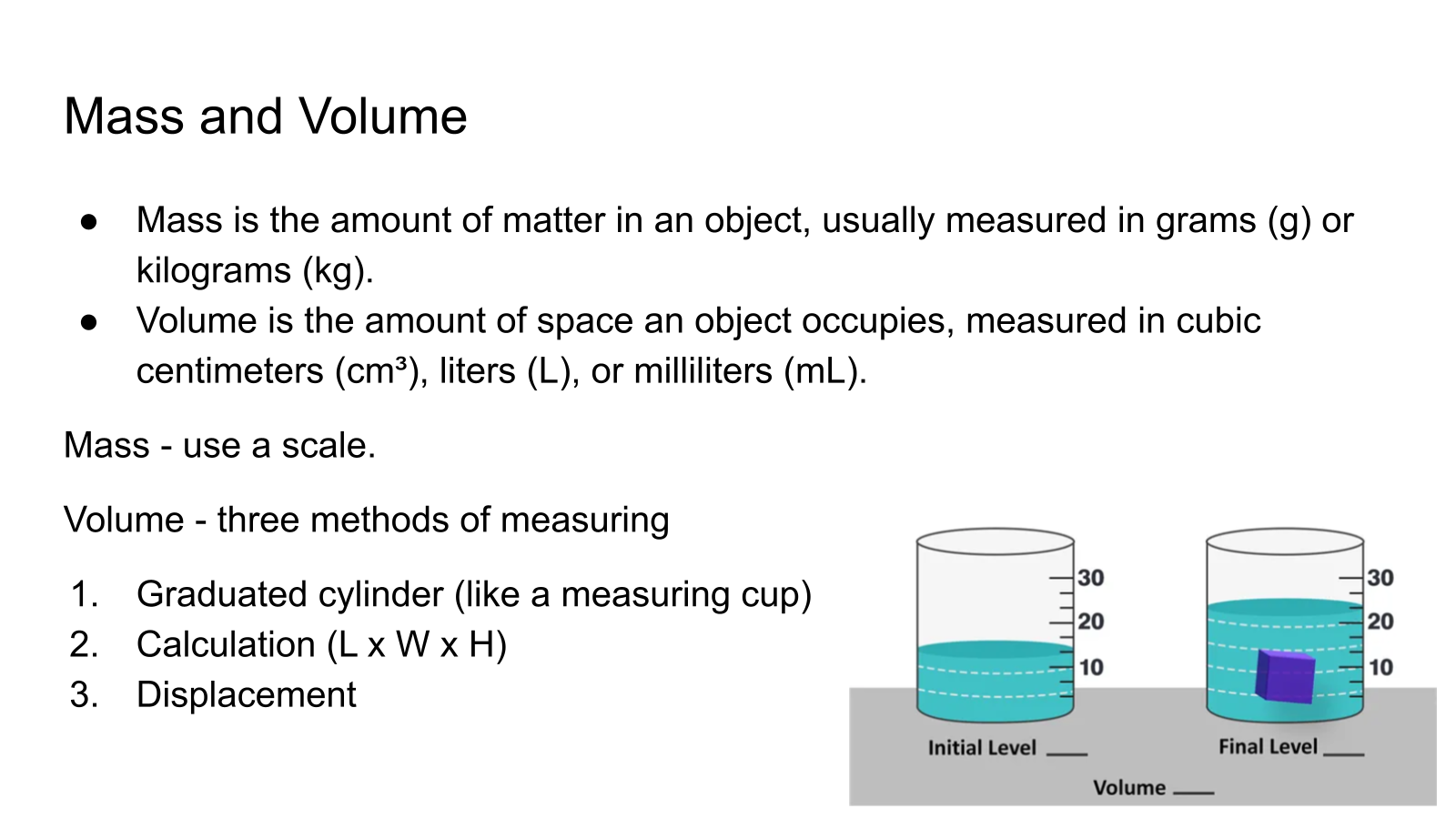
A stone causes the water level in a graduated cylinder to rise from 50 mL to 70 mL. If the stone has a mass of 100 g, what is its density?
An object with a density of 0.8 g/cm³ is placed in water. Will it float or sink? Justify your answer.
a.) A liquid has a volume of 200 mL and a mass of 240 g. What is the density?
b.) A block of metal has a volume of 100 mL and a mass of 270 g. What is the density?
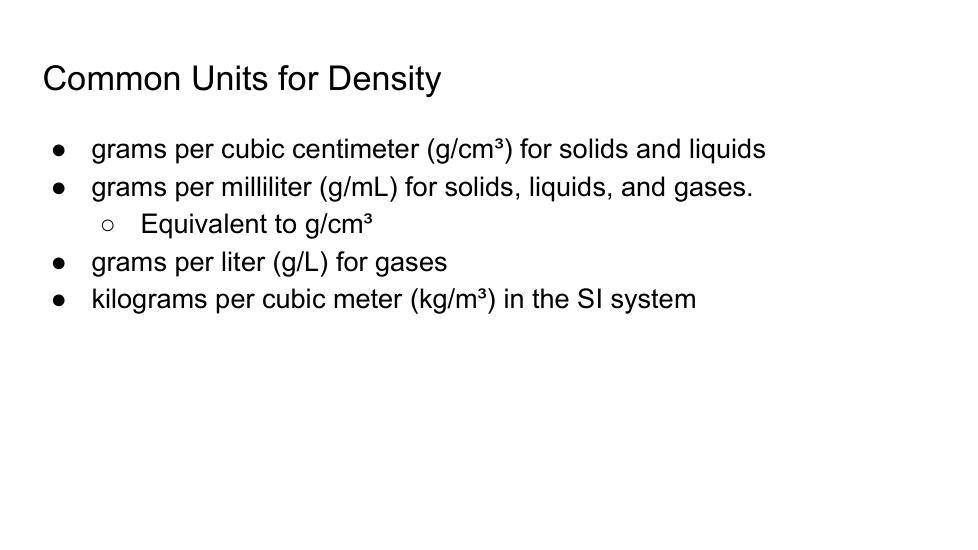
c.) A gas has a mass of 1.5 g and occupies a volume of 3 L. What is its density in g/L?
d.) Ice has a density of 0.92 g/cm³. If you have a block of ice with a mass of 250 g, what is its volume? (re-write the density equation)
You have three liquids: Liquid A (density = 1.5 g/cm³), Liquid B (density = 0.9 g/cm³), and Liquid C (density = 1.2 g/cm³). Which liquids will float on top of each other if mixed?
Liquid A
Liquid B
Liquid C