Log in
Sign up for FREE
arrow_back
Library

Copy of Density Questions 1 (5/28/2026)

star
star
star
star
star
Last updated about 2 hours ago
7 questions
10
1
1
1
1
1
5

Density

  • Density helps us understand how tightly packed together particles of matter are within a substance.
  • The densities of pure substances do not change from one sample of this substance to another. Therefore, density can be used to help identify one pure substance from another.
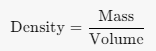
  • Density is defined as the mass of a substance divided by the amount of space that it takes up (volume).
  • To determine density two things must be known: 1.) the mass of the substance (in grams or kilograms); 2.) the volume of the substance (in milliliters or liters).
  • Mass is usually determined by using a scale (similar to a bathroom scale).
  • Volume can be determined in three ways:
  1. Fluids - use a graduated cylinder to measure the volume.
  2. Regular Shaped Solids (cubes, etc) - use the formula, length x width x height, to find the volume in cm3 or m3 .
  3. All solids - displacement, begin with a known volume of water (initial volume), place the object in water, the volume of water will increase, find this new volume level (final volume), subtract the final volume and initial volume.

Necessary Formulae

Volume by Displacement:
  • Final Volume - Initial Volume = Volume
Density:
Question 1
1.
Determine the density for the following:
a.) A rock has a mass of 300 grams and a volume of 100 cubic centimeters. _______
b.) A cube of metal weighs 2 kilograms and occupies a volume of 500 cubic centimeters. _______
c.) A liquid has a mass of 250 grams and a volume of 200 milliliters. _______
d.) A block of wood has a mass of 1.5 kilograms and a volume of 1200 cubic centimeters. _______
e.) A gas has a mass of 0.5 grams and occupies a volume of 1 liter. _______
f.) A bottle contains 750 milliliters of water with a mass of 750 grams. _______
g.) A piece of plastic has a mass of 60 grams and a volume of 30 cubic centimeters. _______
h.) A metal sphere has a mass of 400 grams and a volume of 100 cubic centimeters. _______
i.) A sample of air has a mass of 1.2 grams and occupies a volume of 1000 liters. _______
j.) A sample of mercury has a mass of 1500 grams and a volume of 100 milliliters. _______
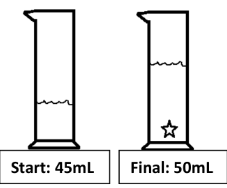
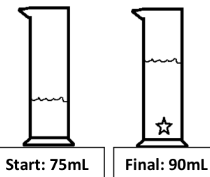
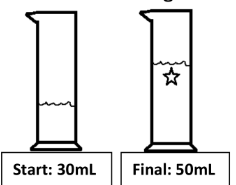
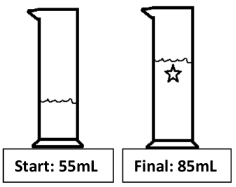
For the following questions, you will use the displacement method to find the volume. This volume will be used, along with the provided mass, to determine the density of each.

Volume by Displacement:

Volume = Final Volume - Initial Volume
  • Initial Volume - volume of the water prior to placing the object within it.
  • Finial Volume - volume of the water after placing the object within it.
Question 2
2.
Mass = 22.5 g
Volume = _______
Density = _______
Question 3
3.
Mass = 55.25 g
Volume = _______
Density = _______ (round to the nearest 10th)
Question 4
4.
Mass = 11.3 g
Volume = _______
Density = _______
Question 5
5.

Mass = 9.9 g
Volume = _______
Density = _______
For the next set of questions, you will use the provided densities to determine how different substances will interact.
Question 6
6.

Question 7
7.

Determine how the following fluids will line up according to their densities.
2.7 g/mL
11.3 g/mL
5.25 g/mL
5.3 g/cm3
0.789 g/mL
The following are placed within a fluid that has a density of 2.45 g/mL. Categorize each as either floating or sinking.
liquid water 1.0 g/mL
iron 7.87 g/mL
concrete 2.40 g/mL
glass 2.50 g/mL
ethanol 0.789 g/mL
mercury 13.56 g/mL
solid water 0.92 g/mL
aluminum 2.7 g/mL
copper 8.96 g/mL
olive oil 0.91
Float
Sink