Copy of POGIL - Bal Chem Eq (Incomplete) (5/28/2026)
star
star
star
star
star
Last updated 3 months ago
9 Nsɛmmisa
1
1
1
1
1
1
1
1
What stays the same and why may change during a chemical reaction?
Read This!
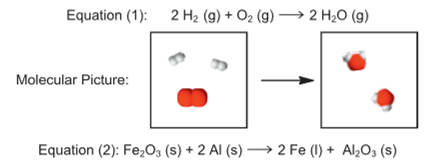
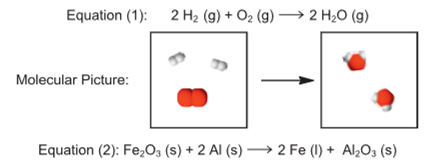
Matter (atoms) are conserved during chemical reactions. Atoms can neither be created nor destroyed when chemical reactions occur. Two balanced chemical reactions (equations) are shown in the model, below. In a chemical equation, the reactants are shown on the left side of the arrow and the products are show on the right side of the arrow.
Consider equation 1, above.
a. What are the reactants? Write your answer as words and the formula.
Words - reactant 1:
Formula - reactant 1:
b. What is the product? Write your answer as words and the formula.
Words -
Formula -
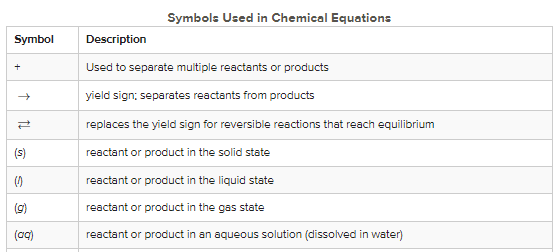
What does the arrow do, represent, or display in a chemical reaction?
How many hydrogen molecules (not atoms) are represented on the reactant side of equation 1?
How many water molecules are represented on the product side of equation 1?
How many H atoms are represented on the reactant side of equation 1?
On the product side?
Tip - the coefficient is a number placed in front of a molecule to state how many molecules there are. The subscript is placed to the bottom-right of atoms to state how many atoms there are in a chemical. If there isn't a subscript, assume there is one of that atom type. Multiply the coefficient by the subscript.
How many O atoms are represented on the reactant side of equation 1?
On the product side?
Compare the number of atoms of each element (H, O) on the reactant and product sides of equation 1. How could you describe their quantities?
Tip - Think: are they different? If so, state that; if not, what are they?
Compare the number of atoms of each element (Fe, Al, O) on the reactant and product sides of equation 2. How could you describe their quantities?
In reaction 1:
a. For each H2 molecule consumed, how many H2O molecules were produced?
b. For each O2 molecule consumed, how many H2O molecules were produced?
c. Is there a difference in the total number of H atoms on the reactant versus product side?
d. Is there a difference in the total number of O atoms on the reactant versus product side?