The reactants and products in a chemical reaction contain the same atoms, but they are rearranged during the reaction. As a result, the atoms are in different combinations in the products than they were in the reactants. This happens because chemical bonds break in the reactants and new chemical bonds form in the products.
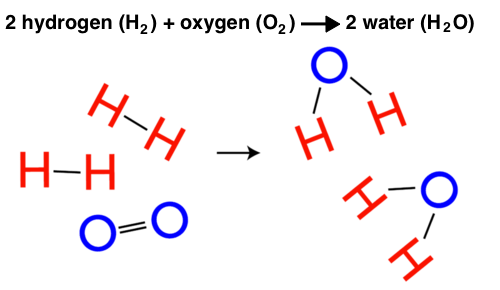
Consider the chemical reaction in which water forms from oxygen and hydrogen gases. The Figure below represents this reaction. Bonds break in molecules of hydrogen and oxygen, and then new bonds form in molecules of water. In both reactants and products there are four hydrogen atoms and two oxygen atoms, but the atoms are combined differently in water.
4
Types of Chemical Reactions
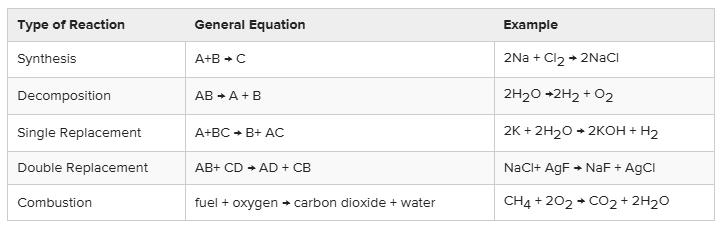
The chemical reaction in the Figure above, in which water forms from hydrogen and oxygen, is an example of a synthesis reaction. In this type of reaction, two or more reactants combine to synthesize a single product. There are several other types of chemical reactions, including decomposition, replacement, and combustion reactions. The Table below compares these four types of chemical reactions.
Q: The burning of wood is a chemical reaction. Which type of reaction is it?
A: The burning of wood—or of anything else—is a combustion reaction. In the combustion example in the table, the fuel is methane gas (CH4).
4
Energy In and Energy Out
All chemical reactions involve energy. Energy is used to break bonds in reactants, and energy is released when new bonds form in products. In terms of energy, there are two types of chemical reactions: endothermic reactions and exothermic reactions.
In exothermic reactions, more energy is released when bonds form in products than is used to break bonds in reactants. These reactions release energy to the environment, often in the form of heat or light.
In endothermic reactions, more energy is used to break bonds in reactants than is released when bonds form in products. These reactions absorb energy from the environment.
Q: When it comes to energy, which type of reaction is the burning of wood? Is it an endothermic reaction or an exothermic reaction? How can you tell?
A: The burning of wood is an exothermic reaction. You can tell by the heat and light energy given off by a wood fire.
Summary
A chemical reaction is a process in which some substances, called reactants, change into different substances, called products. During the reaction, chemical bonds break in the reactants and new chemical bonds form in the products.
Types of chemical reactions include synthesis, decomposition, replacement, and combustion reactions.
All chemical reactions involve energy. Exothermic reactions release more energy than they use. Endothermic reactions use more energy than they release.
7
When you are finished with this, review the reading then attempt the following:
Cuando haya terminado con esto, revise la lectura y luego intente lo siguiente:
Reading Quiz (Examen de lectura) - https://app.formative.com/formatives/67bf590d01f2c3bc3b6478b8
Password (Contraseña) - Ciudad
Chemical Reaction
Does the term chemical reaction bring to mind an image like this one? In the picture, a chemist is mixing chemicals in a lab. Many chemical reactions take place in labs. However, most chemical reactions do not. Where do they occur? They happen in the world all around you. They even happen inside your own body. In fact, you are alive only because of the many chemical reactions that constantly take place inside your cells.
What Is a Chemical Reaction?
A chemical reaction is a process in which some substances change into different substances. Substances that start a chemical reaction are called reactants. Substances that are produced in the reaction are called products. Reactants and products can be elements or compounds. Chemical reactions are represented by chemical equations, like the one below, in which reactants (on the left) are connected by an arrow to products (on the right).
Reactants → Products
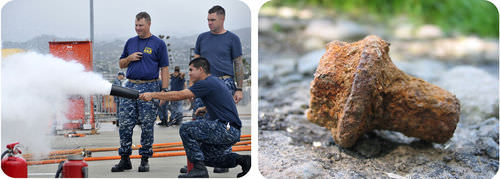
Chemical reactions may occur quickly or slowly. Look at the two pictures in the Figure below. Both represent chemical reactions. In the picture on the left, a reaction inside a fire extinguisher causes foam to shoot out of the extinguisher. This reaction occurs almost instantly. In the picture on the right, a reaction causes the iron tool to turn to rust. This reaction occurs very slowly. In fact, it might take many years for all of the iron in the tool to turn to rust.
Q: What happens during a chemical reaction? Where do the reactants go, and where do the products come from?
A: During a chemical reaction, chemical changes take place. Some chemical bonds break and new chemical bonds form.
a.) A _______ is a process where some substances transform into different substances.
b.) The substances that initiate a chemical reaction are referred to as _______ .
c.) In a chemical equation, reactants are displayed on the _______ side of the equation.
d.) Chemical reactions can occur at varying speeds, with some happening _______ and others taking a much longer time.
e.) The substances produced as a result of a chemical reaction are known as _______ .
Question 2
2.
a.) During a chemical reaction, the same _______ are found in both the reactants and products, but they are rearranged.
b.) In the formation of water, bonds break in molecules of _______ and _______ gases.
c.) The combinations of atoms in the products differ from those in the _______ .
Question 3
3.
a.) A synthesis reaction occurs when two or more _______ combine to create a _______ .
b.) The burning of wood is classified as a _______ reaction.
c.) Other types of chemical reactions include _______ , replacement, and combustion reactions.
Question 4
4.
a.) Energy is needed to break _______ in reactants during a chemical reaction.
b.) In exothermic reactions, the energy released when bonds form in products is _______ than the energy used to break bonds in reactants.
c.) Reactions that absorb energy from the environment are known as _______ reactions.
d.) Heat or light energy is often released to the environment in _______ reactions.
e.) During a chemical reaction, new chemical _______ form in the products.
f.) The burning of wood is an example of an _______ reaction.
g.) Chemical reactions can be classified into types, including synthesis, decomposition, replacement, and _______ reactions.