When you cook a meal, quite often there are leftovers because you prepared more than people would eat at one sitting. Sometimes when you repair a piece of equipment, you end up with what are called “pocket parts,” small pieces you put in your pocket because you’re not sure where they belong. Chemistry tries to avoid leftovers and pocket parts. In normal chemical processes, we cannot create or destroy matter (law of conservation of matter). If we start out with ten carbon atoms, we need to end up with ten carbon atoms. John Dalton’ atomic theory said that chemical reactions basically involve the rearrangement of atoms. Chemical equations need to follow these principles in order to be correct.
a.) In a chemical reactions, matter cannot be
b.) According to Dalton's theory, atoms will be
A balanced equation is a chemical equation in which mass is conserved and there are equal numbers of atoms of each element on both sides of the equation. We can write a chemical equation for the reaction of carbon with hydrogen gas to form methane (CH4). In order to write a correct equation, you must first write the correct skeleton equation with the correct chemical formulas. Recall that hydrogen is a diatomic molecule and so is written as H2.
C + H2 → CH4
When we count the number of atoms of both elements, shown under the equation, we see that the equation is not balanced.
C + H2 → CH4
1 C atom 2 H atoms 1 C atom, 4 H atoms
There are only 2 atoms of hydrogen on the reactant side of the equation, while there are 4 atoms of hydrogen on the product side. We can balance the above equation by adding a coefficient of 2 in front of the formula for hydrogen.
C + 2H2 → CH4
A coefficient is a small whole number placed in front of a formula in an equation in order to balance it. The 2 in front of the H2 means that there are a total of 2 × 2 = 4 atoms of hydrogen as reactants. Visually, the reaction looks like Figure below.
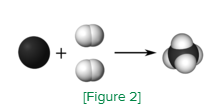
Reaction between carbon and hydrogen to form methane.
In the balanced equation, there is one atom of carbon and four atoms of hydrogen on both sides of the arrow. Below are guidelines for writing and balancing chemical equations.
Determine the correct chemical formulas for each reactant and product.
Write the skeleton equation.
Count the number of atoms of each element that appears as a reactant and as a product. If a polyatomic ion is unchanged on both sides of the equation, count it as a unit.
Balance each element on at a time by placing coefficients in front of the formulas. *It is best to begin by balancing elements that only appear in one formula on each side of the equation. *No coefficient is written for a 1. *Never change the subscripts in a chemical formula – you can only balance equations by using coefficients.
Check each atom or polyatomic ion to be sure that they are equal on both sides of the equation.
Make sure that all coefficients are in the lowest possible ratio. If necessary, reduce to the lowest ratio.
a.) How many hydrogen atoms are present on the reactant side of the unbalanced equation H2 + O2 → H2O?
What is the purpose of adding a coefficient in front of a chemical formula in a balanced equation?
When balancing equations, why should you never change the subscripts in a chemical formula?

Aqueous solutions of lead (II) nitrate and sodium chloride are mixed. The products of the reaction are an aqueous solution of sodium nitrate and a solid precipitate of lead (II) chloride.
Step 1: Plan the problem.
Follow the steps for writing and balancing a chemical equation.
Step 2: Solve.
Write the skeleton equation with the correct formulas.
Pb(NO3)2 + NaCl → NaNO3 + PbCl2
Count the number of each atom or polyatomic ion on both sides of the equation.
Reactants Products
1 Pb 1 Pb
2 NO3- 1 NO3-
1 Na 1 Na
1 Cl 2 Cl
The nitrate ions (NO3-) and the chlorine atoms are unbalanced. Start by placing a 2 in front of the NaCl. This increases the reactant counts to 2 Na atoms and 2 Cl atoms. Then place a 2 in front of the NaNO3. The result is:
Pb(NO3)2 + 2 NaCl → 2 NaNO3 + PbCl2
Reactants Products
1 Pb 1 Pb
2 NO3- 2 NO3-
2 Na 2 Na
2 Cl 2 Cl
Step 3: Think about your result.
The equation is now balanced since there are equal numbers of atoms of each element on both sides of the equation.
Background for the video
Chemical reactions happen all the time, you just can’t always “see" them happen. Let’s take a closer look at the chemical reaction that takes place when we light methane bubbles on fire. To form methane bubbles, methane gas is released into soapy water. Inside of a single bubble, there are many molecules of methane, CH4. Outside of the bubbles there is air. A component of air is oxygen, O2. Let’s zoom in on one of the methane molecules and two of the oxygen molecules. With a little energy, we get a chemical reaction. In a chemical reaction, atoms rearrange themselves to form a new substance, or substances. In the simulation, you will see one methane molecule and two oxygen molecules react to form one carbon dioxide molecule and two water molecules, as well as releasing some heat (energy change).
Instructions for the Simulation:
Chemical Equation Balancer
The blue arrows change the coefficients chemical in the equation.
Table of Reactants and Products
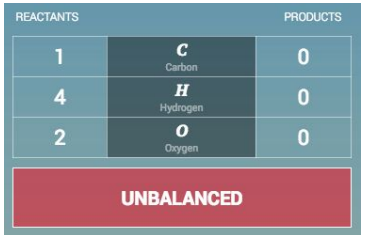
This table shows how many of each atom are on both sides of the chemical equation. When the chemical equation is balanced the numbers in each row will match and the label will change to read “balanced" with a green background.
Next Equation
This button will take you to the next chemical equation that needs to be balanced. You do not need to balance the chemical equation you’re working on to move on to the next one.
Run the simulation as many times as needed. Be sure to pay close attention and read through everything presented. There are questions that follow the simulation.
Answer the following from completing the equation balancer in the simulation. Tell me the quantity of each atom when the equations are balanced.
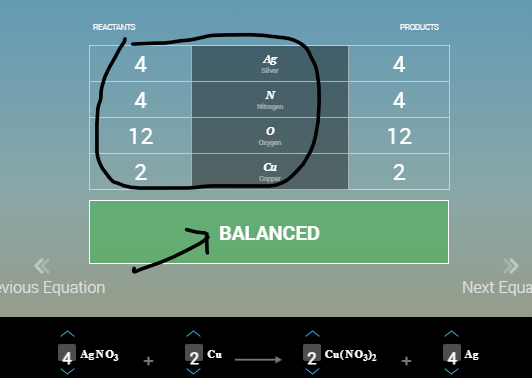
Example:
Equation: Ag 4; N 4; O 12; Cu 2
Only do the first 5 equations.
Equation 1: C
Equation 2: Na
Equation 3: Mg
Equation 4: P
Equation 5: Rb
What is the law of the conservation of mass (or matter)?
How is the law of the conservation of mass (matter) related to balancing equations?
What is a balanced equation (when does this occur)?
Try to balance the following equation. If you do not need to place a coefficient (number in front of a formula), place an underscore (_) in the blank.
a.) A balanced chemical equation ensures that the number of atoms of each element is
b.) To balance a chemical equation, you must add
c.) What coefficient is used when you only need one of something?
d.) Below are two equations, an unbalanced and balanced version of the same reaction.
Unbalanced: C + H2 → CH4
Balanced: 4C + 8H2 → 4CH4
What must be done to the coefficients in the balanced equation?
What will the new coefficients be (if you do need a coefficient, place and underscore (_) in the blank)?