Log in
Sign up for FREE
arrow_back
Library

Copy of Arrhenius Acids and Bases Reading w/Questions (5/28/2026)

star
star
star
star
star
Last updated about 2 hours ago
5 questions
Acids and Arrhenius Acids
Bases and Arrhenius Bases

Acids

Acids are very common in some of the foods that we eat. Citrus fruits such as oranges and lemons contain citric acid and ascorbic acid, which is better known as vitamin C. Carbonated sodas contain phosphoric acid. Vinegar contains acetic acid. Your own stomach utilizes hydrochloric acid to digest food.

Acids are a distinct class of compounds because of the properties of their aqueous solutions. Those properties are outlined below:
  1. Aqueous solutions of acids are electrolytes, meaning that they conduct an electrical current. Some acids are strong electrolytes because they ionize completely in water, yielding a great many ions. Other acids are weak electrolytes that exist primarily in a non-ionized form when dissolved in water.
  2. Acids have a sour taste. Lemons, vinegar, and sour candies all contain acids.
  3. Acids change the color of certain acid-base indicators. Two common indicators are litmus and phenolphthalein. Blue litmus turns red in the presence of an acid, while phenolphthalein turns colorless.
  4. Acids react with active metals to yield hydrogen gas. Recall that an activity series is a list of metals in descending order of reactivity. Metals that are above hydrogen in the activity series will replace the hydrogen from an acid in a single-replacement reaction, as shown below: Zn(s) + H2SO4(aq) → ZnSO4(aq) + H2(g)
  5. Acids react with bases to produce a salt compound and water. When equal moles of an acid and a base are combined, the acid is neutralized by the base. The products of this reaction are an ionic compound, which is labeled as a salt, and water.
5

Arrhenius Acids

Swedish chemist Svante Arrhenius (1859-1927) was the first to propose a theory to explain the observed behavior of acids and bases. Because of their ability to conduct a current, he knew that both acids and bases contained ions in solution. An Arrhenius acid is a compound, which ionizes to yield hydrogen ions (H+) in an aqueous solution.

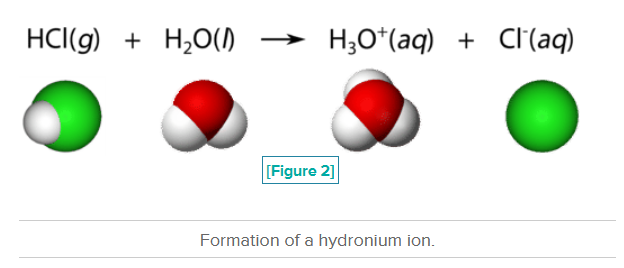
Acids are molecular compounds with ionizable hydrogen atoms. Only hydrogen atoms that are part of a highly polar covalent bond are ionizable. Hydrogen chloride (HCl) is a gas at room temperature and under normal pressure. The H-Cl bond in hydrogen chloride is a polar bond. The hydrogen atom is electron deficient because of the higher electronegativity of the chlorine atom. Consequently, the hydrogen atom is attracted to the lone pair of electrons in a water molecule when HCl is dissolved in water. The result is that the H-Cl bond breaks, with both bonding electrons remaining with the Cl, forming a chloride ion. The H+ ion attaches to the water molecule, forming a polyatomic ion called the hydronium ion. The hydronium ion (H3O+) can be thought of as a water molecule with an attached hydrogen ion.

3
Equations showing the ionization of an acid in water are frequently simplified by omitting the water molecule:

HCl(g) → H+(aq) + Cl−

This is merely a simplification of the previous equation, but it is commonly used. Any hydrogen ions in an aqueous solution will be attached to water molecules as hydronium ions.

Not all hydrogen atoms in molecular compounds are ionizable. In methane (CH4), the hydrogen atoms are covalently bonded to carbon in bonds that are only slightly polar. The hydrogen atoms are not capable of ionizing and methane has no acidic properties. Acetic acid (CH3COOH) belongs to a class of acids called organic acids. There are four hydrogen atoms in the molecule, but only the one hydrogen that is bonded to an oxygen atom is ionizable.

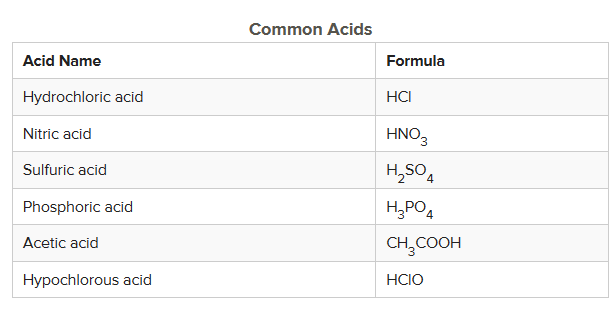
The table below lists some of the more common acids:


A monoprotic acid is an acid that contains only one ionizable hydrogen. Hydrochloric acid and acetic acid are monoprotic acids. A polyprotic acid is an acid that contains multiple ionizable hydrogens. Most common polyprotic acids are either diprotic (such as H2SO4) or triprotic (such as H3PO4).
4

Bases

Bases have properties that mostly contrast with those of acids.
  1. Aqueous solutions of bases are also electrolytes. Bases can be either strong or weak, just as acids can.
  2. Bases often have a bitter taste and are found in foods less frequently than acids. Many bases, like soaps, are slippery to the touch.
  3. Bases also change the color of indicators. Litmus turns blue in the presence of a base while phenolphthalein turns pink.
  4. Bases do not react with metals in the way that acids do.
  5. Bases react with acids to produce a salt and water.


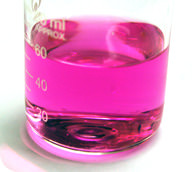
[Figure 2] Phenolphthalein indicator in presence of base.

Please note that tasting chemicals and touching them are NOT good lab practices and should be avoided – in other words, don’t do this at home. Bases are less common as foods, but they are nonetheless present in many household products. Many cleaners contain ammonia, a base. Sodium hydroxide is found in drain cleaner. Antacids, which combat excess stomach acid, are comprised of bases such as magnesium hydroxide or sodium hydrogen carbonate.
3

Arrhenius Bases

An Arrhenius base is a compound, which ionizes to yield hydroxide ions (OH−) in aqueous solution. The table below lists several of the more common bases:

All of the bases listed in the table are solids at room temperature. Upon dissolving in water, each dissociates into a metal cation and the hydroxide ion.

Sodium hydroxide is a very caustic substance also known as lye. Lye is used as a rigorous cleaner and is an ingredient in the manufacture of soaps. Care must be taken with strong bases like sodium hydroxide, as exposure can lead to severe burns.

Sodium belongs to the group of elements called the alkali metals. An alkaline solution is another name for a solution that is basic. All alkali metals react readily with water to produce the metal hydroxide and hydrogen gas. The resulting solutions are basic.

Bases that consist of an alkali metal cation and the hydroxide anion are all very soluble in water. Compounds of the Group 2 metals (the alkaline earth metals) are also basic. However, these compounds are generally not as soluble in water. Therefore the dissociation reactions for these compounds are shown as equilibrium reactions.

These relatively insoluble hydroxides were some of the compounds discussed in the context of the solubility product constant (Ksp). The solubility of magnesium hydroxide is 0.0084 g per liter of water at 25°C. Because of its low solubility, magnesium hydroxide is not as dangerous as sodium hydroxide. In fact, magnesium hydroxide is the active ingredient in a product called milk of magnesia, which is used as an antacid or a mild laxative.
5
Question 1
1.
a. Carbonated sodas contain _______ acid.

b. Two common acid-base indicators are _______ and phenolphthalein.

c. Acids are electrolytes, which means they conduct _______ .

d. Active metals react with acids to yield _______ gas.

e. When acids react with bases, the products of the reaction are a salt compound and _______ .
Question 2
2.
a. An Arrhenius acid is a compound that ionizes to yield _______ ions in aqueous solution.

b. Hydrogen atoms that are part of a highly polar covalent bond are _______ .

c. The hydronium ion (H3O+) can be thought of as a water molecule with an attached _______ ion.
Question 3
3.
a. Equations showing the ionization of an acid in water are simplified by omitting what molecule? _______

b. How many hydrogen atoms in acetic acid are ionizable? _______

c. An acid with one ionizable hydrogen is known as a _______.

d. H2SO4 or H3PO4 are examples of a _______.
Question 4
4.
a. Bases can be either strong or weak, just like _______ .

b. Litmus turns _______ in the presence of a base.

c. Sodium hydroxide is found in _______.
Question 5
5.
a. What ion does an Arrhenius base yield in an aqueous solution? _______

b. What happens to bases listed in the table when they dissolve in water (what's the phenomenon called - one word)? _______

c. What is another name for a solution that is basic? _______

d. Are bases of the Group 2 metals as soluble in water as those of alkali metals? _______

e. What product uses magnesium hydroxide as its active ingredient? _______