Copy of Virtual Lab - pH (5/28/2026)
star
star
star
star
star
Last updated 3 months ago
27 Nsɛmmisa
Hyɛ no nsow a efi ɔkyerɛwfo no hɔ:
Part 1
6
6
Part 2
1
1
1
1
1
1
1
1
1
1
1
1
1
1
1
1
1
1
Parts 3 and 4
4
1
6
1
1
1
1
Indiana Standards:
6.1 Analyze the properties of solutions and their solutes and solvents.
6.2 Investigate the behavior of acids and bases in solution and analyze their properties.
Learning Goals (I can...):
Use lab tools to determine the pH of various everyday substances.
Determine if a solution is acidic or alkaline using H3O+/OH- ratio, hydronium concentration, and hydroxide concentration.
Relate pH to H3O+/OH-ratio, hydronium concentration, and hydroxide concentration.
Relate how volume change affects pH.
Relate how molarity affects pH.
Indiana Standards:
6.1 Analyze the properties of solutions and their solutes and solvents.
6.2 Investigate the behavior of acids and bases in solution and analyze their properties.
Learning Goals (I can...):
Use lab tools to determine the pH of various everyday substances.
Determine if a solution is acidic or alkaline using H3O+/OH- ratio, hydronium concentration, and hydroxide concentration.
Relate pH to H3O+/OH-ratio, hydronium concentration, and hydroxide concentration.
Relate how volume change affects pH.
Relate how molarity affects pH.
Part One
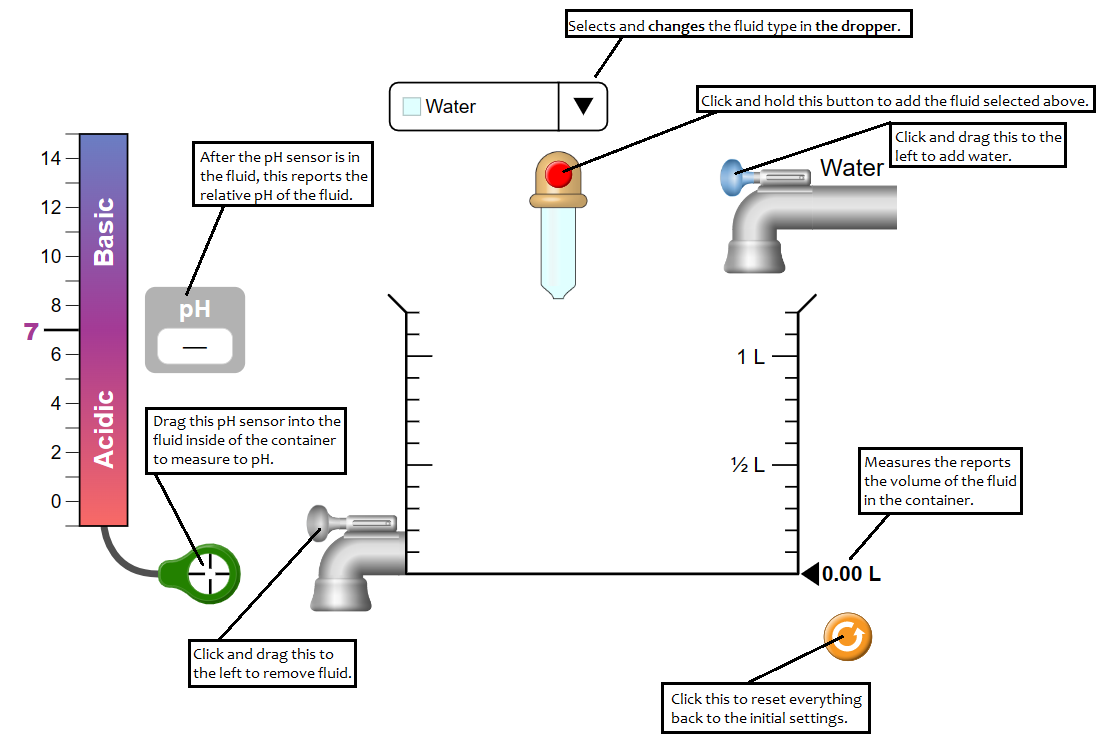
Click "Macro" in the lab simulation.
Add 0.5 L of water, by using the fluid selector menu (the dropper will automatically add the required volume).
Drag the pH sensor into the volume of water, read and record the pH of water, below, where it asks for it.
Select "Vomit" in the dropdown fluid selector menu and fill the container with 0.5 L of it (don't worry, there won't be any chunks).
Use the pH sensor to find the pH of vomit and record this below.
Repeat this process until you record all of the required pH of 0.5 L of every fluid.
Record the pH of 0.5 L of each of the following substances:
water
vomit
spit
soda pop
orange juice
milk
hand soap
drain cleaner
coffee
chicken soup
blood
battery acid
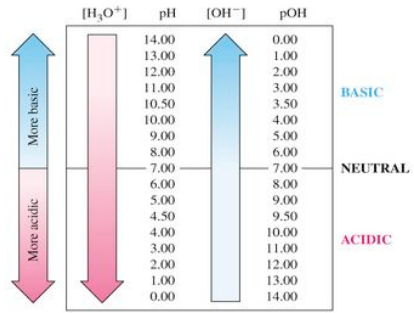
Review the pH of each substance (above) and classify each as either acidic, alkaline, or neutral.
Drag and drop them into each category.
Drain Cleaner
Soda Pop
Orange Juice
Vomit
Coffee
Milk
Chicken Soup
Spit
Hand Soap
Blood
Battery Acid
Water
Acidic
Alkaline
Neutral
Part Two:
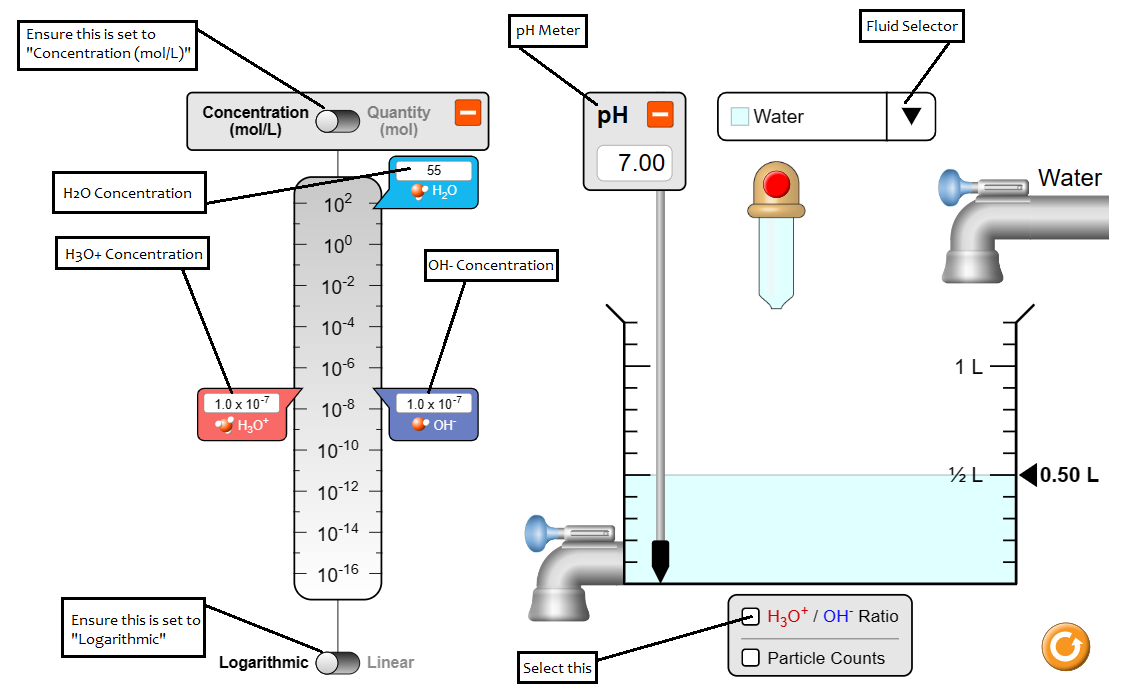
Click "Micro" in the simulation, below.
The same substances from part 1 are in part 2; however, this part of the simulation provides more information about each.
Select the H3O+/OH- Ratio box in the menu below the simulation.
Make sure that the selector to the upper left is set to "concentration" and the sector to the lower left is set to "Logarithmic" and use the scale to the left to measure the concentration (mol/L = molarity (M)) of H2O, H3O+, and OH- for each substance.
Use the scale to the left to record the concentration of H2O, H3O+, and OH- for each substance; make sure that you also use the pH meter in the upper middle section of the simulation to record the pH. Record this information below for each substance.
Begin with water and then move down the list, alphabetically.
Water
pH
Battery Acid
pH
Blood
pH
Chicken Soup
pH
Coffee
pH
Drain Cleaner
pH
Hand Soap
pH
Milk
pH
Orange Juice
pH
Soda Pop
pH
Spit
pH
Vomit
pH
Hydronium (H3O+), Hydroxide (OH-), and pH
A water molecule (H2O) and a hydrogen ion (H+) combine to form hydronium ions (H3O+). The pH scale is used to express the acidity or basicity of a solution in aqueous solutions and is based on the concentration of hydronium ions. The pH scale, which ranges from 0 to 14, measures the amount of hydronium ions present in a solution. A pH of 7 is regarded as neutral, meaning the amount of hydronium ions and hydroxide ions (OH-) in the solution are equal. A pH value of less than 7 denotes an acidic solution, meaning that the ratio of hydronium to hydroxide ions is higher. On the other hand, a pH value greater than 7 denotes a basic solution, which means that the ratio of hydroxide to hydronium ions is higher. Essentially, measuring the concentration of hydronium ions is equivalent to measuring the concentration of protons/hydrogen ions (H+).
When water and many bases dissociate, negatively charged ions called hydroxide ions (OH-) are formed. In other words, together with hydronium ions (H3O+), they are a byproduct of the self-ionization of water. An increase in hydronium ion concentration causes a reduction in hydroxide ion concentration and vice versa in an aqueous solution because the concentration of hydroxide ions is inversely proportional to the concentration of hydronium ions. Since the pH of a solution is a measure of its hydronium ion concentration, it is also tangentially connected to the concentration of hydroxide ions. Lower pH values, or higher hydronium ion concentrations, result in lower concentrations of hydroxide ions, and vice versa.
As the pH approaches 0, what happens to the concentration of H3O+ ions?
As the pH approaches 0, what happens to the concentration of OH- ions?
As a solution becomes more acidic, the concentration of
As the pH approaches 14, what happens to the concentration of H3O+ ions?
As the pH approaches 14, what happens to the concentration of OH- ions?
As a solution becomes more alkaline, the concentration of
Part 3 - Changes in volume and pH.
Click "Micro" in the simulation.
Investigate how adding more of the substance with the red button on the dropper changes the pH of the resulting solution — we will be investigating two acids (battery acid and coffee) and two bases (drain cleaner and spit).
You will be doubling the volume of each substance from 0.5 to 1.0 L.
As you perform this investigation, record the initial and final volume in liters, as well as the initial and final pH for each substance, below.
Battery Acid — Initial Vol
Coffee — Initial Vol
Drain Cleaner — Initial Vol
Spit — Initial Vol
What happens to the pH of the solution as you add more of the substance to it?
Hydronium (H3O+), Hydroxide (OH-), and pH
A water molecule (H2O) and a hydrogen ion (H+) combine to form hydronium ions (H3O+).
The pH scale is used to express the acidity or basicity of a solution in aqueous solutions and is based on the concentration of hydronium ions. The pH scale, which ranges from 0 to 14, measures the amount of hydronium ions present in a solution. A pH of 7 is regarded as neutral, meaning the amount of hydronium ions and hydroxide ions (OH-) in the solution are equal.
A pH value of less than 7 denotes an acidic solution, meaning that the ratio of hydronium to hydroxide ions is higher. On the other hand, a pH value greater than 7 denotes a basic solution, which means that the ratio of hydroxide to hydronium ions is higher. Essentially, measuring the concentration of hydronium ions is equivalent to measuring the concentration of protons/hydrogen ions (H+).
When water and many bases dissociate, negatively charged ions called hydroxide ions (OH-) are formed. In other words, together with hydronium ions (H3O+), they are a byproduct of the self-ionization of water. An increase in hydronium ion concentration causes a reduction in hydroxide ion concentration and vice versa in an aqueous solution because the concentration of hydroxide ions is inversely proportional to the concentration of hydronium ions. Since the pH of a solution is a measure of its hydronium ion concentration, it is also tangentially connected to the concentration of hydroxide ions. Lower pH values, or higher hydronium ion concentrations, result in lower concentrations of hydroxide ions, and vice versa.
Part 4 - Water Dilution and pH
Click on "Micro" in the simulation.
Make sure to click on the H3O+/OH- Ratio box located below the beaker with the substance.
Investigate the effect of adding water to the prior four solutions (battery acid, coffee, drain cleaner, and spit).
Use the fluid selector to add each substance and record the initial pH, H3O+ concentration, and OH- concentration at 0.5 L, below the simulation.
Using the faucet control, to the upper right of the simulation, click and drag the plunger to increase the overall volume from 0.5 to 1.0 L; this is diluting the substance with water.
Record the final pH, H3O+ concentration, and OH- concentration at 1.0 L, below the simulation.
Bat. Acid - pH(0.5L)
Coffee - pH(0.5L)
Dr. Clean - pH(0.5L)
Spit - pH(0.5L)
Hydronium (H3O+), Hydroxide (OH-), and pH
A water molecule (H2O) and a hydrogen ion (H+) combine to form hydronium ions (H3O+).
The pH scale is used to express the acidity or basicity of a solution in aqueous solutions and is based on the concentration of hydronium ions. The pH scale, which ranges from 0 to 14, measures the amount of hydronium ions present in a solution. A pH of 7 is regarded as neutral, meaning the amount of hydronium ions and hydroxide ions (OH-) in the solution are equal.
A pH value of less than 7 denotes an acidic solution, meaning that the ratio of hydronium to hydroxide ions is higher. On the other hand, a pH value greater than 7 denotes a basic solution, which means that the ratio of hydroxide to hydronium ions is higher. Essentially, measuring the concentration of hydronium ions is equivalent to measuring the concentration of protons/hydrogen ions (H+).
When water and many bases dissociate, negatively charged ions called hydroxide ions (OH-) are formed. In other words, together with hydronium ions (H3O+), they are a byproduct of the self-ionization of water. An increase in hydronium ion concentration causes a reduction in hydroxide ion concentration and vice versa in an aqueous solution because the concentration of hydroxide ions is inversely proportional to the concentration of hydronium ions. Since the pH of a solution is a measure of its hydronium ion concentration, it is also tangentially connected to the concentration of hydroxide ions. Lower pH values, or higher hydronium ion concentrations, result in lower concentrations of hydroxide ions, and vice versa.
What happens to the pH of an acid as water is added?
What happens to the concentration of both H3O+ and OH- ions as water is added to an acid?
What happens to the pH of a base as water is added?
What happens to the concentration of both H3O+ and OH- ions as water is added to a base?