Copy of Virtual Lab - Acid-Base Solutions (5/28/2026)
star
star
star
star
star
Last updated 3 months ago
2 Nsɛmmisa
Pre-Lab Reading and Questions
1
1
Part 1 - Introduction
Read This!
pH is often measured on a scale of 0 to 14 and is a measure of the concentration of hydronium ions versus hydroxide ions. pHs of 7.00 are regarded as neutral because they are neither acidic nor alkaline. Below 7.00 would be considered acidic and as the pH moves closer to 0.00 the stronger the acid becomes. Acids tend to have a higher concentration of hydronium ions than hydroxide ions. As the pH moves above 7.00 the solution would be considered alkaline or basic, and as it moves closer to 14.00 the base becomes stronger. Bases tend to have a higher concentration of hydroxide ions than hydronium ions. These ratios are also reflected by the molarity of a solution.
Molarity is a measure of the concentration of a solution and is defined as the number of moles of solute per liter of solution (moles solute/moles solvent). In the context of hydronium (H3O+), hydroxide (OH-), and pH, molarity is directly related to the concentration of these ions in an aqueous solution.
Hydronium ions (H3O+) are formed when a water molecule (H2O) combines with a hydrogen ion (H+) that is given off by an acid. The concentration of hydronium ions in a solution is represented by the molarity of the hydronium ion. The higher molarity of an acid indicates a more acidic solution and a lower pH, as there are more hydronium ions present. Thus, an acid with a molarity of 1.0 M will have more hydronium ions than an acid with a molarity of 0.5 M.
Similarly, hydroxide ions (OH-) are formed when water and bases dissociate. The concentration of hydroxide ions in a solution is also represented by its molarity. The higher molarity of a base (alkaline solution) indicates a more alkaline solution and a higher pH, as there are more hydroxide ions present. Thus, an alkaline solution with a molarity of 1.0 M will have more hydroxide ions than an alkaline solution with a molarity of 0.5 M.
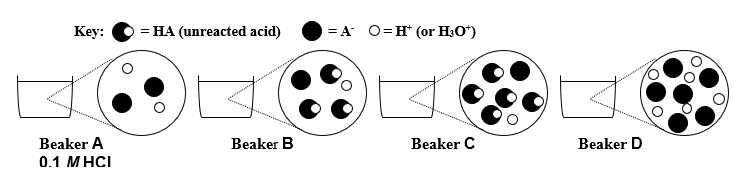
In each of the beakers in the diagram above, water molecules are not shown. Each beaker contains the same volume of solution, but the concentrations are not the same.
a.) Which of the following might be on the label for Beaker C?
0.01 M HC2H3O2
0.01 M HCl
0.3 M HC2H3O2
0.1 M HC2H3O2
0.3 M HCl
b.) Which beaker would have the lowest pH?
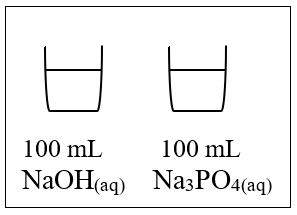
You have two beakers. One beaker contains 100 mL of NaOH (a strong base); the other contains 100 mL of aqueous Na3PO4 (a weak base). You test the pH of each solution.
Which of the following statements is true?
Directions:
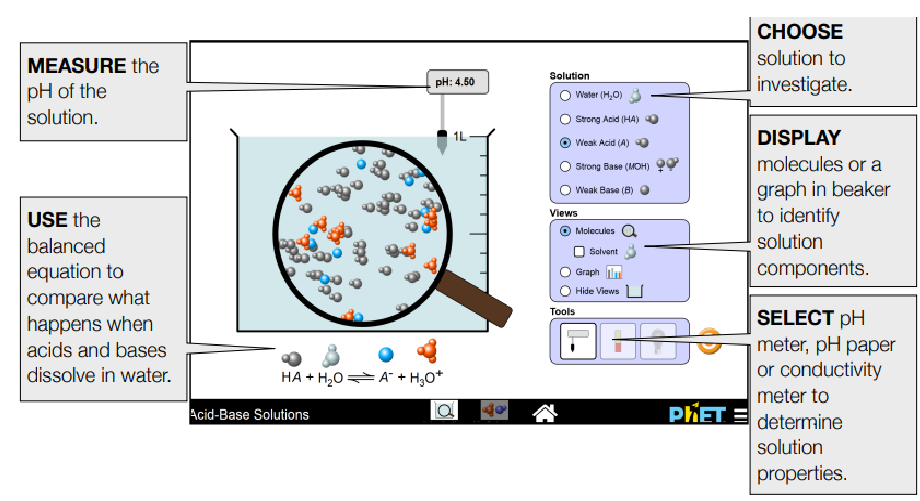
Click "Introduction" in the simulation to open up the Part 1 lab.
Explore the simulation and functionality of every tool, view, and solution.
As you explore the simulation attempt to answer the following questions:
For an acid, what happens to the molecule when it is in a water solution?
What is different about what happens to a weak acid molecule and what happens to a strong acid molecule?
How do the representations of a weak acid reaction differ from a strong one?
If you increase the concentration of an acid, what changes in both types of acids?