Copy of Weak and Strong Acids (5/28/2026)
star
star
star
star
star
Last updated 3 months ago
14 Nsɛmmisa
1
1
1
1
1
Acids are ubiquitous in our daily lives; we experience them in various forms. Their applications span from supplying vital nutrients to our bodies to eroding metals. While certain acids are benign enough to be handled barehanded or incorporated into food preparation, others possess the potential to inflict severe burns on human skin. It is crucial to grasp the underlying reasons why these substances, despite all being acids, exhibit such contrasting properties.
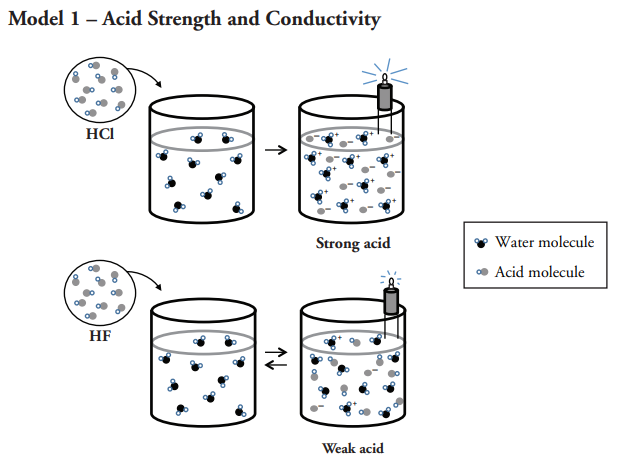
Note the similarities and differences of each particle within each solution. Look for the particles in each solution mentioned in the legend to the right, and look for particles not in the legend - what could they be?
Match each molecule with its identity.


Water Molecule
Acid Molecule
Conjugate Base Molecule
Hydronium (H2O + H+)
Examine Model 1 - what product (solutions on the right) do they have in common?
Describe the formation of the product (from #2) from an acid and a water molecule.
Electrolytes are substances that, when dissolved in water, generate ions within the solution. These ions enable the solution to conduct electric current. There are two primary mechanisms by which ions are produced: either through the dissolution of ionic substances (such as salt) or through the reaction of the substance with water, resulting in ion formation (as seen with acids). The strength of an electrolyte is directly proportional to the quantity of ions formed in the solution. On the other hand, nonelectrolytes are substances whose aqueous solutions lack ions and, consequently, do not facilitate the flow of electrical current.
Examine Model 1 - what do the light bulbs represent?
Which acid (strong or weak) is a better conductor of electricity; use evidence from Model 1 in your answer.
Briefly describe the relationship between the percent ionization and the conductivity of a solution.
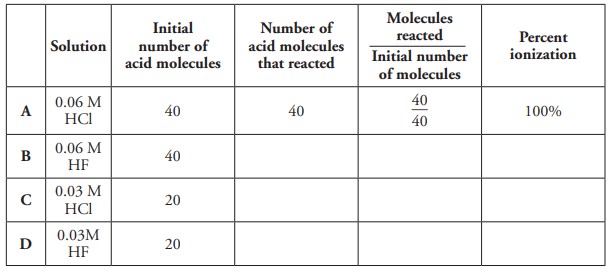
Let's assume that solutions of HCl and HF, similar to the ones in Model 1, are prepared. Infinitesimally small samples of these solutions are collected and analyzed to quantify the extent of ionization taking place.
Using the provided data, calculate the percentage of ionization for each acid solution. Solution A has already been computed for your convenience.
Solution B (0.06 M HF) - number of acid molecules that reacted.
Solution B - Molecules reacted/Initial number of molecules
Solution B - Percent Ionization
Solution C (0.03 M HCl) - number of acid molecules that reacted.
Solution C - Molecules reacted/Initial number of molecules
Solution C - Percent Ionization
Solution D (0.03 M HF) - number of acid molecules that reacted.
Solution D - Molecules reacted/Initial number of molecules
Solution D - Percent Ionization