Copy of Atmospheric Pressure; Pressure Units and Conversion (5/28/2026)
star
star
star
star
star
Last updated about 2 hours ago
17 questions
Untitled Section
1
1
1
1
1
1
1
1
1
Pressure Units and Conversions
1
1
1
1
1
1
1
1
Summary
Atmospheric pressure is the pressure exerted by gas particles in Earth’s atmosphere as those particles collide with objects.
A barometer measures atmospheric pressure.
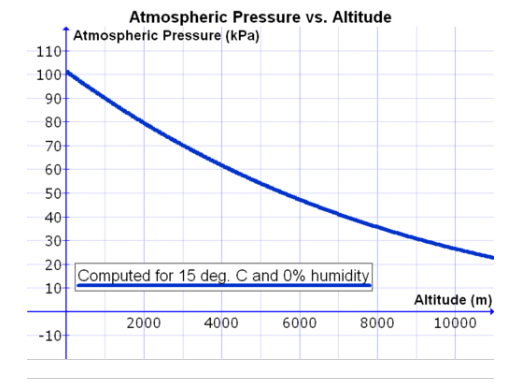
Atmospheric pressure decreases as the altitude increases.
Question 1
1.
What liquid is used in a traditional barometer?
_______
Question 2
2.
The device used to measure atmospheric pressure is called a(n) _______.
Question 3
3.
Question 4
4.
With a decrease in gravity, the atmospheric pressure _______
Question 5
5.
The atmospheric pressure at sea level is _______ mmHg.
Question 6
6.
What is the approximate atmospheric pressure on the summit of Mt. Everest _______ mmHg.
Question 7
7.
A _______ barometer measures pressure by the expansion and contraction of a small spring with an evacuated metal capsule.
Question 8
8.
At altitude decreases, atmospheric pressure _______ .
Question 9
9.
Use the graph to answer the following question.
Denver, CO is located at an altitude of approximately 1600 m. The atmospheric pressure of Denver is approximately _______ kPa.
Summary
Calculations are described for converting between different pressure units.
Question 10
10.
The standard atmosphere (1 atm) is a unit of pressure and is defined as being equal to _______ kPa
Question 11
11.
Convert the following:
1 atm = _______ torr
Question 12
12.
_______ is credited as the inventor of the mercury barometer.
Question 13
13.
Suppose that a vessel filled with gas is sealed such that the inside pressure is 120 kPa. What is the pressure in atm?
_______ atm
Question 14
14.
The atmospheric pressure at 2000 m altitude is 560 mmHg. What is the atmospheric pressure in atm?
_______ atm
Question 15
15.
At a carnival, a baby is given a helium balloom whose pressure equaled the atmospheric pressure at the carnival which was 102.7 kPa. However, the baby wasn't paying attention and the balloon floated away into the troposhere a layer of the atmosphere where the pressure is 97.8 kPa. What is the positive difference between teh pressure in the balloon and the pressure of the troposhphere in atm?
_______ atm
Question 16
16.
The average atmospheric pressure of City A is 1.02 atm. What is this pressure in mmHg?
_______ mmHg
(your answer should have 3 significant figures)
Question 17
17.
The pressure exerted by water at the bottom of a well is 0.50 atm. How many mmHg is this?
_______ mmHg
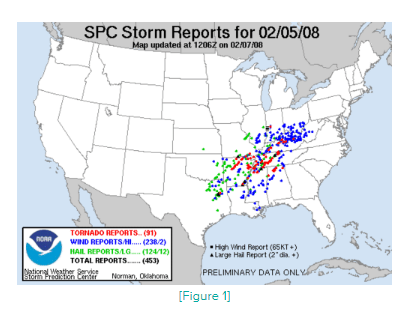
What do storm reports reveal?
The pressure in the atmosphere is an important factor in determining what the weather will be like. If the barometric pressure is high in an area, this will cause air to move to a region of lower pressure. The greater the difference in pressure between the two areas, the stronger the winds will develop. Under certain conditions, the winds can produce a tornado (a violent rotating column of air that reaches from a thunderstorm down to the ground).
Atmospheric Pressure
Atmospheric pressure is the pressure exerted by gas particles in Earth’s atmosphere as those particles collide with objects. A barometer is an instrument used to measure atmospheric pressure. A traditional mercury barometer consists of an evacuated tube immersed in a container of mercury. Air molecules push down on the surface of the mercury. Because the inside of the tube is a vacuum, the mercury rises inside the tube. The height to which the mercury rises is dependent on the external air pressure.
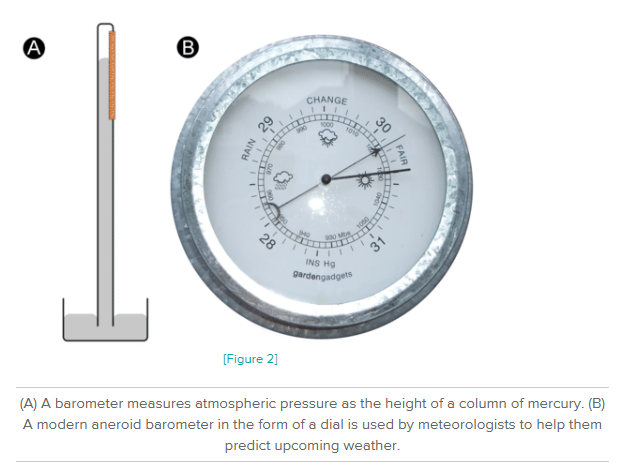
A more convenient barometer, called an aneroid barometer, measures pressure by the expansion and contraction of a small spring within an evacuated metal capsule.
Atmospheric Pressure and Altitude
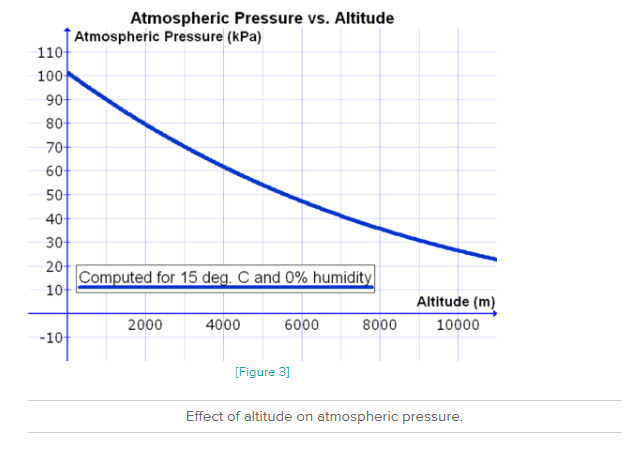
At sea level, a mercury column will rise a distance of 760 mm. This atmospheric pressure is reported as 760 mmHg (millimeters of mercury). At higher altitudes, the atmospheric pressure is decreased and so the column of mercury will not rise as high. On the summit of Mt. Everest (elevation of 8848 m), the air pressure is 253 mmHg. Atmospheric pressure is slightly dependent on weather conditions. From the graph we can see the decrease in atmospheric pressure as the altitude increases. At sea level, the atmospheric pressure would be a little over 100 kPa (one atmosphere or 760 mm Hg). If we climb to the top of Mount Everest (the highest mountain in the world at 29,029 feet or 8848 meters), the atmospheric pressure will drop to slightly over 30 kPa (about 0.30 atmospheres or 228 mm Hg). This marked decrease in atmospheric pressure results in much lower levels of oxygen. Teams that climb this mountain must bring supplies of oxygen with them in order to breathe at these high altitudes.
What does this graph tell us?
According to the line graph (figure 3, above), as you increase in altitude (go higher in the atmosphere), the effect on atmospheric pressure is that it decreases. In other words, as altitude increases, atmospheric pressure decreases. This is an inversely proportional relationship; as one increases, the other decreases.
How is the atmospheric pressure reported by using a traditional barometer?
speed that the mercury rises up the tube
volume of mercury in the tube
height of the mercury column
temperature of the mercury
Pressure Units and Conversion
A barometer measures gas pressure by the height of the column of mercury. One unit of gas pressure is the millimeter of mercury (mmHg). An equivalent unit to the mmHg is called the torr, in honor of the inventor of the barometer, Evangelista Torricelli. The pascal (Pa) is the standard unit of pressure. A pascal is a very small amount of pressure, so the more useful unit for everyday gas pressures is the kilopascal (kPa). A kilopascal is equal to 1000 pascals. Another commonly used unit of pressure is the atmosphere (atm). Standard atmospheric pressure is called 1 atm of pressure and is equal to 760 mmHg and 101.3 kPa. Atmospheric pressure is also often stated as pounds/square inch (psi). The atmospheric pressure at sea level is 14.7 psi.
It is important to be able to convert between different units of pressure. To do so, we will use the equivalent standard pressures shown above.
Sample Problem: Pressure Unit Conversions
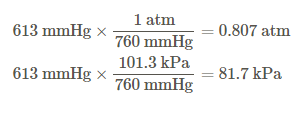
The atmospheric pressure in a mountainous location is measured to be 613 mmHg. What is this pressure in atm and in kPa?
Step 1: List the known quantities and plan the problem.
Known
given: 613 mmHg
1 atm = 760 mmHg
101.3 kPa = 760 mmHg
Unknown
pressure = ? atm
pressure = ? kPa
Use conversion factors from the equivalent pressure units to convert from mmHg to atm and from mmHg to kPa.