Log in
Sign up for FREE
arrow_back
Library

Copy of Average Kinetic Energy and Temperature (5/28/2026)

star
star
star
star
star
Last updated about 2 hours ago
13 questions
1
1
3
1
1
1
1
1
1
1
1
1
1

How much energy does it take to hit a baseball?

Kinetic energy is the energy of motion. Any object that is moving possesses kinetic energy. Baseball involves a great deal of kinetic energy. The pitcher throws a ball, imparting kinetic energy to the ball. When the batter swings, the motion of swinging creates kinetic energy in the bat. The collision of the bat with the ball changes the direction and speed of the ball, with the idea of kinetic energy being involved again.


Kinetic Energy and Temperature

As stated in the kinetic-molecular theory, the temperature of a substance is related to the average kinetic energy of the particles of that substance. When a substance is heated, some of the absorbed energy is stored within the particles, while some of the energy increases the motion of the particles. This is registered as an increase in the temperature of the substance.

Average Kinetic Energy

At any given temperature, not all of the particles of a sample of matter have the same kinetic energy. Instead, the particles display a wide range of kinetic energies. Most of the particles have a kinetic energy near the middle of the range. However, a small number of particles have kinetic energies a great deal lower or a great deal higher than the average (see Figure below).
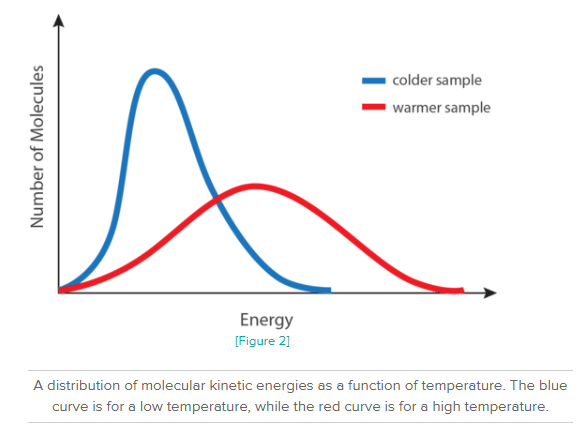


The blue curve in the figure above is for a sample of matter at a relatively low temperature, while the red curve is for a sample at a relatively high temperature. In both cases, most of the particles have intermediate kinetic energies, close to the average. Notice that as temperature increases, the range of kinetic energies increases and the distribution curve “flattens out.” At a given temperature, the particles of any substance have the same average kinetic energy.

Absolute Zero

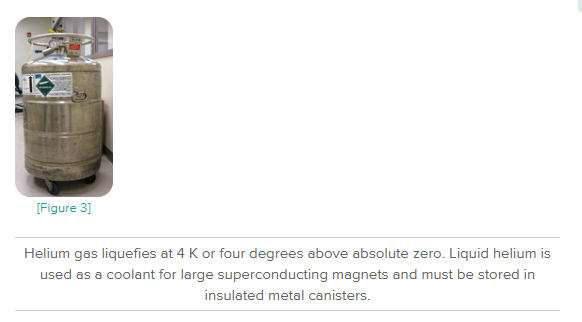
As a sample of matter is continually cooled, the average kinetic energy of its particles decreases. Eventually, one would expect the particles to stop moving completely. Absolute zero is the temperature at which the motion of particles theoretically ceases. Absolute zero has never been attained in the laboratory, but temperatures on the order of 1 × 10-10 K have been achieved. The Kelvin temperature scale is the scale that is based on molecular motion and so absolute zero is also called 0 K. The Kelvin temperature of a substance is directly proportional to the average kinetic energy of the particles of the substance. For example, the particles in a sample of hydrogen gas at 200 K have twice the average kinetic energy as the particles in a hydrogen sample at 100 K.


Summary

  • Kinetic energy is the energy of motion.
  • At a given temperature, individual particles of a substance have a range of kinetic energies.
  • The motion of particles theoretically ceases at absolute zero.
Question 1
1.
If the temperature of a substance increases, the particles of that substance will move _______ as they were before the temperature changed.
Question 2
2.
The _______ of a gas affects its average kinetic energy the most.
Question 3
3.
If the kinetic energies of three gases (Gas A, Gas B, and Gas C) were expressed as:
a. Gas _______ has the highest temperature.
b. Gas _______ has the lowest temperature.
c. Gas _______ has a temperature that is neither the highest nor the lowest.
Question 4
4.
When the absolute temperature of gas molecules is increased 4 times, the average kinetic energy _______ (does it increase or decrease, and if so, by how many times; or does it stay the same?).
Question 5
5.
_______ is the temperature scale used for measuring and expressing absolute temperature as well as extreme temperatures.
Question 6
6.
The average kinetic energy of the partciles in a sample of matter at 600 K is _______ as the average kinetic energy of the particles of another sample at -73 degrees C.

Tip - add the degrees C by the conversion factor for going from C to K (273), then figure out how many times greater or less the two temperatures are from each other, or if they are the same, as this will have a directly proportional affect on the average kinetic energy.
Question 7
7.
Consider two 100 mL samples of water. One at 40 degrees C and the other at 80 degrees C. Would it be true that none of the water molecules in the 40 degree C sample have a higher kinetic energy than any of the molecules in the 80 degree sample? _______
Question 8
8.
When a substance is heated the kinetic energy _______ .
Question 9
9.
The motion of molecules is directly related to their _______ .
Question 10
10.
The motion of particles at absolute zero will _______.
Question 11
11.
As you decrease in altitude the atmospheric pressure will _______ .
Question 12
12.
Collisions between gas particles and with the walls of their container are _______ . The more collisions that occur within a piece of time, the greater the answer in the blank will be.
Question 13
13.
Collisions between gas particles and with their container result in the _______ of that gas.
Review:

Kinetic-Molecular Theory
  1. Gases consist of very large numbers of tiny spherical particles that are far apart from one another compared to their size.
  2. Gas particles are in constant rapid motion in random directions.
  3. Collisions between gas particles and between particles and the container walls are elastic collisions.
  4. There are no forces of attraction or repulsion between gas particles.
  5. The average kinetic energy of gas particles is dependent upon the temperature of the gas.
Gas Pressure:
  1. Pressure is defined as force/area (P = f/a).
  2. Gas pressure is the result of collisions between gas particles and an object.
  3. An increase in temperature will produce an increase in pressure of a gas.
Atmospheric Pressure:
  1. Atmospheric pressure is the pressure exerted by gas particles in Earth’s atmosphere as those particles collide with objects.
  2. A barometer measures atmospheric pressure.
  3. Atmospheric pressure decreases as the altitude increases.
Pressure Units and Conversion:
  • 1 atm = 760 mmHg = 760 torr = 101.3 kPa = 14.7 psi
Average Kinetic Energy and Temperature:
  1. Kinetic energy is the energy of motion.
  2. At a given temperature, individual particles of a substance have a range of kinetic energies.
  3. The motion of particles theoretically ceases at absolute zero.