Log in
Sign up for FREE
arrow_back
Library

Copy of 9.1 Gas Pressure (5/28/2026)

star
star
star
star
star
Last updated about 2 hours ago
35 questions
2.5
0
0
0
1
2
2
C.5.1 Use the kinetic molecular theory with the combined and ideal gas laws to explain changes in volume, pressure, moles, and temperature of a gas.

Learning Goals:
  • Define the property of pressure.
  • Define and convert among the units of pressure measurements.
  • Describe the operation of common tools for measuring gas pressure.
  • Calculate pressure from manometer data.
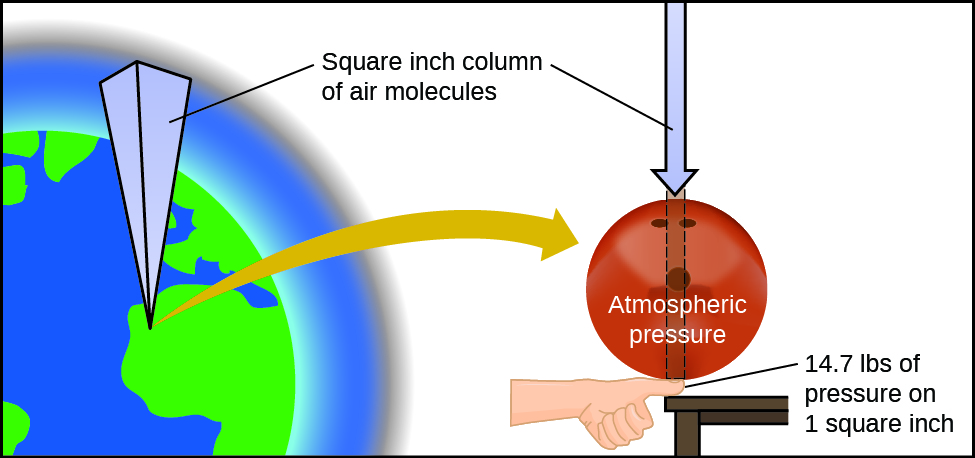
The earth’s atmosphere exerts a pressure, as does any other gas. Although we do not normally notice atmospheric pressure, we are sensitive to pressure changes—for example, when your ears “pop” during take-off and landing while flying, or when you dive underwater. Gas pressure is caused by the force exerted by gas molecules colliding with the surfaces of objects (Figure 9.2). Although the force of each collision is very small, any surface of appreciable area experiences a large number of collisions in a short time, which can result in a high pressure. In fact, normal air pressure is strong enough to crush a metal container when not balanced by equal pressure from inside the container.

Figure 9.2 The atmosphere above us exerts a large pressure on objects at the surface of the earth, roughly equal to the weight of a bowling ball pressing on an area the size of a human thumbnail.

Videos - An illustration of how dramatic atmospheric pressure can be is demonstrated in the video, below, in which a railway tanker implodes from the external atmospheric pressure, as the internal pressure of the tanker is decreased. A smaller scale demonstration of this phenomenon is described in the second video.
1
1
1
1
1
1
1
1
1
1
1
2
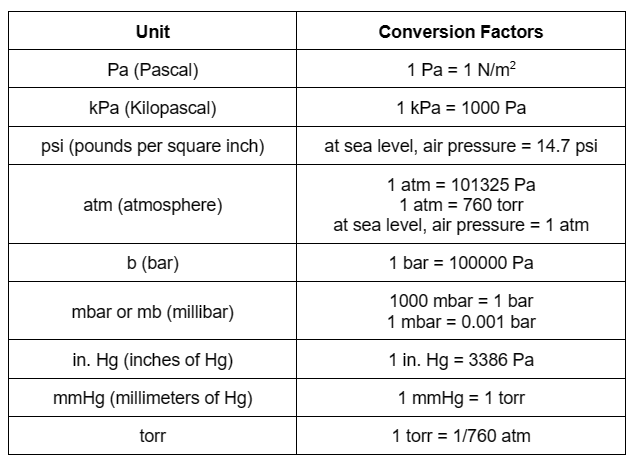
The SI unit of pressure is the pascal (Pa), with 1 Pa = 1 N/m2, where N is the Newton, a unit of force defined as 1 kg m/s2. One pascal is a small pressure; in many cases, it is more convenient to use units of kilopascal (1 kPa = 1000 Pa) or bar (1 bar = 100,000 Pa). In the United States, pressure is often measured in pounds of force on an area of one square inch—pounds per square inch (psi)—for example, in car tires. Pressure can also be measured using the unit atmosphere (atm), which originally represented the average sea level air pressure at the approximate latitude of Paris (45°). The table below provides some information on these and a few other common units for pressure measurements.
1
1
Pressure Units Conversion Table

Question 15
15.
a.) One _______ is equivalent to 101,325 pascals (Pa).
b.) One _______ is equal to 1 torr.
c.) One _______ is approximately 0.001 bar.
d.) One _______ equals 760 torr.
e.) Air pressure at sea level is _______ .
Example 1 - Converting Between Pressure Units Examples

The United States National Weather Service reports pressure in both inches of Hg and millibars. Convert a pressure of 29.2 in. Hg into:
(a) torr
(b) atm
(c) kPa
(d) mbar

Solution

This is a unit conversion problem. The relationships between the various pressure units are given in the conversion table (above).


Question 16
16.
Bonus Question (not required - all blanks must be correct to earn the bonus):

A typical barometric pressure in Kansas City is 740 torr.
What is this pressure in atmospheres, in millimeters of mercury, in kilopascals, and in bar?

atm _______
mmHg _______
kPa _______
bar _______
1
2
1
1
3
Example 2 - Calculation of Barometric Pressure

Show the calculation supporting the claim that atmospheric pressure near sea level corresponds to the pressure exerted by a column of mercury that is about 760 mm high. The density of mercury = 13.6 g/cm3.

Solution

The hydrostatic pressure is given by p = hρg, with h = 760 mm, ρ = 13.6 g/cm3, and g = 9.81 m/s2. Plugging these values into the equation and doing the necessary unit conversions will give us the value we seek. (Note: We are expecting to find a pressure of ~101,325 Pa. or 1.01 x 10⁵ Pa.)


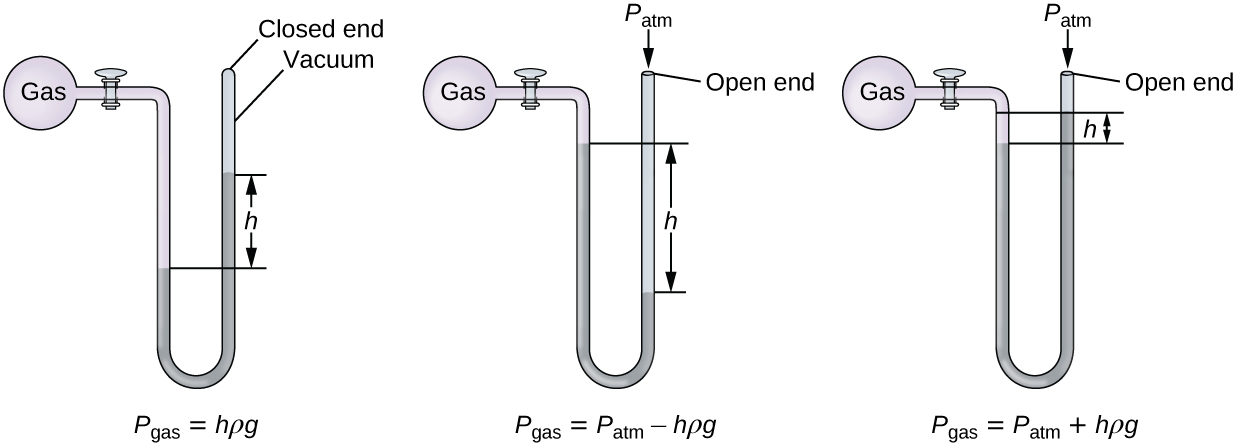
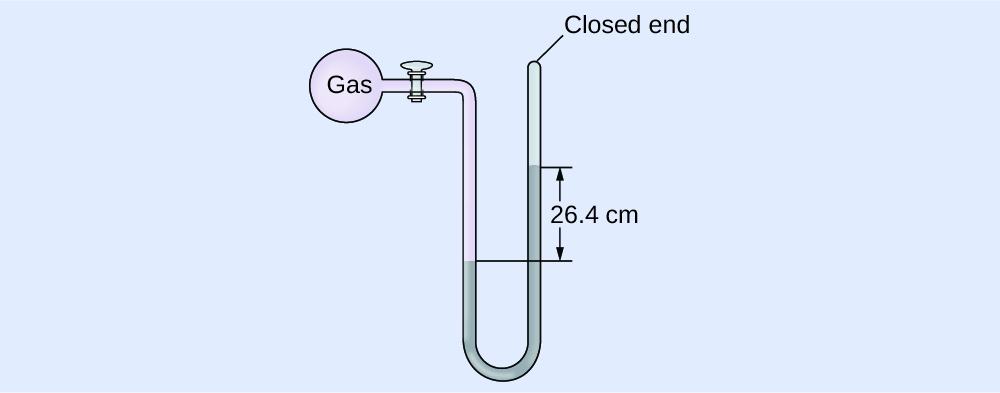
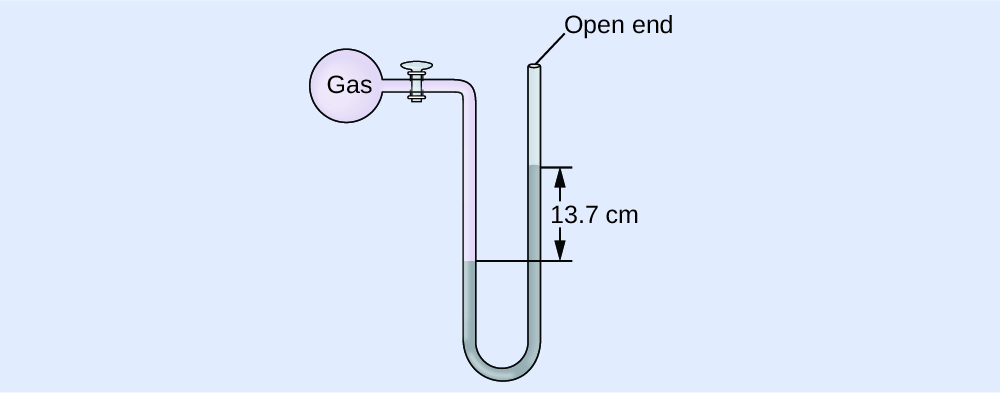
A manometer is a device similar to a barometer that can be used to measure the pressure of a gas trapped in a container. A closed-end manometer is a U-shaped tube with one closed arm, one arm that connects to the gas to be measured, and a nonvolatile liquid (usually mercury) in between. As with a barometer, the distance between the liquid levels in the two arms of the tube (h in the diagram) is proportional to the pressure of the gas in the container. An open-end manometer (Figure 9.5) is the same as a closed-end manometer, but one of its arms is open to the atmosphere. In this case, the distance between the liquid levels corresponds to the difference in pressure between the gas in the container and the atmosphere.

Figure 9.5 A manometer can be used to measure the pressure of a gas. The (difference in) height between the liquid levels (h) is a measure of the pressure. Mercury is usually used because of its large density.
1
1
2
1
Pressure Units Conversion Table

Example 3 - Calculation of Pressure Using a Closed-End Manometer

The pressure of a sample of gas is measured with a closed-end manometer, as shown to the right. The liquid in the manometer is mercury.

Determine the pressure of the gas in:
(a) torr
(b) Pa
(c) bar


Solution

The pressure of the gas is equal to a column of mercury of height 26.4 cm. (The pressure at the bottom horizontal line is equal on both sides of the tube. The pressure on the left is due to the gas and the pressure on the right is due to 26.4 cm Hg, or mercury.) We could use the equation p = hρg as in Example 2, but it is simpler to just convert between units using the pressure conversion table (above).


Question 26
26.
Bonus Question (not required - must be correct on all blanks to earn the bonus):

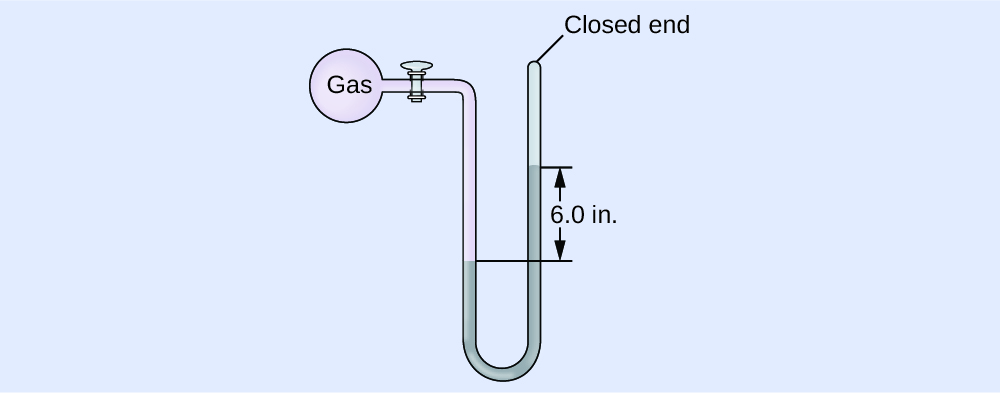
The pressure of a sample of gas is measured with a closed-end manometer. The liquid in the manometer is mercury.


Determine the pressure of the gas in:
(a) torr _______
(b) Pa _______
(c) bar _______

Example 4 - Calculation of Pressure Using an Open-End Manometer

The pressure of a sample of gas is measured at sea level with an open-end Hg (mercury) manometer, as shown.


Determine the pressure of the gas in:
(a) mm Hg
(b) atm
(c) kPa

Solution

The pressure of the gas equals the hydrostatic pressure due to a column of mercury of height 13.7 cm plus the pressure of the atmosphere at sea level. (The pressure at the bottom horizontal line is equal on both sides of the tube. The pressure on the left is due to the gas and the pressure on the right is due to 13.7 cm of Hg plus atmospheric pressure.)


Question 27
27.
Bonus Question (not required - must be correct on all blanks to earn the bonus):

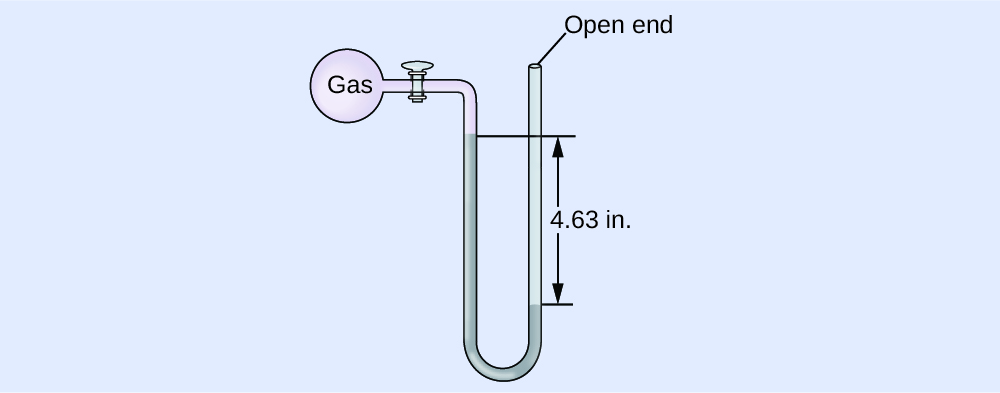
The pressure of a sample of gas is measured at sea level with an open-end Hg manometer, as shown.


Determine the pressure of the gas in:
(a) mmHg _______
(b) atm _______
(c) kPa _______

Chemistry in Everyday Life - Measuring Blood Pressure

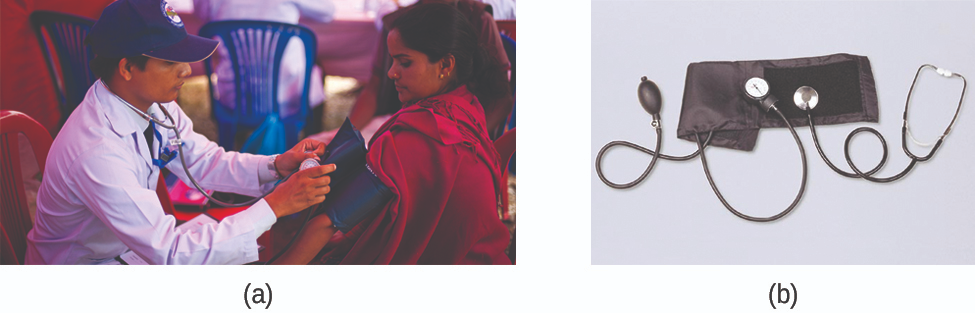
Blood pressure is measured using a device called a sphygmomanometer (Greek sphygmos = “pulse”). It consists of an inflatable cuff to restrict blood flow, a manometer to measure the pressure, and a method of determining when blood flow begins and when it becomes impeded (Figure 9.6). Since its invention in 1881, it has been an essential medical device. There are many types of sphygmomanometers: manual ones that require a stethoscope and are used by medical professionals; mercury ones, used when the most accuracy is required; less accurate mechanical ones; and digital ones that can be used with little training but that have limitations. When using a sphygmomanometer, the cuff is placed around the upper arm and inflated until blood flow is completely blocked, then slowly released. As the heart beats, blood forced through the arteries causes a rise in pressure. This rise in pressure at which blood flow begins is the systolic pressure—the peak pressure in the cardiac cycle. When the cuff’s pressure equals the arterial systolic pressure, blood flows past the cuff, creating audible sounds that can be heard using a stethoscope. This is followed by a decrease in pressure as the heart’s ventricles prepare for another beat. As cuff pressure continues to decrease, eventually sound is no longer heard; this is the diastolic pressure—the lowest pressure (resting phase) in the cardiac cycle. Blood pressure units from a sphygmomanometer are in terms of millimeters of mercury (mm Hg).

Figure 9.6 (a) A medical technician prepares to measure a patient’s blood pressure with a sphygmomanometer. (b) A typical sphygmomanometer uses a valved rubber bulb to inflate the cuff and a diaphragm gauge to measure pressure.
2
2
1
1
2.5
Question 32
32.
Question 33
33.

Explain how atmospheric pressure is caused by the weight of air molecules.

Question 34
34.

Describe the difference between a closed-end manometer and an open-end manometer.

Question 35
35.

How does the density of mercury affect the design of barometers compared to water?

Question 1
1.
a.) What does the earth’s atmosphere exert, as does any other gas? _______
b.) What is strong enough to crush a metal container when not balanced? _______
Question 2
2.

What causes gas pressure?

Atmospheric pressure is caused by the weight of the column of air molecules in the atmosphere above an object, such as the tanker car. At sea level, this pressure is roughly the same as that exerted by a full-grown African elephant standing on a doormat, or a typical bowling ball resting on your thumbnail. These may seem like huge amounts, and they are, but life on earth has evolved under such atmospheric pressure. If you actually perch a bowling ball on your thumbnail, the pressure experienced is twice the usual pressure, and the sensation is unpleasant.

In general, pressure is defined as the force exerted on a given area:

Note that pressure is directly proportional to force and inversely proportional to area. Proportional to force means that if you increase the force applied to something, the effect or outcome also increases. For example, pushing harder on a door will make it open more easily. Inversely proportional to area means that if you increase the area over which a force is applied, the effect or outcome decreases. For instance, if you push on a large surface (like a wide door), the pressure you create is lower compared to pushing on a small surface (like a pin). So, more area means less pressure.

Thus, pressure can be increased either by increasing the amount of force or by decreasing the area over which it is applied; pressure can be decreased by decreasing the force or increasing the area.
Question 3
3.

What causes atmospheric pressure?

Question 4
4.
At sea level, atmospheric pressure is roughly equivalent to the weight of a _______ .
Question 5
5.

What happens to pressure when you perch a bowling ball on your thumbnail?

Question 6
6.
How is pressure defined mathematically?


x = _______
y = _______
Question 7
7.

What does it mean that pressure is inversely proportional to area?

Question 8
8.

What does it mean that pressure is proportional to force?

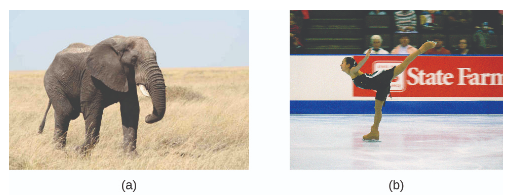
Let’s apply this concept to determine which exerts a greater pressure in Figure 9.3—the elephant or the figure skater? A large African elephant can weigh 7 tons, supported on four feet, each with a diameter of about 1.5 ft (footprint area of 250 in2), so the pressure exerted by each foot is about 14 lb/in2:


The figure skater weighs about 120 lbs, supported on two skate blades, each with an area of about 2 in2, so the pressure exerted by each blade is about 30 lb/in2:


Even though the elephant is more than one hundred-times heavier than the skater, it exerts less than one-half of the pressure. On the other hand, if the skater removes their skates and stands with bare feet (or regular footwear) on the ice, the larger area over which their weight is applied greatly reduces the pressure exerted:


Figure 9.3 Although (a) an elephant’s weight is large, creating a very large force on the ground, (b) the figure skater exerts a much higher pressure on the ice due to the small surface area of the skates. (credit a: modification of work by Guido da Rozze; credit b: modification of work by Ryosuke Yagi)
Question 9
9.

Question 10
10.

Question 11
11.

What happened to the pressure exhibited by the skater when they took off their figure skates?

Question 12
12.

Follow up to questions 9-11.

Why did the pressure exhibited by the figure skater in the scenarios of questions 9 and 10 change?

Question 13
13.

Question 14
14.

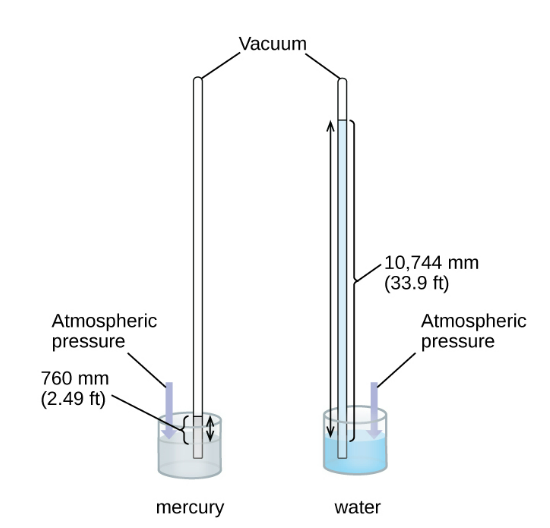
We can measure atmospheric pressure, the force exerted by the atmosphere on the earth’s surface, with a barometer (Figure 9.4). A barometer is a glass tube that is closed at one end, filled with a nonvolatile liquid such as mercury, and then inverted and immersed in a container of that liquid. The atmosphere exerts pressure on the liquid outside the tube, the column of liquid exerts pressure inside the tube, and the pressure at the liquid surface is the same inside and outside the tube. The height of the liquid in the tube is therefore proportional to the pressure exerted by the atmosphere.

Figure 9.4 In a barometer, the height, h, of the column of liquid is used as a measurement of the air pressure. Using very dense liquid mercury (left) permits the construction of reasonably sized barometers, whereas using water (right) would require a barometer more than 30 feet tall.

If the liquid is water, normal atmospheric pressure will support a column of water over 10 meters high, which is rather inconvenient for making (and reading) a barometer. Because mercury (Hg) is about 13.6-times denser than water, a mercury barometer only needs to be 1/13.6 as tall as a water barometer—a more suitable size. Standard atmospheric pressure of 1 atm at sea level (101325 Pa) corresponds to a column of mercury that is about 760 mm (29.92 in.) high. The torr was originally intended to be a unit equal to one millimeter of mercury, but it no longer corresponds exactly.

The pressure exerted by a fluid due to gravity is known as hydrostatic pressure, p:

p = hρg

h = height of the fluid
ρ (lowercase Greek letter "rho"; pronounced, row) = density of the fluid
g = acceleration due to gravity
Question 17
17.

Explain why a barometer filled with water would need to be impractically tall compared to one filled with mercury.

Question 18
18.

Describe the relationship between the height of the liquid in the barometer and atmospheric pressure.

Question 19
19.

Question 20
20.

Question 21
21.
a.) The height of the liquid column in a barometer is proportional to the _______ exerted by the atmosphere.

b.) Standard atmospheric pressure at sea level is _______ Pa.

c.) A mercury barometer is approximately _______ mm high at standard atmospheric pressure.

d.) he formula for hydrostatic pressure is p = hρg, where h is the _______ of the fluid, ρ is the _______ of the fluid, and g is the _______ due to gravity.
Question 22
22.

Question 23
23.

Question 24
24.
a.) A manometer is a U-shaped tube that measures the pressure of a _______ trapped in a container.

b.) In a closed-end manometer, the distance between the liquid levels is proportional to the _______ of the gas.

c.) An open-end manometer shows the difference in pressure between the gas and the _______ .

d.) The liquid used in a manometer is usually _______ because of its large density.
Question 25
25.

Explain how a closed-end manometer measures gas pressure.

Question 28
28.
a.) A sphygmomanometer consists of an inflatable cuff, a _______ to measure the pressure, and a method to determine blood flow.

b.) The pressure at which blood flow begins is known as _______ pressure.

c.) The lowest pressure in the cardiac cycle, when sound is no longer heard, is called _______ pressure.

d.) Blood pressure is measured in units of _______ of mercury (mm Hg).
Question 29
29.

Describe the difference between systolic and diastolic pressure.

How Sciences Interconnect - Meteorology, Climatology, and Atmospheric Science

Throughout the ages, people have observed clouds, winds, and precipitation, trying to discern patterns and make predictions: when it is best to plant and harvest; whether it is safe to set out on a sea voyage; and much more. We now face complex weather and atmosphere-related challenges that will have a major impact on our civilization and the ecosystem. Several different scientific disciplines use chemical principles to help us better understand weather, the atmosphere, and climate. These are meteorology, climatology, and atmospheric science. Meteorology is the study of the atmosphere, atmospheric phenomena, and atmospheric effects on earth’s weather. Meteorologists seek to understand and predict the weather in the short term, which can save lives and benefit the economy. Weather forecasts (Figure 9.7) are the result of thousands of measurements of air pressure, temperature, and the like, which are compiled, modeled, and analyzed in weather centers worldwide.
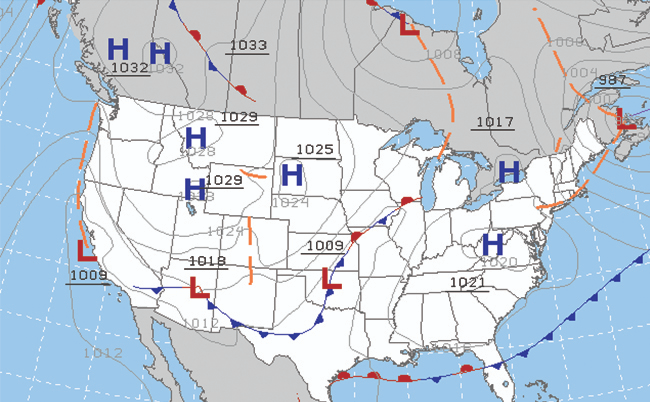
Figure 9.7 Meteorologists use weather maps to describe and predict weather. Regions of high (H) and low (L) pressure have large effects on weather conditions. The gray lines represent locations of constant pressure known as isobars.

In terms of weather, low-pressure systems occur when the earth’s surface atmospheric pressure is lower than the surrounding environment: Moist air rises and condenses, producing clouds. Movement of moisture and air within various weather fronts instigates most weather events.

The atmosphere is the gaseous layer that surrounds a planet. Earth’s atmosphere, which is roughly 100–125 km thick, consists of roughly 78.1% nitrogen and 21.0% oxygen, and can be subdivided further into the regions shown in Figure 9.8: the exosphere (furthest from earth, > 700 km above sea level), the thermosphere (80–700 km), the mesosphere (50–80 km), the stratosphere (second lowest level of our atmosphere, 12–50 km above sea level), and the troposphere (up to 12 km above sea level, roughly 80% of the earth’s atmosphere by mass and the layer where most weather events originate). As you go higher in the troposphere, air density and temperature both decrease.
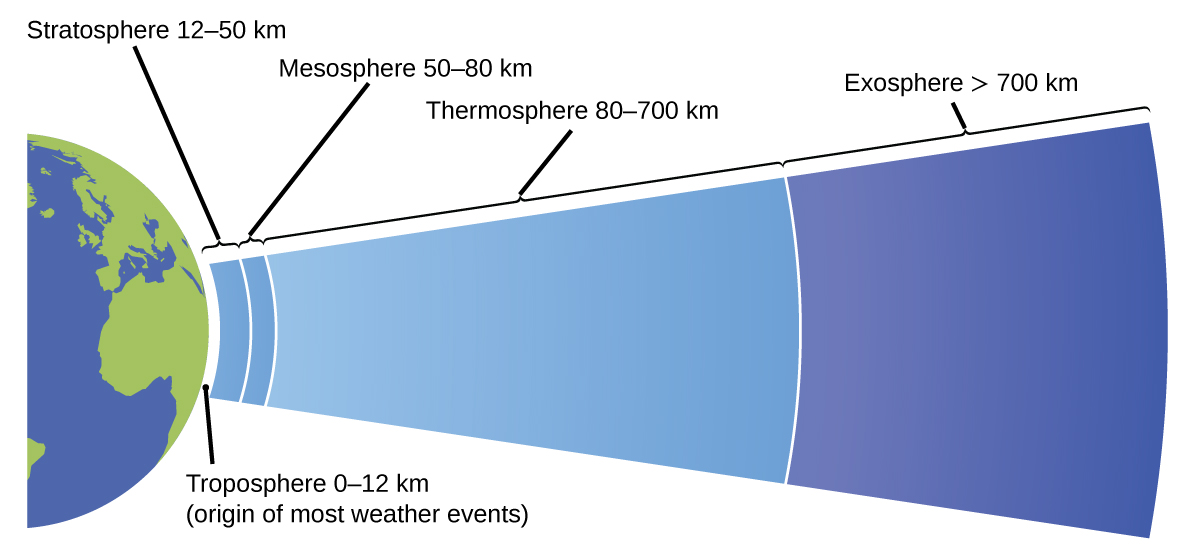
Figure 9.8 Earth’s atmosphere has five layers: the troposphere, the stratosphere, the mesosphere, the thermosphere, and the exosphere.

Climatology is the study of the climate, averaged weather conditions over long time periods, using atmospheric data. However, climatologists study patterns and effects that occur over decades, centuries, and millennia, rather than shorter time frames of hours, days, and weeks like meteorologists. Atmospheric science is an even broader field, combining meteorology, climatology, and other scientific disciplines that study the atmosphere.
Question 30
30.

Question 31
31.

a.) Meteorology helps predict _______ in the short term to save lives and benefit the economy.

b.) Climatology studies averaged weather conditions over _______ time periods.

c.) The Earth's atmosphere is composed of approximately _______ % nitrogen.

d.) The layer of the atmosphere where most weather events originate is called the _______ .

e.) The five layers of the Earth's atmosphere are the thermosphere, mesosphere, troposphere, stratosphere, and _______ .
What pressure does each skate blade of a figure skater exert?
30 lb/in²
25 lb/in²
20 lb/in²
15 lb/in²
What is the pressure exerted by one foot of the skater when standing with bare feet?
1 lb/in²
4 lb/in²
3 lb/in²
2 lb/in²
Which unit is commonly used to measure pressure in car tires (select all that apply)?
Bar
Pounds per square inch (psi)
Atmosphere (atm)
Pascal (Pa)
What does "atm" stand for in pressure measurement (select all that apply)?
Atmospheric pressure
Absolute temperature measurement
Area tension
Average tire measurement
What is a barometer used to measure (select all that apply)?
Atmospheric pressure
Humidity
Wind speed
Temperature
Why is mercury used in barometers instead of water?
Mercury evaporates less
Mercury is denser than water
Mercury is cheaper
Mercury is less toxic
What does a manometer measure (select all that apply)?
Volume
Humidity
Gas pressure
Temperature
In a closed-end manometer, one arm is connected to the gas while the other arm is:
Empty
Open to the atmosphere
Filled with water
Sealed
What is the primary focus of meteorology?
The composition of the atmosphere
Ocean currents
Atmospheric phenomena and weather prediction
Long-term climate patterns
Which atmospheric layer is closest to the Earth's surface?
Mesosphere
Troposphere
Thermosphere
Stratosphere