Directions:
Complete the following reading guide as you read the section about the kinetic-molecular theory, below. Fill in all of the yellow-highlighted areas on the reading guide by using the reading, below.
Once you are complete, submit the document at the bottom of this formative.
After you open the link, click "file" then "make a copy". Next, change the name of the document by adding your name to the front of the title (example → "Jason Poe - Kinetic-Molecular Theory Reading Guide").
Be sure to move this document to a folder in your Google Drive that is dedicated to this chemistry class. Click "file" then "move" and select the folder.
Before you can type on the document, make a copy of it - click "file" then "make a copy".
https://docs.google.com/document/d/1aakhNvAQ42tlzRgNyeDFv7iX6BHX8HoEQLZzcrN1AQQ/edit?usp=sharing
Instrucciones:
Completa la siguiente guía de lectura mientras lees la sección sobre la teoría cinético-molecular, a continuación. Rellena todas las áreas resaltadas en amarillo en la guía de lectura utilizando la lectura de abajo.
Una vez que hayas terminado, envía el documento al final de esta formative.
Después de abrir el enlace, haz clic en "File" y luego en "Make a Copy". A continuación, cambia el nombre del documento añadiendo tu nombre al principio del título (ejemplo → "Jason Poe - Guía de Lectura de la Teoría Cinético-Molecular").
Asegúrate de mover este documento a una carpeta en tu Google Drive que esté dedicada a esta clase de química. Haz clic en "file" y luego en "move" y selecciona la carpeta.
Antes de que puedas escribir en el documento, haz una copia de él: haz clic en "File" y luego en "Make a Copy".
https://docs.google.com/document/d/10yX8wT4wKCTlM7fVKLtY7pQilmmn5S6ifNbujRLMfhY/edit?usp=sharing
The gas laws that we have seen to this point, as well as the ideal gas equation, are empirical and macroscopic in nature, that is, they have been derived from experimental observations. The mathematical forms of these laws closely describe the macroscopic behavior of most gases at pressures less than about 1 or 2 atm. Although the gas laws describe relationships that have been verified by many experiments, they do not tell us why gases follow these relationships.
The kinetic molecular theory (KMT) is a simple microscopic model that effectively explains the gas laws described in previous modules of this chapter. This theory is based on the following five postulates described below.
Gases are composed of molecules that are in continuous motion, travelling in straight lines and changing direction only when they collide with other molecules or with the walls of a container.
The molecules composing the gas are negligibly small compared to the distances between them.
The pressure exerted by a gas in a container results from collisions between the gas molecules and the container walls.
Gas molecules exert no attractive or repulsive forces on each other or the container walls; therefore, their collisions are elastic (do not involve a loss of energy).
The average kinetic energy of the gas molecules is proportional to the kelvin temperature of the gas.
Gases whose behavior aligns to the above five assumptions are called ideal gases. By applying these principles to gases, it is possible to show that the properties of gases on the macroscopic level are a direct result of the behavior of molecules on the microscopic level.
The test of the KMT and its postulates is its ability to explain and describe the behavior of a gas. The various gas laws can be derived from the assumptions of the KMT, which have led chemists to believe that the assumptions of the theory accurately represent the properties of gas molecules. We will first look at the individual gas laws (Boyle’s, Charles’s, Amonton's, Avogadro’s, and Dalton’s laws) conceptually to see how the KMT explains them.
Las leyes de los gases que hemos visto hasta este punto, así como la ecuación del gas ideal, son empíricas y macroscópicas por naturaleza, es decir, han sido derivadas de observaciones experimentales. Las formas matemáticas de estas leyes describen de cerca el comportamiento macroscópico de la mayoría de los gases a presiones menores de aproximadamente 1 o 2 atm. Aunque las leyes de los gases describen relaciones que han sido verificadas por muchos experimentos, no nos dicen por qué los gases siguen estas relaciones.
La teoría cinético-molecular (KMT) es un modelo microscópico simple que explica eficazmente las leyes de los gases descritas en los módulos anteriores de este capítulo. Esta teoría se basa en los siguientes cinco postulados descritos a continuación:
Los gases están compuestos por moléculas que están en movimiento continuo, viajando en líneas rectas y cambiando de dirección solo cuando chocan con otras moléculas o con las paredes de un recipiente.
Las moléculas que componen el gas son insignificantes en comparación con las distancias entre ellas.
La presión ejercida por un gas en un recipiente resulta de las colisiones entre las moléculas de gas y las paredes del recipiente.
Las moléculas de gas no ejercen fuerzas atractivas o repulsivas entre sí ni sobre las paredes del recipiente; por lo tanto, sus colisiones son elásticas (no implican una pérdida de energía).
La energía cinética promedio de las moléculas de gas es proporcional a la temperatura en kelvins del gas.
Los gases cuyo comportamiento se alinea con los cinco postulados anteriores se llaman gases ideales. Al aplicar estos principios a los gases, es posible demostrar que las propiedades de los gases a nivel macroscópico son el resultado directo del comportamiento de las moléculas a nivel microscópico.
La prueba de la KMT y sus postulados es su capacidad para explicar y describir el comportamiento de un gas. Las diversas leyes de los gases pueden derivarse de las suposiciones de la KMT, lo que ha llevado a los químicos a creer que las suposiciones de la teoría representan con precisión las propiedades de las moléculas de gas. Primero examinaremos las leyes de los gases individuales (las leyes de Boyle, Charles, Amonton, Avogadro y Dalton) conceptualmente para ver cómo la KMT las explica.
Recalling that gas pressure is exerted by rapidly moving gas molecules and depends directly on the number of molecules hitting a unit area of the wall per unit of time, we see that the KMT conceptually explains the behavior of a gas as follows:
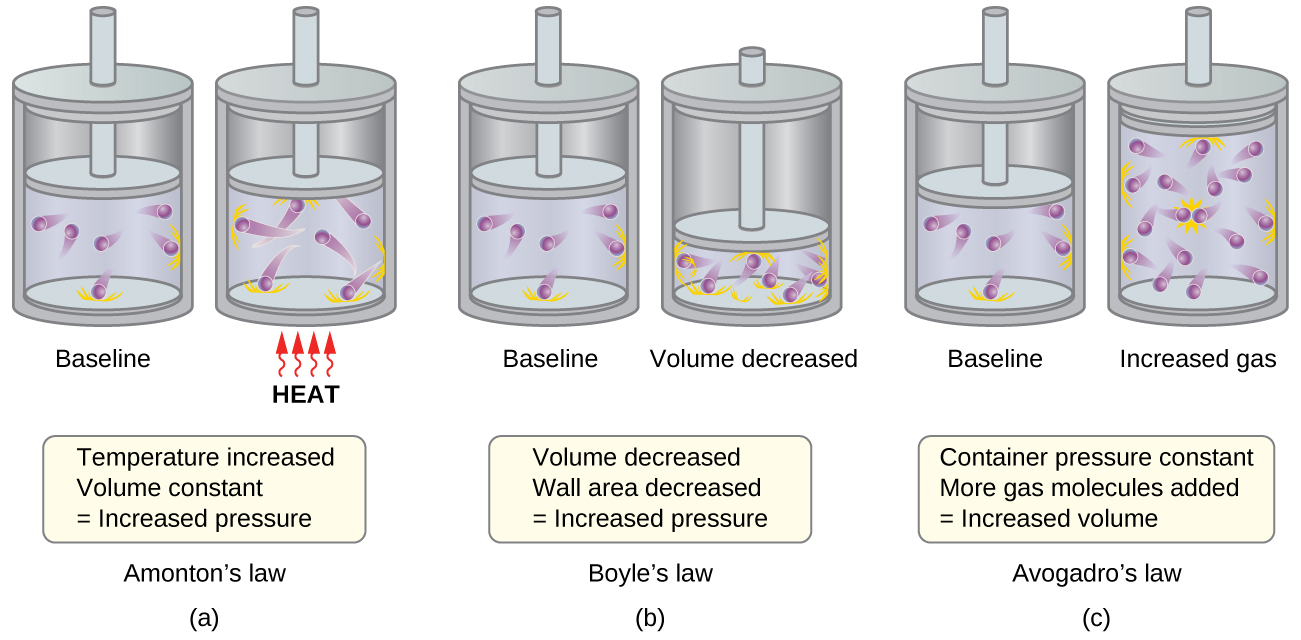
Amontons’s law. If the temperature is increased, the average speed and kinetic energy of the gas molecules increase. If the volume is held constant, the increased speed of the gas molecules results in more frequent and more forceful collisions with the walls of the container, therefore increasing the pressure (Figure 9.31).
Charles’s law. If the temperature of a gas is increased, a constant pressure may be maintained only if the volume occupied by the gas increases. This will result in greater average distances traveled by the molecules to reach the container walls, as well as increased wall surface area. These conditions will decrease the both the frequency of molecule-wall collisions and the number of collisions per unit area, the combined effects of which balance the effect of increased collision forces due to the greater kinetic energy at the higher temperature.
Boyle’s law. If the gas volume of a given amount of gas at a given temperature is decreased (that is, if the gas is compressed), the molecules will be exposed to a decreased container wall area. Collisions with the container wall will therefore occur more frequently and the pressure exerted by the gas will increase (Figure 9.31).
Avogadro’s law. At constant pressure and temperature, the frequency and force of molecule-wall collisions are constant. Under such conditions, increasing the number of gaseous molecules will require a proportional increase in the container volume in order to yield a decrease in the number of collisions per unit area to compensate for the increased frequency of collisions (Figure 9.31).
Dalton’s Law. Because of the large distances between them, the molecules of one gas in a mixture bombard the container walls with the same frequency whether other gases are present or not, and the total pressure of a gas mixture equals the sum of the (partial) pressures of the individual gases.
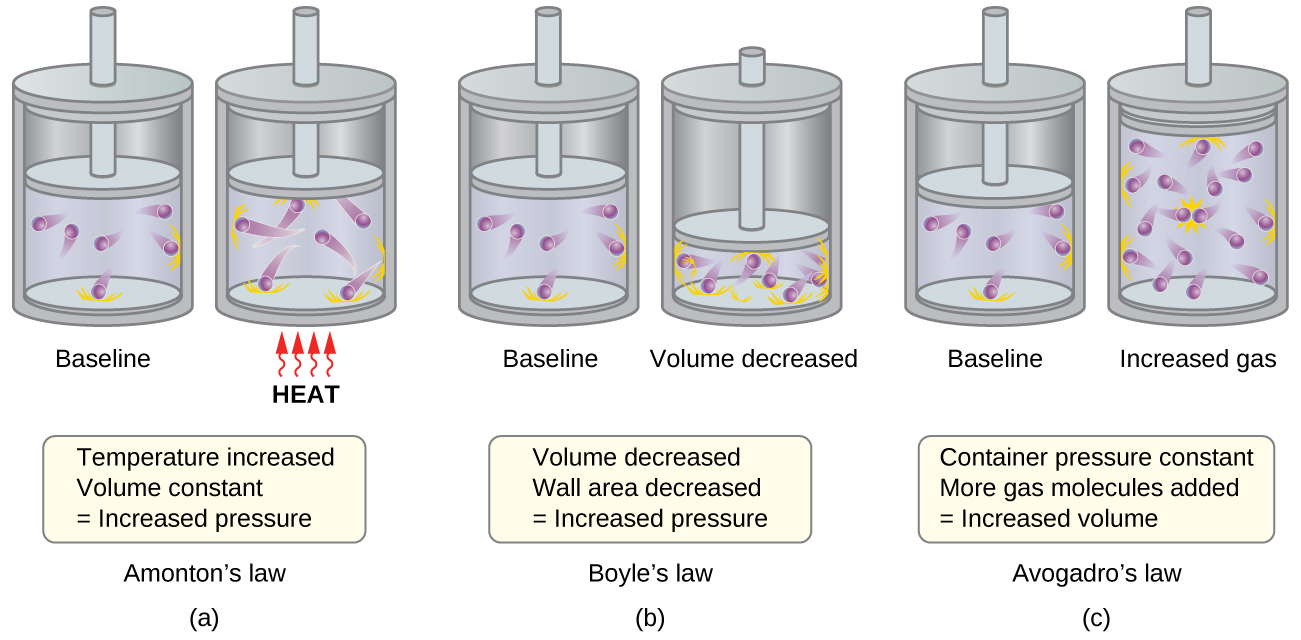
Figure 9.31
(a) When gas temperature increases, gas pressure increases due to increased force and frequency of molecular collisions.
(b) When volume decreases, gas pressure increases due to increased frequency of molecular collisions.
(c) When the amount of gas increases at a constant pressure, volume increases to yield a constant number of collisions per unit wall area per unit time.
Attach your completed reading guide from your Google Drive, here.
Adjunta tu guía de lectura completada desde tu Google Drive, aquí.