Use your reading guide (from Monday and Tuesday) to assist you with the following questions. Some information from Wednesday's videos will also be helpful. If you paid attention to the videos, it will pay off on a couple questions. If you did not complete the reading guide, then you should do so prior to attempting these questions (https://app.formative.com/formatives/6401111b73327165e6adb5be).
C.5.1 Use the kinetic molecular theory with the combined and ideal gas laws to explain changes in volume, pressure, moles, and temperature of a gas.
Learning Goals:
I can use the kinetic molecular theory to explain changes in:
volume of a gas
pressure of a gas
moles of a gas
temperature of a gas.
Use your reading guide (from Monday and Tuesday) to assist you with the following questions. Some information from Wednesday's videos will also be helpful. If you paid attention to the videos, it will pay off on a couple questions. If you did not complete the reading guide, then you should do so prior to attempting these questions (https://app.formative.com/formatives/6401111b73327165e6adb5be).
C.5.1 Use the kinetic molecular theory with the combined and ideal gas laws to explain changes in volume, pressure, moles, and temperature of a gas.
Learning Goals:
I can use the kinetic molecular theory to explain changes in:
volume of a gas
pressure of a gas
moles of a gas
temperature of a gas.
Provide an abbreviated list (you don't need to be word-for-word, just capture the gist of each postulate) of the postulates of the kinetic-molecular theory. Assess how good or bad the KMT does with how real gases behave.
Arrange the states of matter in terms of highest to lowest kinetic energies:
Highest KE:
Moderate KE:
Lowest KE:
Which of the following will have particles moving at OoC?
Select all of the following with the highest average kinetic energy.
Explain your answer to #4, above.
Using the postulates of the kinetic‑molecular theory, explain why a gas uniformly fills a container of any shape.
Can the speed of a given molecule in a gas double at constant temperature? Explain your answer.
Describe what happens to the average kinetic energy of ideal gas molecules when the pressure of the gas is increased by reducing the volume at constant temperature.
Describe what happens to the average kinetic energy of ideal gas molecules when the pressure of the gas is increased by increasing the temperature at constant volume.
Describe what happens to the average kinetic energy of ideal gas molecules when the average speed of the molecules is increased by a factor of 2.
Consider the diagram of a solid, liquid, a gas. It has been stated that gases are compressible but solids and liquids are generally not. Provide an explanation for this.
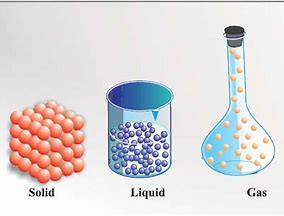
Consider the diagram of a solid, liquid, a gas. It has been stated that gases are compressible, but solids and liquids are generally not. Provide an explanation for this.