Copy of Atmospheric Pressure; Factors Affecting Gas Pressure (5/28/2026)
star
star
star
star
star
Last updated about 2 hours ago
18 questions
Note from the author:
Air Pressure
1
1
1
1
1
1
1
1
1
Factors Affecting Gas Pressure
1
1
1.5
1
1
1
2
1.5
1
Use the reading in each section to help you answer the questions after each section.
Summary
Atmospheric pressure is the pressure exerted by gas particles in Earth’s atmosphere as those particles collide with objects.
A barometer measures atmospheric pressure.
Atmospheric pressure decreases as the altitude increases.
Question 1
1.
What liquid is used in a traditional barometer?
_______
Question 2
2.
The device used to measure atmospheric pressure is called a(n) _______.
Question 3
3.
Question 4
4.
With a decrease in gravity, the atmospheric pressure _______
Question 5
5.
The atmospheric pressure at sea level is _______ mmHg.
Question 6
6.
What is the approximate atmospheric pressure on the summit of Mt. Everest _______ mmHg.
Question 7
7.
A _______ barometer measures pressure by the expansion and contraction of a small spring with an evacuated metal capsule.
Question 8
8.
At altitude decreases, atmospheric pressure _______ .
Question 9
9.
Use the graph to answer the following question.
Denver, CO is located at an altitude of approximately 1600 m. The atmospheric pressure of Denver is approximately _______ kPa.
How high does a basketball bounce?
The pressure of the air in a basketball has to be adjusted so that the ball bounces to the correct height. Before a game, the officials check the ball by dropping it from shoulder height and seeing how far back up it bounces. What would the official do if the ball did not bounce up as far as it is supposed to? What would he do if it bounced too high?
The pressure inside a container is dependent on the amount of gas inside the container. If the basketball does not bounce high enough, the official could remedy the situation by using a hand pump and adding more air to the ball. Conversely, if it bounces too high, he could let some air out of the ball.
Factors Affecting Gas Pressure
Recall from the kinetic-molecular theory that gas particles move randomly and in straight lines until they elastically collide with either other gas particles or with one of the walls of the container. It is these collisions with the walls of the container that defines the pressure of the gas. Four variables are used to describe the condition of a gas. They are pressure (P), volume (V), temperature (T), and the amount of the gas as measured by the number moles
. We will examine separately how the volume, temperature, and amount of gas each affect the pressure of an enclosed gas sample.
Question 10
10.
When the temperature of the gas increases, the kinetic energy of the molecules _______ .
Question 11
11.
What happens to the pressure inside a rigid container if the amount gas is doubled?
Question 12
12.
Question 13
13.
Question 14
14.
Question 15
15.
The force of the collisions of gas particles is a measurement of _______ .
Question 16
16.
When a flexible container is heated, the particles will _______ and the volume _______ .
Question 17
17.
Question 18
18.
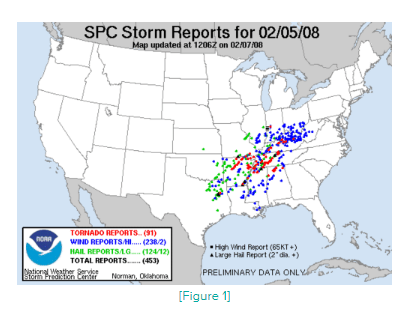
What do storm reports reveal?
The pressure in the atmosphere is an important factor in determining what the weather will be like. If the barometric pressure is high in an area, this will cause air to move to a region of lower pressure. The greater the difference in pressure between the two areas, the stronger the winds will develop. Under certain conditions, the winds can produce a tornado (a violent rotating column of air that reaches from a thunderstorm down to the ground).
Atmospheric Pressure
Atmospheric pressure is the pressure exerted by gas particles in Earth’s atmosphere as those particles collide with objects. A barometer is an instrument used to measure atmospheric pressure. A traditional mercury barometer consists of an evacuated tube immersed in a container of mercury. Air molecules push down on the surface of the mercury. Because the inside of the tube is a vacuum, the mercury rises inside the tube. The height to which the mercury rises is dependent on the external air pressure.
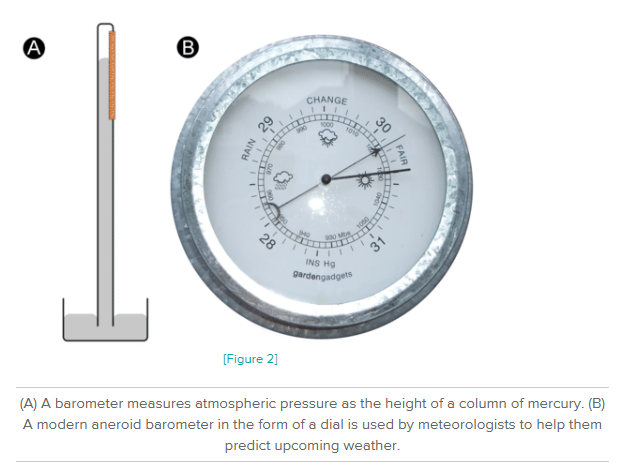
A more convenient barometer, called an aneroid barometer, measures pressure by the expansion and contraction of a small spring within an evacuated metal capsule.
Atmospheric Pressure and Altitude
At sea level, a mercury column will rise a distance of 760 mm. This atmospheric pressure is reported as 760 mmHg (millimeters of mercury). At higher altitudes, the atmospheric pressure is decreased and so the column of mercury will not rise as high. On the summit of Mt. Everest (elevation of 8848 m), the air pressure is 253 mmHg. Atmospheric pressure is slightly dependent on weather conditions. From the graph we can see the decrease in atmospheric pressure as the altitude increases. At sea level, the atmospheric pressure would be a little over 100 kPa (one atmosphere or 760 mm Hg). If we climb to the top of Mount Everest (the highest mountain in the world at 29,029 feet or 8848 meters), the atmospheric pressure will drop to slightly over 30 kPa (about 0.30 atmospheres or 228 mm Hg). This marked decrease in atmospheric pressure results in much lower levels of oxygen. Teams that climb this mountain must bring supplies of oxygen with them in order to breathe at these high altitudes.
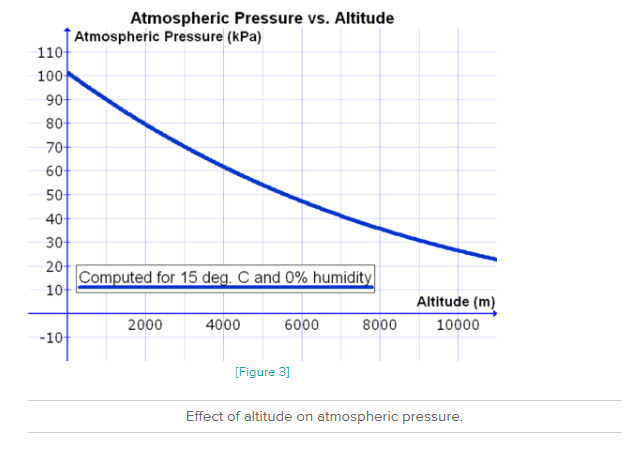
What does this graph tell us?
According to the line graph (figure 3, above), as you increase in altitude (go higher in the atmosphere), the effect on atmospheric pressure is that it decreases. In other words, as altitude increases, atmospheric pressure decreases. This is an inversely proportional relationship; as one increases, the other decreases.
How is the atmospheric pressure reported by using a traditional barometer?
temperature of the mercury
speed that the mercury rises up the tube
height of the mercury column
volume of mercury in the tube
Amount of Gas
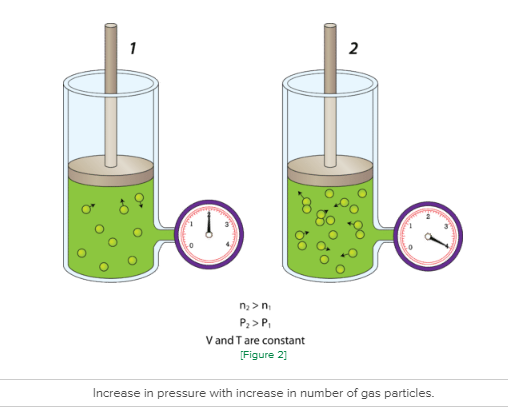
Figure below shows what happens when air is added to a rigid container. A rigid container is one that is incapable of expanding or contracting. A steel canister is an example of a rigid container. The canister on the left contains a gas at a certain pressure. The attached air pump is then used to double the amount of gas in the canister. Since the canister cannot expand, the increased number of air molecules will strike the inside walls of the canister twice as frequently as they did before. The result is that the pressure inside the canister doubles. As you might imagine, if more and more air is continually added to a rigid container, it may eventually burst. Reducing the number of molecules in a rigid container has the opposite effect and the pressure decreases.
Volume
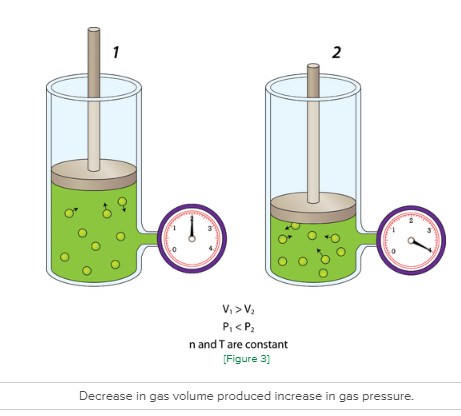
Pressure is also affected by the volume of the container. If the volume of a container is decreased, the gas molecules have less space in which to move around. As a result, they will strike the walls of the container more often and the pressure increases.
Figure below shows a cylinder of gas whose volume is controlled by an adjustable piston. On the left, the piston is pulled mostly out and the gauge reads a certain pressure. On the right, the piston has been pushed so that the volume of the enclosed portion of the container where the gas is located has been cut in half. The pressure of the gas doubles. Increasing the volume of the container would have the opposite effect and the pressure of the gas would decrease.
Temperature
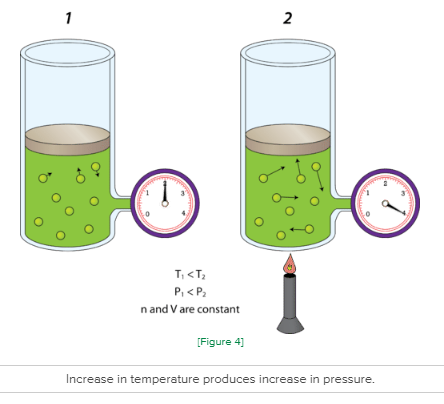
It would be very unadvisable to place a can of soup over a campfire without venting the can. As the can heats up, it may explode. The kinetic-molecular theory explains why. The air inside the rigid can of soup is given more kinetic energy by the heat coming from the campfire. The kinetic energy causes the air molecules to move faster and they impact the container walls more frequently and with more force. The increase in pressure inside may eventually exceed the strength of the can and it will explode. An additional factor is that the soup may begin boiling which will then aid even more gas and more pressure to the inside of the can.
Shown in Figure below is a cylinder of gas on the left that is at room temperature (300 K). On the right, the cylinder has been heated until the Kelvin temperature has doubled to 600 K. The kinetic energy of the gas molecules increases, so collisions with the walls of the container are now more forceful than they were before. As a result, the pressure of the gas doubles. Decreasing the temperature would have the opposite effect, and the pressure of an enclosed gas would decrease.
Which statement is/are true about the pressure of a gas?
Pressure increases when the amount of gas is decreased under constant volume and temperature.
Pressure decreases when the amount of gas is increased under constant volume and temperature.
Pressure increases when volume increases and temperature is unchanged.
Pressure increases when volume is decreased under constant temperature.
Pressure increases when temperature increases under constant volume
How does the pressure inside a rigid container change if the temperature of the gas inside is quadrupled?
It is reduced by one fourth
It is reduced by 4x
It quadruples
It increases
It doubles
What happens to the gas particles and the pressure inside a flexible container filled with gas if the volume is reduced by squeezing it?
The particles move further apart and the pressure increases
The particles move closer together
The pressure increases.
The particles move further apart and the pressure decreases
The particles move closer together and the pressure decreases
How does an increase in temperature affect the collisions of gas particles with the walls of the container?
It increases the force of the collisions
It does not affect the collisions
It increases the frequency of the collisions
It decreases the frequency and the force of the collisions
It decreases the frequency of the collisions.
The same number of gas particles can occupy a small and a large container.