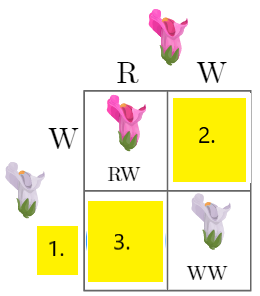
What are the missing genotypes in the cross below?
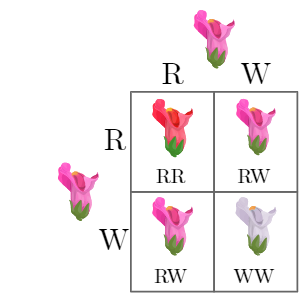
The cross, below, between the purple and white snapdragons (below) follow the principles of incomplete dominance. Use the information from the reading on incomplete dominance, as well as the information provided on the incomplete Punnett square, to detetermine the whole genotype of the white parent snapdragon (#1) as well as the two unknown offspring (#2 & #3).
1
1
1
Multiple Alleles
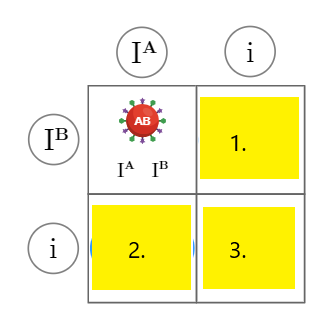
Many genes have multiple (more than two) alleles. An example is ABO blood type in humans. There are three common alleles for the gene that controls this characteristic. The alleles IA and IB are dominant over i. A person who is homozygous recessive ii has type O blood. Homozygous dominant IAIA or heterozygous dominant IAi have type A blood, and homozygous dominant IBIB or heterozygous dominant IBi have type B blood. IAIB people have type AB blood, because the A and B alleles are codominant. Type A and type B parents can have a type AB child. Type A and type B parents can also have a child with Type O blood, if they are both heterozygous (IBi, IAi).
Possible Genotypes for each Blood Type:
· Type A blood: IAIA, IAi
· Type B blood: IBIB, IBi
· Type AB blood: IAIB
· Type O blood: ii
What are the missing genotypes of the offspring in the cross below?
The cross, below, follows the principles of codomiance. Use the reading, above, and the information provided on the Punnett square to determine the genotypes of the three missing offspring inside of the Punnett square.
1
1
1
Polygenic Traits
Polygenic traits are controlled by more than one gene, and each gene may have two or more alleles. The genes may be on the same chromosome or on nonhomologous chromosomes.
If the genes are located close together on the same chromosome, they are likely to be inherited together. However, it is possible that they will be separated by crossing over during meiosis, in which case they may be inherited independently of one another.
If the genes are on nonhomologous chromosomes, they may be recombined in various ways because of independent assortment.
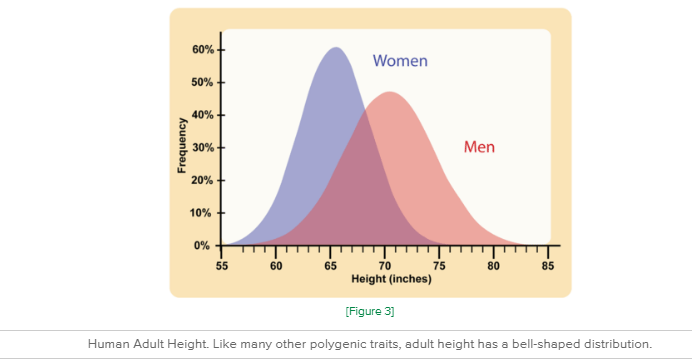
For these reasons, the inheritance of polygenic traits is very complicated. Such characteristics may have many possible phenotypes. Skin color, eye color, and adult height are examples of polygenic traits in humans. Do you have any idea how many phenotypes each characteristic has?
Effects of Environment on Phenotype
Genes play an important role in determining an organism’s characteristics. However, for many characteristics, the individual’s phenotype is influenced by other factors as well. Environmental factors, such as sunlight and food availability, can affect how genes are expressed in the phenotype of individuals. Here are just two examples:
Genes play an important part in determining our adult height. However, factors such as poor nutrition can prevent us from achieving our full genetic potential.
Genes are a major determinant of human skin color. However, exposure to ultraviolet radiation can increase the amount of pigment in the skin and make it appear darker.
Question 7
7.
Question 8
8.
What will be the blood type of children whose male parent is homozygous for blood type A (IAIA) and the female parent is homozygous for blood type B (IBIB)?
_______
Question 9
9.
The tail length trait in dogs is an example of incomplete dominance. What will be the tail length (short, medium, long, or extra long) of pups whose male parent has a long tail and the female parent has a short tail?
_______
Summary
Many characteristics have more complex inheritance patterns than those studied by Mendel. They are complicated by factors such as codominance, incomplete dominance, multiple alleles, and environmental influences.
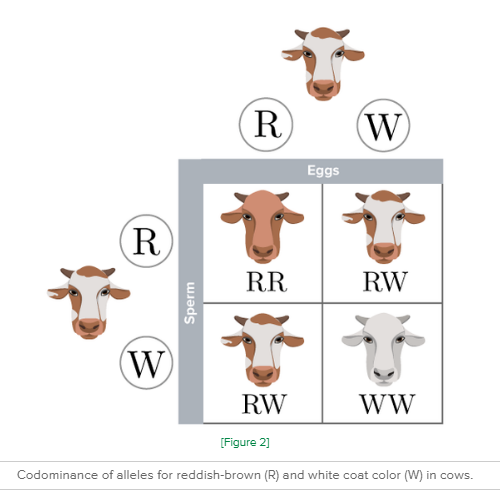
Codominance occurs when both alleles are expressed equally in the phenotype of the heterozygote.
Incomplete dominance occurs when the phenotype of a heterozygote offspring is somewhere in between the phenotypes of both homozygous parents; a completely dominant allele does not occur.
Multiple alleles occurs when agene has multiple (more than two) alleles.
Polygenic traits are controlled by more than one gene, and each gene may have two or more alleles.
Question 10
10.
Question 11
11.
Question 12
12.
Question 13
13.
A person with the genotype ii with have the blood type _______.
Question 14
14.
In a codominance situation, are both alleles expressed, or is the phenotype a blend of the two? _______
Question 15
15.
Question 16
16.
Question 17
17.
The genotype of a person with type O blood is _______.
Question 18
18.
Question 19
19.
What you will learn
Complex patterns of inheritance other than those studied by Mendel
The types of Non-Mendelian inheritance: codominance, incomplete dominance, multiple alleles, and polygenic traits
How environment affects the phenotype of an individual.
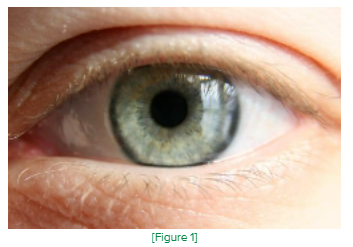
Green, blue, brown, black, hazel, violet, or grey. What color are your eyes?
Of course, human eyes do not come in multi-color, but they do come in many colors. How do eyes come in so many colors? That brings us to complex inheritance patterns, known as non-Mendelian inheritance. Many times inheritance is more complicated than the simple patterns observed by Mendel.
Non-Mendelian Inheritance
The inheritance of characteristics is not always as simple as it is for the characteristics that Mendel studied in pea plants. Each characteristic Mendel investigated was controlled by one gene that had two possible alleles, one of which was completely dominant to the other. This resulted in just two possible phenotypes for each characteristic. Each characteristic Mendel studied was also controlled by a gene on a different (nonhomologous) chromosome. As a result, each characteristic was inherited independently of the other characteristics. Geneticists now know that inheritance is often more complex than this.
A characteristic may be controlled by one gene with two alleles, but the two alleles may have a different relationship than the simple dominant-recessive relationship that you have read about so far. For example, the two alleles may have a codominant or incompletely dominant relationship.
Codominance
Codominance occurs when both alleles are expressed equally in the phenotype of the heterozygote. The reddish-brown and white coat color in the example below has codominant alleles for reddish-brown coat color and white coat color in cows.
Incomplete Dominance
Incomplete dominance occurs when the phenotype of a heterozygote offspring is somewhere in between the phenotypes of both homozygous parents; a completely dominant allele does not occur. For example, when red snapdragons (RR) are crossed with white snapdragons (WW), the F1 hybrids are all pink heterozygotes for flower color (RW). The pink color is an intermediate between the two parent colors. When two F1 (RW) hybrids are crossed they will produce red, pink, and white flowers. The genotype of an organism with incomplete dominance can be determined from its phenotype.
Question 1
1.
What is the genotype of the white parent snapdragon (#1)?
_______
Question 2
2.
What is the genotype of the unknown offspring #2?
Two letters are required in the genotype.
_______
Question 3
3.
What is the genotype of the unknown offspring #3?
Two letters are required in the genotype.
_______
Question 4
4.
What is the genotype of offspring #1?
The genotype is case-sensitive, meaning that uppercase and lowercase letters matter in the answer.
_______
Question 5
5.
What is the genotype of offspring #2?
The genotype is case-sensitive, meaning that uppercase and lowercase letters matter in the answer.
_______
Question 6
6.
What is the genotype of offspring #3?
The genotype is case-sensitive, meaning that uppercase and lowercase letters matter in the answer.
_______
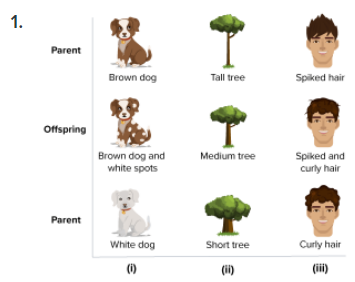
Identify the correct form of inheritiance in the figure above.
(i) incomplete dominance; (ii) codominance; (iii) incomplete dominance
(i) codominance; (ii) incomplete dominance; (iii) codominance
(i) codominance; (ii) incomplete dominance; (iii) incomplete dominance
Which of the following is considered to be a type of non-Mendelian inheritance (select all that apply)?
codominance
dihybrid inheritance
simple dominance and recessiveness
polygenic traits
incomplete dominance
multiple alleles
Food availablility and sunlight are factors that can affect a person's genotype.
True
False
Polygenic traits are susceptible to environmental influences.
True
False
___________ are traits that are due to the actions of more than one gene and often involves interactions with the environment.
Autosomal traits
Polygenic traits
Complex traits
Sex-Linked traits
Multiple alleles are characterized by _____.
More than two alternate forms of a gene
Two alternate forms of a gene
The occurrence of more than two genes in one chromosome
The occurrence of one gene in two chromosomes
What is the inheritance pattern in which both alleles are expressed?
codominance
simple dominance and recessiveness
dihybrid inheritance
polygenic traits
incomplete dominance
multiple alleles
If a gene has three alleles, how many different genotypes can be present in any one individual person?