Copy of 09.02.20 (Sync) Cavities (5/28/2026)
star
star
star
star
star
Last updated 3 months ago
8 Nsɛmmisa
1

9
3

9
1
1
1
1
Warm-Up
What is a cavity? In the space below, draw a cavity as best as you can.
When you think of the word 'cavity', what comes to mind?
If you thought 'a hole in your tooth' - you're on the right track! Cavities are essentially holes, or spaces, and they can be found in all sorts of things.
The cavities we'll be learning about today are the body cavities. Body cavities are spaces in the body, and they are often filled with various organs. Learning about the cavities will help us when talking about organ locations and disfunctions throughout the year.
The diagram below is the lateral view of a sagittal cut through a human.
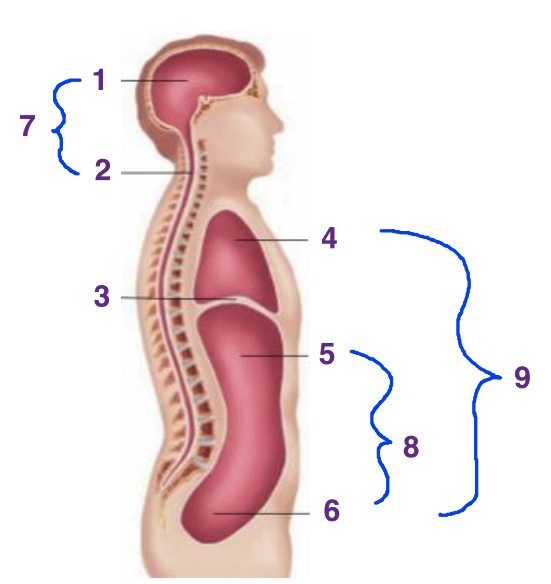
Using the diagram, match the cavities / structures with the proper name. Start with what you're most confident about, then make educated guesses.
Hint #1: Look at the name of the cavity and think about where its name might come from
Hint #2: Number 3 is not a cavity!
abdominal cavity
diaphragm
ventral cavity
vertebral cavity
dorsal cavity
cranial cavity
pelvic cavity
thoracic cavity
abdominopelvic cavity
1
2
3
4
5
6
7
8
9
The two main cavities in the body are the dorsal cavity and the ventral cavity. Explain...
1. Why do you think these cavities are named what they are?
2. Which of these cavities do you think is more protected by the skeletal system? Why?
The diagram below displays the frontal view of a frontal/coronal cut through a human.
Label the diagram with the following terms. Again - start with what you know, then make educated guesses.
abdominal cavity
pelvic cavity
cranial cavity
superior mediastinum cavity
vertebral cavity
diaphragm
abdominopelvic cavity
pleural cavity
pericardial cavity
Throughout the year, we will be labeling a lot of diagrams. Since this will all be done on a computer rather than on paper, I'm curious... which of these two ways did you like more?
Try to match the following organs/structures with the cavity they preside in.
| Draggable item | arrow_right_alt | Corresponding Item |
|---|---|---|
spinal cord | arrow_right_alt | thoracic cavity |
bladder | arrow_right_alt | abdominal cavity |
large intestine | arrow_right_alt | cranial cavity |
brain | arrow_right_alt | vertebral cavity |
lungs | arrow_right_alt | pelvic cavity |
Within each cavity reside visceral and parietal membranes. Visceral membranes surround each individual organ, while parietal membranes line the cavities.
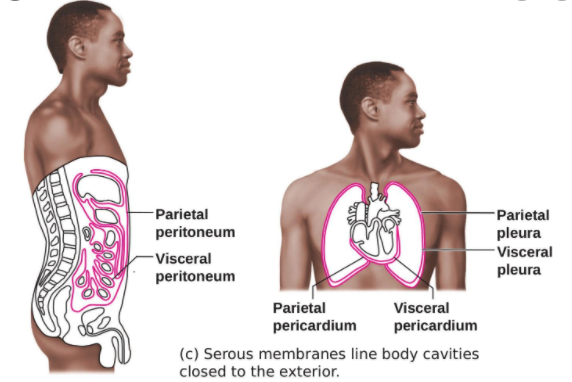
Between the visceral and parietal membranes is a small, fluid-filled space.
What do you think is the function of the visceral and parietal membranes?
Please think of your answer, then do a quick google search (using a reliable source!) to check your answer. PARAPHRASE it (DO NOT copy and paste!) in the space below.
Extension question
Appendicitis is the inflammation and possible infection of the appendix. The appendix is a small, finger-shaped organ located off of the large intestine, and is known to house bacteria that assist in the digestive process.
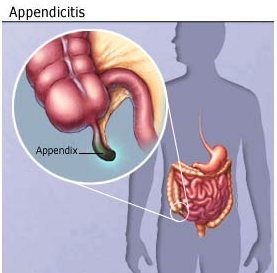
If appendicitis is left untreated for too long, the appendix can grow in size and, eventually, burst. If this happens, surgery to remove (vacuum out) the released bacteria and fecal matter is necessary.
Using this information and your understanding of body cavities and membranes, explain how the presence of body cavities and membranes is evolutionarily advantageous. (i.e. - how are body cavities and membranes helpful in someone with appendicitis?)