For Part 1 (questions 1-8), use the video below and the textbook to label and color diagrams and answer a set of questions.
The Vertebral Column
Use the video to color the diagram below using the key provided. Then label the diagram with the following structures:
cervical curvature
intervertebral disk
atlas
axis
coccyx
thoracic curvature
sacrum
lumbar curvature
The Vertebrae
The illustrations below are of individual vertebrae. Two of the illustrations, A and B, are of the first two cervical vertebrae. Illustrations C and D are of typical lumbar and cervical vertebrae, respectively.
Identify and label the following structures. Some may be used on more than one illustration:
vertebral foramen (also known as the spinal foramen)
spinous process
body
pedicle
superior articular facet
dens
transverse foramen
transverse process
The Sacrum
The sacrum represents a unique feature of the vertebral column in that it is composed of fused vertebrae. Label the following structures on the illustration below:
coccyx
superior articulating surface
sacral canal
sacral hiatus
sacral foramina
sacral crest
Compare and contrast the atlas and the axis
How and why might the bodies and spinal foramens of vertebrae change size as we move down the vertebral column (excluding the sacram and coccyx)?
Categorize the number of vertebrae in each vertebral region, as well as characteristics of the vertebrae found in this region.
5 separate vertebrae
first two vertebrae have special names: the atlas and the axis
12 separate vertebrae
help to form pelvic girdle (along with hip bones)
have the largest body of all vertebrae
5 fused vertebrae
4 fused vertebrae
7 separate vertebrae
have a large spinal foramen and small spinous process
have large transverse processes to allow for the attachment of ribs
attach to muscles of the pelvic floor
Cervical
Thoracic
Lumbar
Sacral
Coccyx
Which regions of the vertebral column are normally arranged wth an anteriorly concave curve?
Match the following terms with their descriptions
| Přetahovatelná položka | arrow_right_alt | Odpovídající položka |
|---|---|---|
body | arrow_right_alt | process on the axis that acts as a pivot for the atlas to move around |
transverse foramen | arrow_right_alt | drum-shaped portion of a vertebrae designed to bear weight |
transverse process | arrow_right_alt | the opening within a vertebrae, through which the spinal cord passes |
sacral crest | arrow_right_alt | the most posterior part of an individual vertebrae |
spinous process | arrow_right_alt | large surface on the thoracic vertebrae that allow for the attachment of ribs |
superior articular facet | arrow_right_alt | the fused spinous processes of the sacrum |
dens | arrow_right_alt | surface of the atlas that makes contact with the occipital bone of the skull |
vertebral foramen | arrow_right_alt | the openings within vertebrae through which vertebral arteries and veins pass |
For part 2 (questions 9-??), use the video below to and the textbook to label and color the diagrams and answer a set of questions.
Thoracic Cage
Use the video to color the diagram below using the key provided. Then label the diagram with the following structures:
xiphoid
body
manubrium
floating ribs
vertebrochondral ribs
There are a total of 24 pairs of ribs.
Ribs numbered ___ to ___ attach directly to the sternum and are called ___.
What is the cartilage connecting ribs to the sternum called, and why is it important?
Why are ribs 11-12 called floating ribs?
Exmine the spine in the MRI below of a patient's lumbar vertebrae:
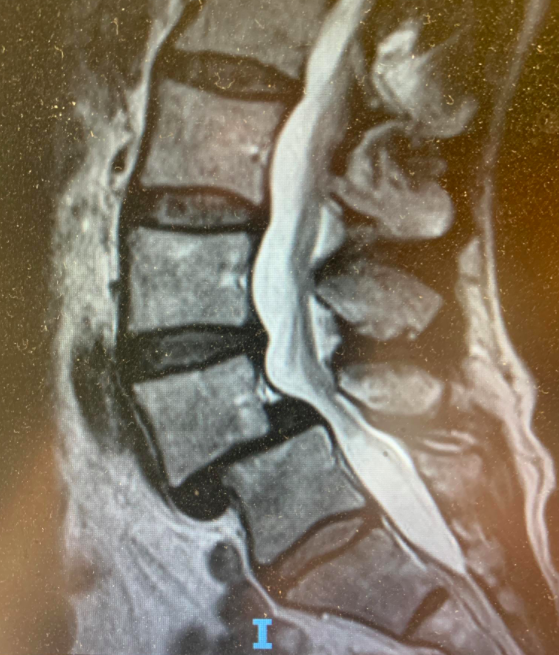
What do you think is wrong with this patient's spine (in general - not the exact name!), and what symptoms might they experience?