Copy of 10.09.20 - Origins, Insertions, and Actions (5/28/2026)
star
star
star
star
star
Last updated 3 months ago
14 Nsɛmmisa
1
1
1
1
1
1
1
1
4
4
4
1
1
1
Objectives:
distinguish between the body movements that can be made by skeletal muscles
identify various skeletal muscles throughout the body
identify the origin, insertion, and action for a set of muscles
Circle the word or words that best describe how you are feeling right now.
What do you need from me (your teacher) to do your best in class today?
Compare and contrast origins and insertions of a muscle.
List two professions in which it might be helpful to know the origins, insertions, and actions of muscles.
What are the origins, insertions, and actions of the muscles?
Watch the following video, then answer questions
(Stop at 3:00- you don't need to know about innervations!)
The part of this video that I REALLY want you to get from this is:
Act out the motions. Feel for the processes and muscles and THINK about what would happen when the muscle contracts.
Consider the sternocleidomastoid muscle (shown below is the right sternocleidomastoid):
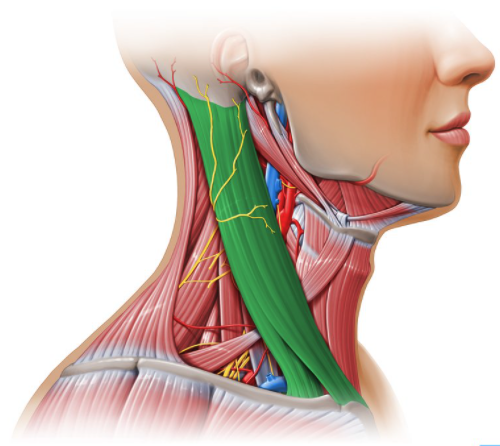
The sternocleidomastoid muscle is named after its origin and insertion. It originates at the sternum (sterno-) and clavicle (-cleido-) and inserts at the mastoid process (-mastoid).
Remember that the origin of a muscle does not move when a muscle contracts, while the insertion does move.
Match up the following actions, considering the information above.
| Draggable item | arrow_right_alt | Corresponding Item |
|---|---|---|
Contraction of both sternocleidomastoid muscles | arrow_right_alt | Rotation of the neck |
Contraction of one sternocleidomastoid muscle | arrow_right_alt | Flexion of the neck |
For flexion of the neck, the sternocleidomastoids are agonists, or prime mover. This means that they are a main muscle in completion of the action. Complete the action, and think about your sternocleidomastoid muscles contracting as you do it. The muscle that would complete the oppositve action (extension of the neck) is called the antagonist.
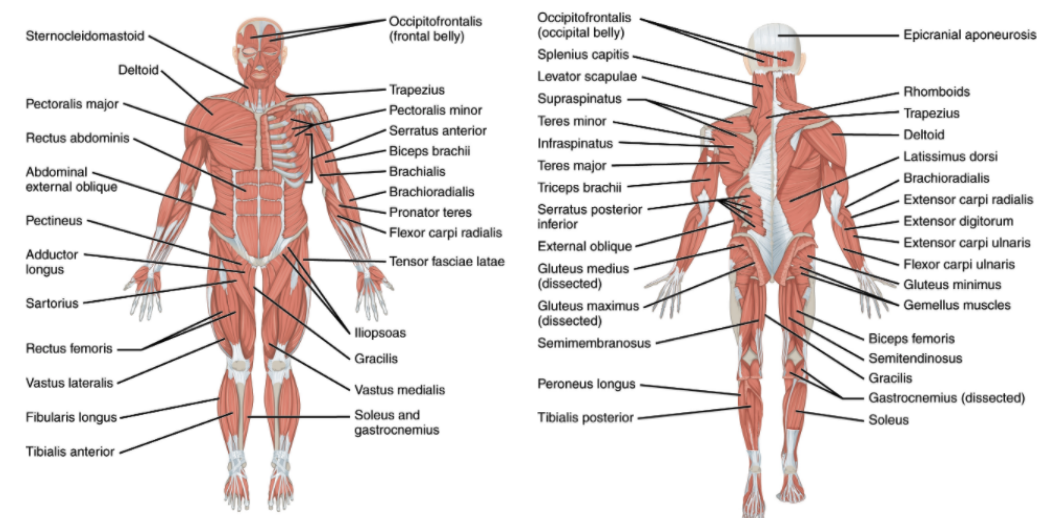
Using the diagram below, determine which muscle is the most likely to be the antagonist of the sternocleidomastoid muscles in neck flexion. (I.e. - which of the following muscles is most likely to extend the neck?)
A Note From Your Teacher!!
For the following questions:
You may need to refer back to your bone formatives so you can remember where some of these structures are. Also, I strongly encourage you to touch these areas of your body and THINK about what will happen when each muscle contracts.
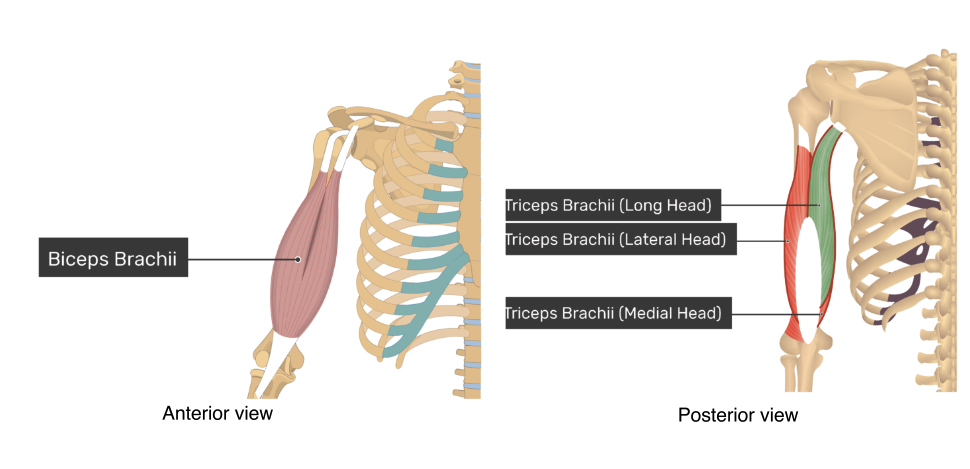
Consider the following image comparing the biceps brachii and triceps brachii.
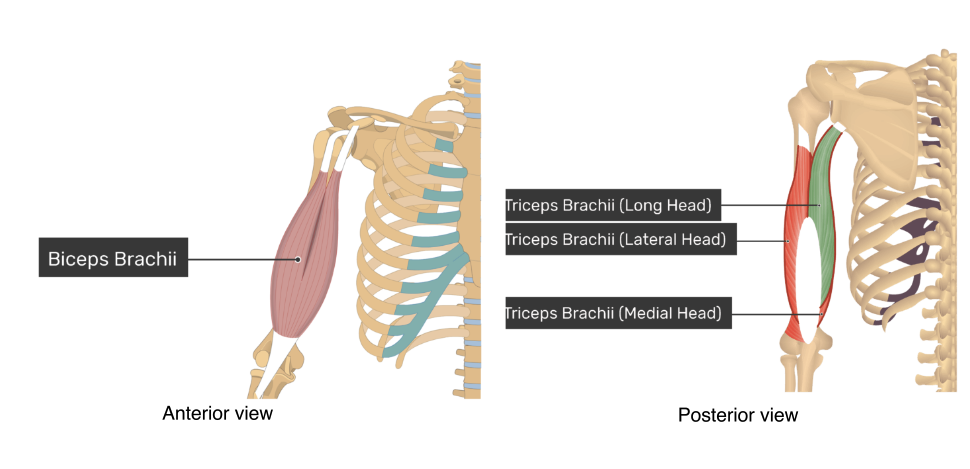
Now, consider the origins and insertions for each:
Biceps brachii
Origin: coracoid process
Insertion: radial tuberosity
Triceps brachii
Origin: posterior of humerus
Insertion: olecranon process of ulna
THINK about the movements, then classify the following actions and labels for each muscle:
Antagonist for elbow extension
Extends elbow
Agonist for elbow flexion
Agonist for elbow extension
Flexes elbow
Antagonist for elbow flexion
Biceps brachii
Triceps brachii
Consider the following image comparing the origins and insertions of the rectus femoris (left, anterior view) and the biceps femoris (right, posterior view)

Feel for these processes and muscle attachment sites on your own body.
Think about it: What will happen when the biceps femoris contracts? What will happen when the rectus femoris contracts?
Agonist of knee extension
Antagonist of knee extension
Agonist of knee flexion
Flexes knee
Antagonist of knee flexion
Extends knee
Rectus femoris
Biceps femoris
Pick TWO opposing movements (actions) from the textbook of the muscles of the Head, Neck and Back.
Write the actions, agonist muscles (prime movers), origins, and insertions in the table in the "show your work" box below. These can be found in the table in the textbook.
Finally, visit the GetBodySmart website. Find the two muscles for your actions. Take a screenshot of both and place them in the "show your work" box below the table.
Pick TWO opposing movements (actions) from the textbook of the muscles of the Shoulder and Upper Limb
Write the actions, agonist muscles (prime movers), origins, and insertions in the table in the "show your work" box below. These can be found in the table in the textbook.
Finally, visit the GetBodySmart website. Find the two muscles for your actions. Take a screenshot of both and place them in the "show your work" box below the table.
Pick TWO opposing movements (actions) from the textbook of the muscles of the Hip and Lower Limb
Write the actions, agonist muscles (prime movers), origins, and insertions in the table in the "show your work" box below. These can be found in the table in the textbook.
Finally, visit the GetBodySmart website. Find the two muscles for your actions. Take a screenshot of both and place them in the "show your work" box below the table.
Pick TWO opposing movements (actions) from the textbook of the muscles of the Abdominal Wall and Thorax. You will likely need to reference the page for the Head, Neck, and Back.
Write the actions, agonist muscles (prime movers), origins, and insertions in the table in the "show your work" box below. These can be found in the table in the textbook.
Finally, visit the GetBodySmart website. Find the two muscles for your actions. Take a screenshot of both and place them in the "show your work" box below the table.
What do you understand about origins, insertions, and actions?
What questions do you still have about origins, insertions, and actions?