Copy of 09.01.20 (Sync) - Body Regions and Cross Sections (5/28/2026)
star
star
star
star
star
Last updated 3 months ago
14 Nsɛmmisa
1

1
1
1
1

12
1
1
1

1

1
1
1
1
On your own, try to match the following body regions with their location on the body. Don't panic - We have not talked about these yet! This is just so I can get an idea of where you are all at. Please resist the urge to google!!
| Draggable item | arrow_right_alt | Corresponding Item |
|---|---|---|
Oral | arrow_right_alt | Proximal part of leg; thigh |
Femoral | arrow_right_alt | Medial line on dorsal side of trunk |
Digital | arrow_right_alt | Area around the mouth |
Vertebral | arrow_right_alt | Anterior side of knee |
Patellar | arrow_right_alt | Most distal region of arms and legs; fingers and toes |
Think about the following questions:
What was the highlight of your weekend?
What is your favorite season? Why?
If you could be any animal, what would it be and why?
Share your answers with your group members. The person whose birthday is the closest to TODAY goes first!
Then, draw a picture of something you have in common with a group member. Please include their name!
In your group, nominate one person to be the Reader, one person to be the Manager, and one person to be the Spokesperson.
Reader - reads questions / terms and other parts of the activity out loud for the group
Manager - makes sure all students are working together on same question and group finishes on time
Spokesperson - shares the group's ideas during whole class discussion
In the space below, list which person in your group has each job.
Note: If you team has 4 people, assign one person the role of Timekeeper.
Share the pictures of your creature with your group and discuss the following:
Does the creature follow the criteria?
Are the drawings consistent? (The biggest mistake I see here is that heads / limbs are pointed in different directions between different perspectives!)
Are the drawings labeled correctly?
As you talk, answer questions 4-5.
What did you do well on your creature?
What changes, if any, do you need to make to your creature? Be specific!
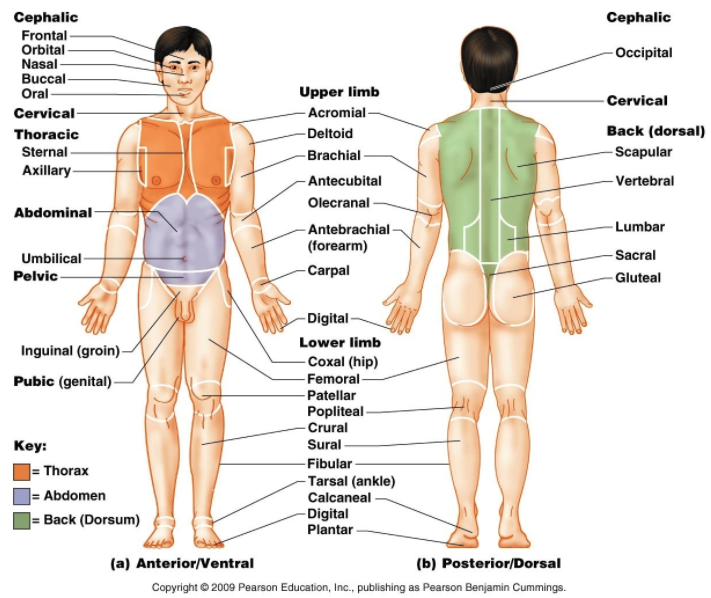
The diagram below shows the body regions that you will be responsible for knowing throughout the year. While some may seem more intuitive than others at the time, we will be using all of these terms at some point in Honors Anatomy & Physiology.
Look through the diagram below. For each term, think to yourself 'Why might that area be named that?'
In the table below, write/type a description for the location of the body regions listed.
Use the directional terminology from last week as much as possible (anterior, posterior, lateral, medial, superior, inferior, distal, proximal, ventral, dorsal)
(Need help getting started? Check out the warm-up! You can steal those word for word if you want!)
ANOTHER HINT! Switch the font to be smaller by choosing the the smallest line thickness.
Pick any three body regions listed in the picture above. For questions 7 - 9, use the medical terminology website (found here) to make an educated guess as to WHY the regions are called what they are.
For example:
Inguinal: acromial: acr = extremities; top; extreme point
Body Region #1
Body Region #2
Body Region #3
Examine three of the planes / cuts that we will be using throughout the year:
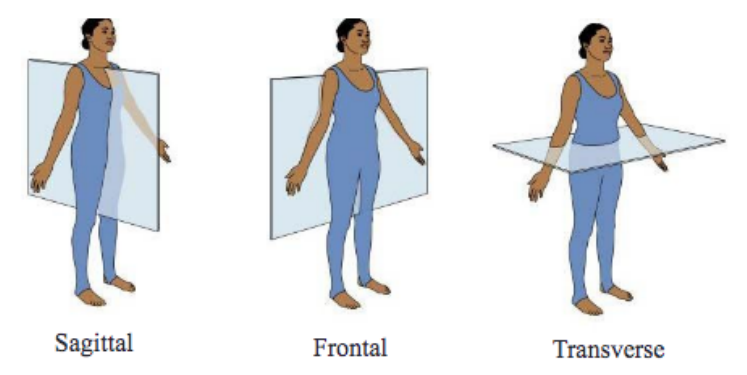
These cuts will be helping us to visualize different parts of the body throughout the year. It is important when doing a dissection or learning about the gross anatomy of an area to know which perspectives will allow us to see certain organs or components best.
Using the image above, categorize the following descriptions and pictures as best as possible.
Horizontal cut that separates the body into superior and inferior portions
Cross section best viewed from lateral perspective
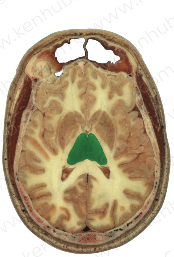
Lengthwise cut done laterally that separates body into anterior and posterior portions
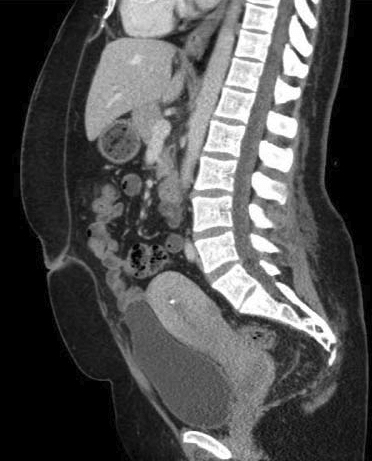
Lengthwise cut down the midline of the body going from anterior to posterior. Separates the body into EQUAL left and right portions
Cross section best viewed from anterior or posterior perspective
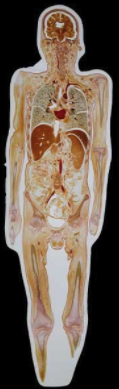
Lengthwise cut going from anterior to posterior that separates the body into left and right portions
Cross section best viewed from superior or inferior perspective
Cross section best viewed from lateral perspective
Transverse Cut
Frontal / Coronal Cut
Sagittal Cut
Midsagittal Cut
Transverse Cut
Frontal / Coronal Cut
Midsagittal Cut
Sagittal Cut