Copy of Histology - Tissue Types Models (5/28/2026)
star
star
star
star
star
Last updated 3 months ago
11 Nsɛmmisa
2
2
1
3
1
1
1
1
2
1
5
Histology is the science of identifying and classifying tissues using microscope examination of samples of very thin slices of tissue.
In medicine, histology plays a crucial role in:
The diagnosis and detection of certain diseases - cancers and degenerative diseases.
Monitoring disease progression and treatment response.
Regenerative medicine.
Drug development and toxicology.
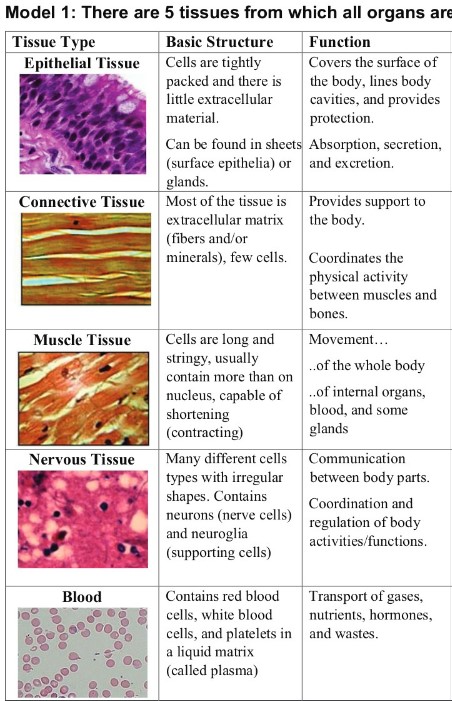
In this activity, you will use a model that contains five tissue types, a description of their structure and function, as well as other tools to classify and describe organs, and other body structures, by their tissue type.
Review model 1 above, use that information to categorize each organ/structure into their appropriate tissue type category.
Erythrocytes (RBC's)
Glial Cells (neuroglial)
Neurons
Cartilage (hyaline of ears and nose)
Ligament
Cuboidal Epithelium (skin, lining of mouth)
Cartilage (Fibrocartilage of joints, and vertebral discs)
Columnar epithelium (lining of stomach and intestine)
Leucocytes (WBC's)
Myocardium (cardiac muscle)
Smooth muscle (intestine, blood vessels, bronchus)
Skeletal muscle
Osteocytes (Bone)
Epithelial Tissue
Connective Tissue
Muscle Tissue
Nervous Tissue
Blood Tissue
Examine the images and descriptions of epithelial and connective tissues.
a.) Which has a higher density of cells?
b.) Which has more extracellular matrix?
What organ best matches up with the listed function of epithelial tissue?
Use the provided links to help you construct a full definition of the following: absorption, secretion, and excretion. Separate each definition with a double-space.
https://byjus.com/biology/difference-between-secretion-and-excretion/
https://www.biologyonline.com/dictionary/absorption
Using the model, what types of things make-up the extracellular matrix (you may have to read something in the model)?
Hydroxyapatite is a chemical that contains a large amount of calcium. Think about structures in the body that may contain a lot of calcium. Provide one example -
Look at connective tissue in the model above and review the functions of it. What structures in your body coordinate the actions of muscles with bone?
What structures are moved by muscle tissue (examine the function of muscle tissue)?
Think about two locations where you would find muscle tissue in the body.
a.)
Read the description of the function of nervous tissue. What organ would be responsible for coordinating and regulating all your body's activities and functions?
a.) What structure does this organ use to communicate with the rest of the body?
Use the model and, if needed, an internet search to find the tissue that comprises each structure below:
a.) Ligament
b.) Outer lining of the liver
c.) Myometrium of the uterus (used for labor contractions during childbirth)
d.) Myenteric plexis (communicates between thoracic nerves and digestive tract)
e.) Intestinal submucosa (supports gastrointestinal tract lining)
f.) Nociceptor (communicates pain to the brain)
g.) Pyloric sphincter (contracts to close off the opening from the stomach to the small intestine)
h.) Thyroid gland (secretes certain hormones):
i.) Alveolar cells (transfers blood gases, carbon dioxide and oxygen, to and from the hemoglobin on erythrocytes)
j.) Intervertebral disks (cushions spine against compression damage)