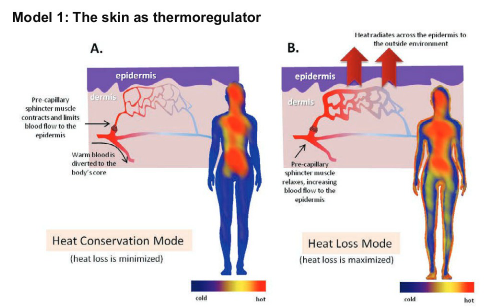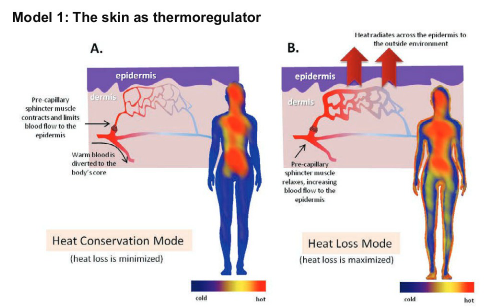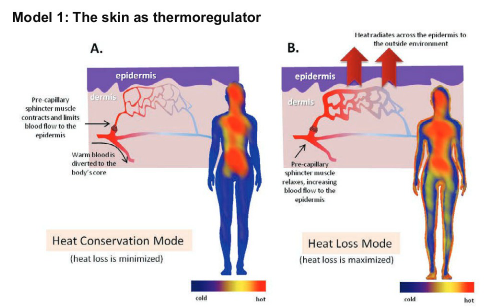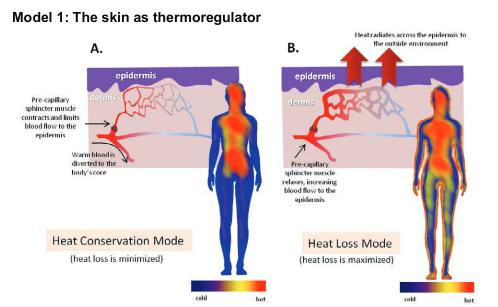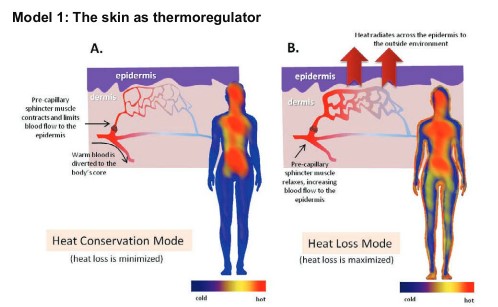
In the "Heat Conservation Mode," what have the precapillary sphincter muscles done?
a.) What has that done to the amount of blood traveling to the epidermis?
b.) According to the model, where does this action cause blood flow to be diverted?
If blood is kept deeper in the body, will the heat in the blood be able to escape easily?
Consider #2 and your answer to that question; why might this be a good idea if the body is in "heat conservation" mode?
Look at part B of the model. What is different about blood flow in this part of the model compared to part A?
What effect has this change in blood flow had on the distribution of heat in the body?
a.) If the left side of the model (A) is labeled "heat conservation" what is the right side of the model labeled?
b.) When might the body want to increase heat loss?
The mechanism of heat loss you just discovered is called radiant heat loss. Devise a simple description in everyday terms that explains how the skin controls radiant heat loss.
If an ice cube is place in warm water, will heat flow from the water into the ice cube and melt it, or will heat flow from the ice cube into the water and freeze it?
a.) Using the same rationale used to answer the first part of this question, would heat move from an area of high heat to an area of low heat, or would it move from an area of low heat to high heat?
b.) If the air surrounding the skin lacks wind or breeze (the wind is not moving) and the temperature is higher than 98.6oF, how much heat is likely to be radiated away from the skin into the surrounding air (none, little, much)?
a.) If you were to walk outside and the temperature is higher than 99oF, would you quickly die?
b.) If you were to walk outside into 99oF temperatures, what is the first thing you would likely notice on your skin?
c.) What happens to liquids when they are exposed to heat?
Besides increased blood flow to the skin, what other physiological process aids in heat loss; why does this cool you down?
What happens to a spoon of hot soup when you blow on it?
a.) which feels cooler, a 90oF room with still air or a 90oF room with a fan on?
Convection is the movement of molecules within a fluid, air, magma, moving water, etc.
Decide if air convection will likely increase or decrease the rate of evaporation of fluids from the skin.
Consider what has been discussed in this activity, and (if necessary) use a web search, to provide a list of three ways that the body sheds excess heat. Two of the three must come directly from this activity.
A man loves to run. Answer the following questions about heat generation and loss in runners.
a.) What tissue type is going to be doing most of the work in moving the runner?
b.) Based upon your answer to question a, what tissue is responsible for generating most of the body heat during exercise?
c.) When the runner hits the 3-mile mark, he is sweating. Other than evaporation what other mechanisms is the runner losing heat (list two)?
d.) If the runner runs on a treadmill indoors, which of the three mechanisms for losing heat will not play a factor in keeping him from overheating?
e.) Is there some way to introduce this method (the answer from d) while on the treadmill? How?
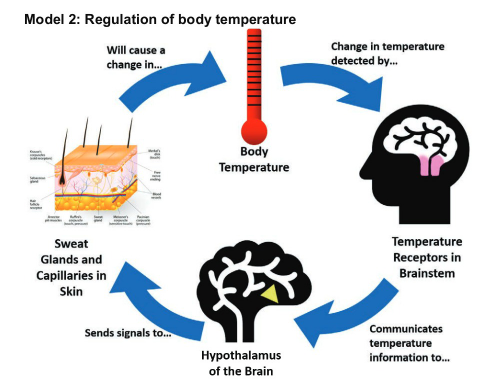
a.) According to model 2, what will cause a change in body temperature?
b.) What detects this change in temperature?
c.) What is the body's response to this increase in temperature?
d.) What organ is integrating the information from the skin receptors and the body's normal set-point temperature?
Body temperature is regulated by a negative feedback loop. There are four components to a negative feedback loop - variable (changing conditions), sensor, integrator, effectors (one or more than one).
In the diagram, label the variable, sensor, integrator, and effector(s).
Definitions:
Variable - things that naturally change or change be changed artificially.
Sensor - something that responds to a physical stimulus (heat, light, sound, pressure, motion, etc.).
Integrator - a unit that combines variables.
Effector - tissue, structure or organ that becomes active in response to a stimulus.