La Lecture en Español - https://docs.google.com/document/d/1QqhrT7vThTYX6UjwKSVFepzJMLDt80nls4YWhvKQmz0/edit?usp=sharing
This neat row of cola bottles represents matter in three different states—solid, liquid, and gas. The bottles and caps are solids, the cola is a liquid, and carbon dioxide dissolved in the cola is a gas. It gives cola its fizz. Solids, liquids, and gases such as these have different properties. Solids have a fixed shape and a fixed volume. Liquids also have a fixed volume but can change their shape. Gases have neither a fixed shape nor a fixed volume. What explains these differences in states of matter? The answer has to do with energy.
Which of the following would best represent a liquid?
¿Cuál de los siguientes representaría mejor un líquido?
Which of the following would best represent a solid?
¿Cuál de los siguientes representaría mejor un sólido?
Which of the following would best represent a gas?
¿Cuál de los siguientes representaría mejor un gas?
Energy is the ability to cause changes in matter. For example, your body uses chemical energy when you lift your arm or take a step. In both cases, energy is used to move matter—your body, in this case. Any matter that is moving has energy just because it’s moving. The energy of moving matter is called kinetic energy. Scientists think that the particles of all matter are in constant motion. In other words, the particles of matter have kinetic energy. The theory that all matter consists of constantly moving particles is called the kinetic theory of matter.
While its true that most particles are in constant motion, this is not the case for all particles; some particles do not move or display motion of any kind.
Si bien es cierto que la mayoría de las partículas están en constante movimiento, este no es el caso de todas las partículas; algunas partículas no se mueven ni muestran ningún tipo de movimiento.
What is the term used to describe the energy of moving matter, and what scientific theory explains that all matter consists of constantly moving particles?
¿Cuál es el término utilizado para describir la energía de la materia en movimiento, y qué teoría científica explica que toda la materia consiste en partículas que se mueven constantemente?
Kinetic energy is the energy an object has because it's moving. The more mass an object has and the faster it's going, the more kinetic energy it has. You can think of it as the energy of motion—like a rolling ball or a car driving down the road. Differences in kinetic energy explain why matter exists in different states.
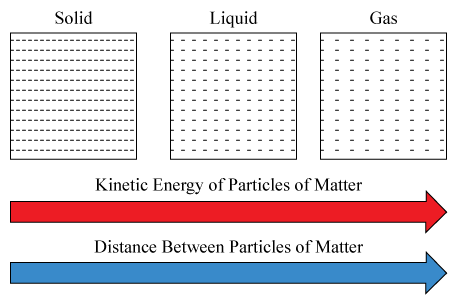
Particles of matter are attracted to each other, so they tend to pull together. The particles can move apart only if they have enough kinetic energy to overcome this force of attraction. It’s like a tug of war between opposing sides, with the force of attraction between particles on one side and the kinetic energy of individual particles on the other side. The outcome of the “war” determines the state of matter. The more kinetic energy possessed by the particles in a substance, the farther apart from one another they are. Logically, the inverse (reverse) is also true — the less kinetic energy present, the closer the particles are.
How do we know if something has kinetic energy?
Solids:
In solids, particles are closely packed together in a fixed arrangement, typically in a regular, repeating pattern known as a crystalline structure. The kinetic energy of the particles is low enough that they cannot overcome the strong intermolecular forces holding them in place. Instead of moving freely, these particles can only vibrate about their fixed positions. This restricted movement results in solids having a definite shape and volume. The orderly arrangement of particles contributes to the rigidity and incompressibility of solids.
Liquids:
In liquids, the kinetic energy of the particles is higher than in solids, which allows them to partially overcome the attractive forces between them. This results in a state where particles are still close together but can move past one another, leading to a more fluid and dynamic structure. The ability of particles to slide and flow explains why liquids take the shape of their containers while maintaining a constant volume. Unlike solids, which retain their shape, liquids adapt to the shape of their surroundings, yet the fixed volume is maintained due to the limited compressibility of the liquid state.
Gases:
If particles have enough kinetic energy to completely overcome the force of attraction between them, matter exists as a gas. The particles can pull apart and spread out. This explains why gases have neither a fixed volume nor a fixed shape. This lack of attraction allows gas particles to spread out and occupy the entire volume of their container, leading to the characteristic property of gases having neither a fixed shape nor a fixed volume. Gas particles are in constant motion, and as they collide with the walls of their container, they exert a force on those walls. This interaction is what generates gas pressure. The pressure is distributed evenly across all surfaces of the container due to the unpredictable motion of the particles, meaning that the gas applies pressure uniformly on all walls. The behavior of gas particles is influenced by temperature and pressure. As temperature increases, the kinetic energy of the particles increases, causing them to move even faster and spread further apart. This explains the compressibility of gases; when pressure is applied, gas particles can be forced closer together, decreasing their volume.
Look at the Figures below. It sums up visually the relationship between kinetic energy and state of matter.
What allows particles in a solid to maintain a fixed shape and volume?
¿Qué permite que las partículas en un sólido mantengan una forma y un volumen fijos?
How do the properties of liquids differ from those of gases in terms of particle movement and attraction?
¿Cómo difieren las propiedades de los líquidos de las de los gases en términos de movimiento y atracción de partículas?
What is the primary difference between solids, liquids, and gases?
¿Cuál es la principal diferencia entre sólidos, líquidos y gases?
Q: How could you use a bottle of cola to demonstrate the relationships between kinetic energy and state of matter?
A: You could shake a bottle of cola and then open it. Shaking causes carbon dioxide to come out of the cola solution and change to a gas. The gas fizzes out of the bottle and spreads into the surrounding air, showing that its particles have enough kinetic energy to spread apart. Then you could tilt the open bottle and pour out a small amount of the cola on a table, where it will form a puddle. This shows that particles of the liquid have enough kinetic energy to slide over each other but not enough to pull apart completely. If you do nothing to the solid glass of the cola bottle, it will remain the same size and shape. Its particles do not have enough energy to move apart or even to slide over each other.
What observations can you make about the kinetic energy of particles in cola when it is shaken and then poured?
¿Qué observaciones puedes hacer sobre la energía cinética de las partículas en la cola cuando se agita y luego se vierte?
When complete with this activity, click the link below, use the password, and use the provided reading in the Google Doc (located in the link below).
Cuando completes esta actividad, haz clic en el enlace a continuación, utiliza la contraseña, y utiliza la lectura proporcionada en el Documento de Google (ubicado en el enlace a continuación).
Kinetic Energy Questions - https://app.formative.com/formatives/68d9c4aa5b442da7ca24978b
Password (contraseña) - post
Which one of these has the most kinetic energy?
¿Cuál de estos tiene la mayor energía cinética?