Twa kɔ nsɛm atitiriw so
Log in
Sign up for FREE
arrow_back
Laabri

Copy of 1.) Reading - Speed and Motion (5/28/2026)

star
star
star
star
star
Last updated about 1 month ago
11 Nsɛmmisa
Hyɛ no nsow a efi ɔkyerɛwfo no hɔ:
1
1
1
1
1
1
1
1
1
1
1

La Lectura en Español - Use la lectura, y solo la lectura, para ayudarlo a responder las preguntas al final de cada sección. https://docs.google.com/document/d/1SdoquqSL1gYTXuAHI856FW2YnOABzv_w4z20y2JwYUg/edit?usp=sharing

Use the reading, and only the reading, to help you answer the questions at the end of each section.

La Lectura en Español - Use la lectura, y solo la lectura, para ayudarlo a responder las preguntas al final de cada sección. https://docs.google.com/document/d/1SdoquqSL1gYTXuAHI856FW2YnOABzv_w4z20y2JwYUg/edit?usp=sharing

Use the reading, and only the reading, to help you answer the questions at the end of each section.

 [Figure 1]

The wings of this hummingbird are moving so fast that they're just a blur of motion. You can probably think of many other examples of things in motion. If you can't, just look around you. It's likely that you'll see something moving, and if nothing else, your eyes will be moving. So you know from experience what motion is. No doubt it seems like a fairly simple concept. However, when you read this article, you'll find out that it's not quite as simple as it seems.

Defining Motion

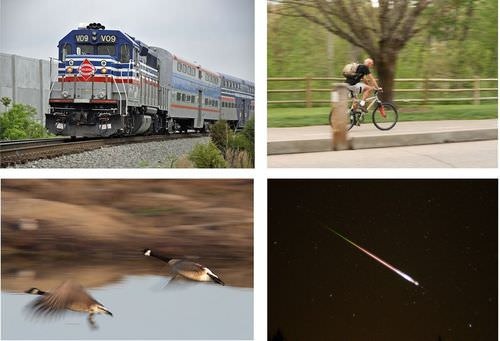
In science, motion is defined as a change in position. An object's position is its location. Besides the wings of the hummingbird in the opening image, you can see other examples of motion in the Figure below. In each case, the position of something is changing.
[Figure 2]

Q: In each picture in the Figure above, what is moving and how is its position changing?

A: The train and all its passengers are speeding straight down a track to the next station. The man and his bike are racing along a curving highway. The geese are flying over their wetland environment. The meteor is shooting through the atmosphere toward Earth, burning up as it goes.
Asemmisa {{asɛmmisaAhyɛnsode}}
1.

According to this reading, what is "motion"?

Según esta lectura, ¿qué es el "movimiento"?

Frame of Reference

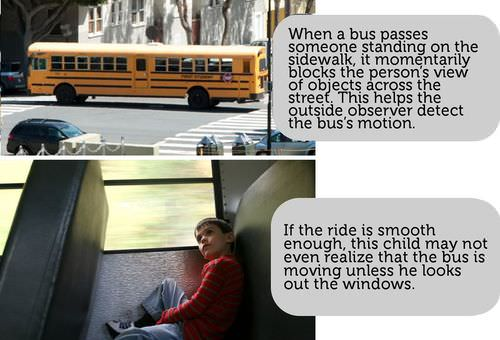
There's more to motion than objects simply changing position. You'll see why when you consider the following example. Assume that the school bus pictured in the Figure below passes by you as you stand on the sidewalk. It's obvious to you that the bus is moving, but what about the children inside the bus? The bus isn't moving relative to them, and if they look at the other children sitting on the bus, they won't appear to be moving either. If the ride is really smooth, the children may only be able to tell that the bus is moving by looking out the window and seeing you and the trees whizzing by.

[Figure 3]

This example shows that how we perceive motion depends on our frame of reference. Frame of reference refers to something that is not moving with respect to an observer that can be used to detect motion. For the children on the bus, if they use other children riding the bus as their frame of reference, they do not appear to be moving. But if they use objects outside the bus as their frame of reference, they can tell they are moving. 

Q: What is your frame of reference if you are standing on the sidewalk and see the bus go by? How can you tell that the bus is moving?

A: Your frame of reference might be the trees and other stationary objects across the street. As the bus goes by, it momentarily blocks your view of these objects, and this helps you detect the bus's motion.


Asemmisa {{asɛmmisaAhyɛnsode}}
2.

According to the reading, what is "frame of reference" within respect to motion?

Según la lectura, ¿qué es el "marco de referencia" con respecto al movimiento?

Asemmisa {{asɛmmisaAhyɛnsode}}
3.

According to the reading, how can someone stand without moving and determine that something else may be moving?

Según la lectura, ¿cómo puede alguien pararse sin moverse y determinar que algo más puede estar moviéndose?

Asemmisa {{asɛmmisaAhyɛnsode}}
4.

Distance

Distance is the length of the route between two points. The distance of a race, for example, is the length of the track between the starting and finishing lines. In a 100-meter sprint, that distance is 100 meters.

SI Unit for Distance

The SI unit for distance is the meter (m). Short distances may be measured in centimeters (cm), and long distances may be measured in kilometers (km). For example, you might measure the distance from the bottom to the top of a sheet of paper in centimeters and the distance from your house to your school in kilometers.

Using Maps to Measure Distance

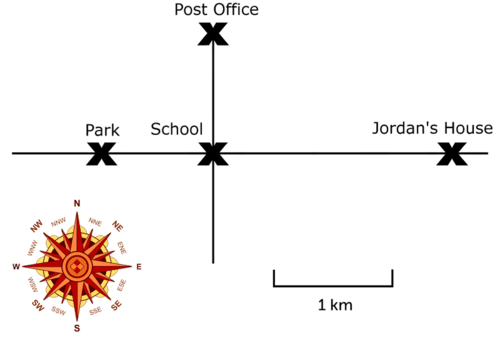
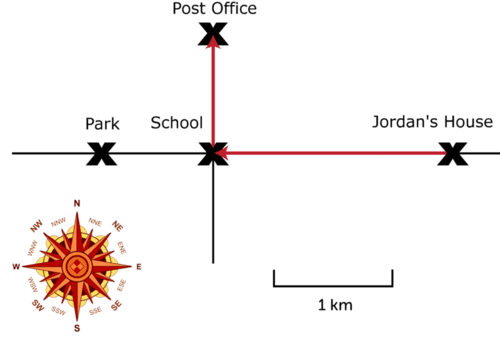
Maps can often be used to measure distance. The map in the Figure below shows the route from Jordan’s house to his school. You can use the scale at the bottom of the map to measure the distance between these two points.

[Figure 2]

Q: What is the distance from Jordan’s house to his school (don't forget the units)?

P: ¿Cuál es la distancia desde la casa de Jordan a su escuela (no olvide las unidades)?

A/R:

Asemmisa {{asɛmmisaAhyɛnsode}}
5.

According to the reading, what is "distance"?

Según la lectura, ¿qué es la "distancia"?

Asemmisa {{asɛmmisaAhyɛnsode}}
6.

According to the reading, what are some SI (metric) units for measuring distance?

Según la lectura ¿cuáles son algunas unidades SI (métricas) para medir la distancia?

Direction

Direction is the location of something relative to something else. Direction can be described in relative terms that compare the position of something to another object, such as up, down, in, out, left, right, forward, backward, or sideways. Direction can also be described with the cardinal directions: north, south, east, or west. On maps, cardinal directions are indicated with a compass rose. You can see one in the bottom left corner of the map in the Figure below. You can use the compass rose to find directions on the map. For example, to go to the school from Jordan’s house, you would travel from east to west. If you wanted to go on to the post office, you would change direction at the school and then travel from south to north.

[Figure 2]

Why Direction Is Important

Look again at the map in the Figure above. The distance from Jordan’s house to the post office is 3 km. But if Jordan told a friend how to reach the post office from his house, he couldn’t just say “go 3 kilometers.” The friend might end up at the park instead of the post office. Jordan would have to include direction as well as distance. He could say, “go west for 2 kilometers and then go north for 1 kilometer."

Asemmisa {{asɛmmisaAhyɛnsode}}
7.

According to the reading, how is direction defined in relation to position?

Según la lectura, ¿cómo se define la dirección en relación con la posición?

Asemmisa {{asɛmmisaAhyɛnsode}}
8.

According to the reading, why is it important to include direction when telling someone the distance they must travel to arrive at a destination?

Según la lectura, ¿por qué es importante incluir la dirección al decirle a alguien la distancia que debe recorrer para llegar a un destino?

Motion and Vectors

When both distance and direction are considered, motion can be represented by a vector. A vector is a measurement that has both size and direction. It may be represented by an arrow. If you are representing motion with an arrow, the length of the arrow represents distance, and the way the arrow points represents direction.

The red arrows on the map in the Figure above are vectors for Jordan’s route from his house to the school and from the school to the post office. 

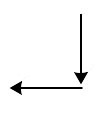
Q: How would you draw arrows to represent the distances and directions from the post office to the park on the map in the Figure above?

A: The vectors would look like this:

[Figure 3]


Asemmisa {{asɛmmisaAhyɛnsode}}
9.

According to the reading, what is a vector in the context of motion?

Según la lectura, ¿qué es un vector en el contexto del movimiento?

Speed

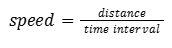
How fast or slow something moves is its speed. Speed determines how far something travels in a time interval. SI units for speed are meters per second (m/s). Speed may be constant, but often it varies from moment to moment. 

Average Speed

Even if speed varies during the course of a trip, the average speed can be calculated using this formula:

For example, assume you go on a car trip with your family. The total distance you travel is 120 miles, and it takes 3 hours to travel that far. The average speed for the trip is:

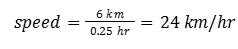
Q: Terri rode her bike very slowly to the top of a big hill. Then she coasted back down the hill at a much faster speed. The distance from the bottom to the top of the hill is 3 kilometers. It took Terri ¼ hour to make the round trip. What was her average speed for the entire trip? (Hint: The round-trip distance is 6 km.)

A: Terri’s speed can be calculated as follows:

Instantaneous Speed

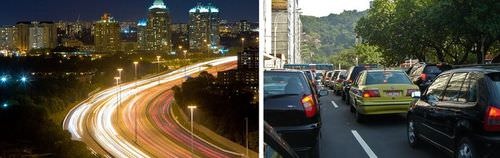
When you travel by car, you usually don’t move at a constant speed. Instead you go faster or slower depending on speed limits, traffic lights, the number of vehicles on the road, and other factors. For example, you might travel 65 miles per hour on a highway but only 20 miles per hour on a city street (see the pictures in the Figure below.) You might come to a complete stop at traffic lights, slow down as you turn corners, and speed up to pass other cars. Therefore, your speed at any given instant, or your instantaneous speed, may be very different than your speed at other times. Instantaneous speed is much more difficult to calculate than average speed. 

[Figure 2] Cars race by in a blur of motion on an open highway but crawl at a snail’s pace when they hit city traffic.

Asemmisa {{asɛmmisaAhyɛnsode}}
10.

According to the reading, what two things are required in order to determine something's speed?

Según la lectura, ¿qué dos cosas se requieren para determinar la velocidad de algo?

Asemmisa {{asɛmmisaAhyɛnsode}}
11.

According to the reading, how is instantaneous speed different than average speed?

Según la lectura, ¿en qué se diferencia la velocidad instantánea de la velocidad promedio?

Calculating Distance or Time from Speed

If you know the average speed of a moving object, you can calculate the distance it will travel in a given period of time or the time it will take to travel a given distance. To calculate distance from speed and time, use this version of the average speed formula given above:

For example, if a car travels at an average speed of 60 km/h for 5 hours, then the distance it travels is:

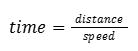
To calculate time from speed and distance, use this version of the formula:

Q: If you walk 6 km at an average speed of 3 km/h, how much time does it take?

A: Use the formula for time as follows: