Copy of 3.) Speed and Distance ver. 1 (5/28/2026)
star
star
star
star
star
Last updated 3 months ago
18 Nsɛmmisa
Section 1A
1
1
1
1
1
1
1
7
0
Section 1B
1
1
1
1
1
1
1
7
0
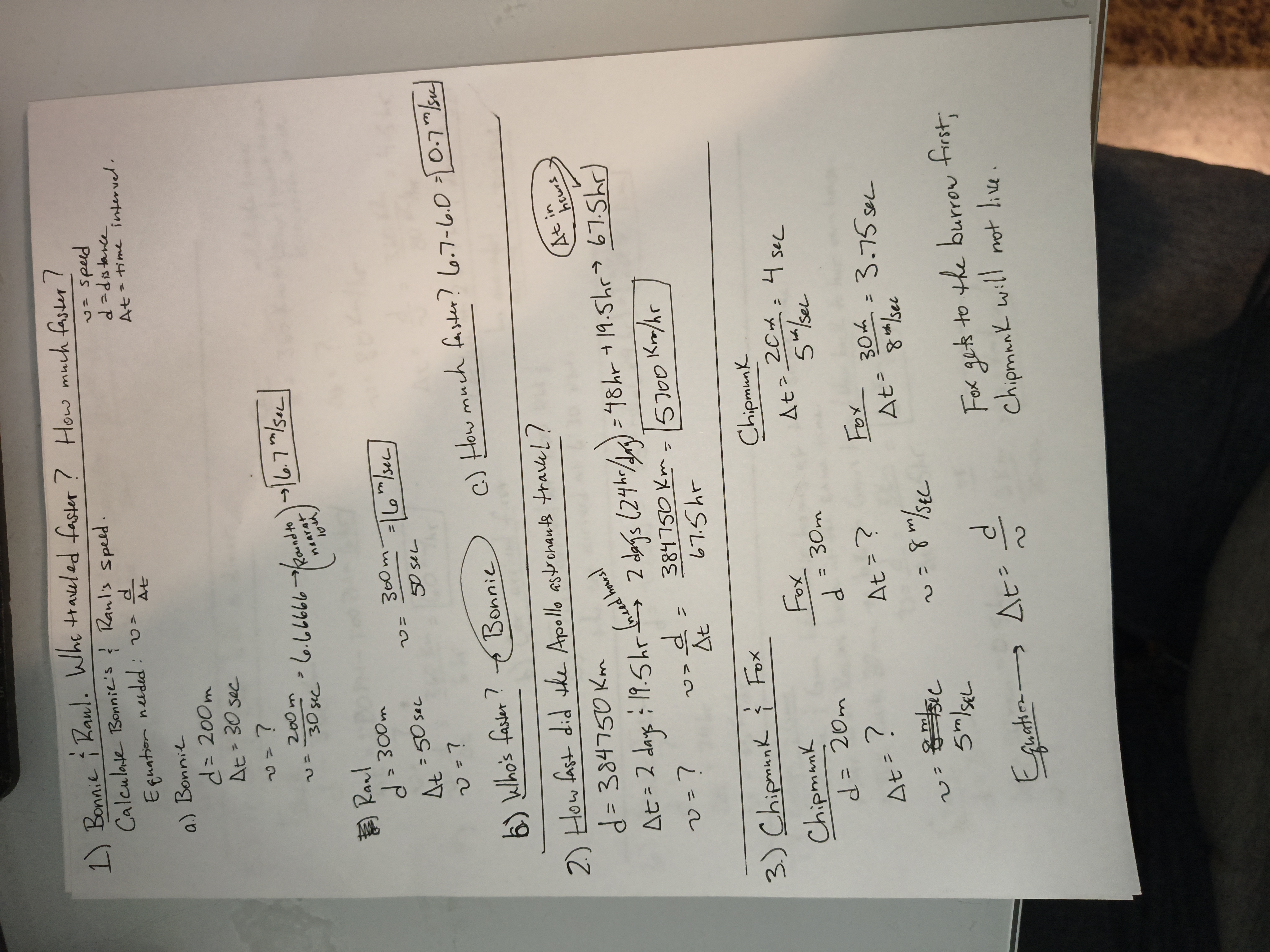
Bonnie rode her skateboard 200 m in 30 sec. Raul rode his bicycle 300 m in 50 sec.
Bonnie montó su patineta 200 m en 30 s. Raúl montó su bicicleta 300 m en 50 s.
a.) Speed (Velocidad): Bonnie =
b.) Who traveled faster? (¿Quién viajó más rápido?)
c.) How much faster? (¿Cuánto más rápido?)
It is approximately 384,750 km from the Earth to the Moon. It took the Apollo astronauts approximately 2 days and 19.5 hours to fly to the Moon. How fast did they travel?
Está aproximadamente a 384,750 km de la Tierra a la Luna. A los astronautas del Apolo les tomó aproximadamente 2 días y 19.5 horas volar a la Luna. ¿Qué tan rápido viajaron?
a.) Time Interval in hours (Intervalo de tiempo en horas.) =
b.) Speed (Velocidad) =
A chipmunk can run 5 m/sec and a fox can run 8 m/sec. If a chipmunk and fox start running at the same time, will the chipmunk make it safely to its burrow in time (before the fox eats it)?
Una ardilla listada puede correr 5 m/s y un zorro puede correr 8 m/s. Si una ardilla listada y un zorro comienzan a correr al mismo tiempo, ¿llegará la ardilla a su madriguera a salvo a tiempo (antes de que el zorro se la coma)?
 a. Which equation do you need? (¿Qué ecuación necesitas?)
b. Chipmunk (Ardilla listada)
c. Fox (Zorro)
d. Will the chipmunk live? (¿Sobrevivirá la ardilla?)
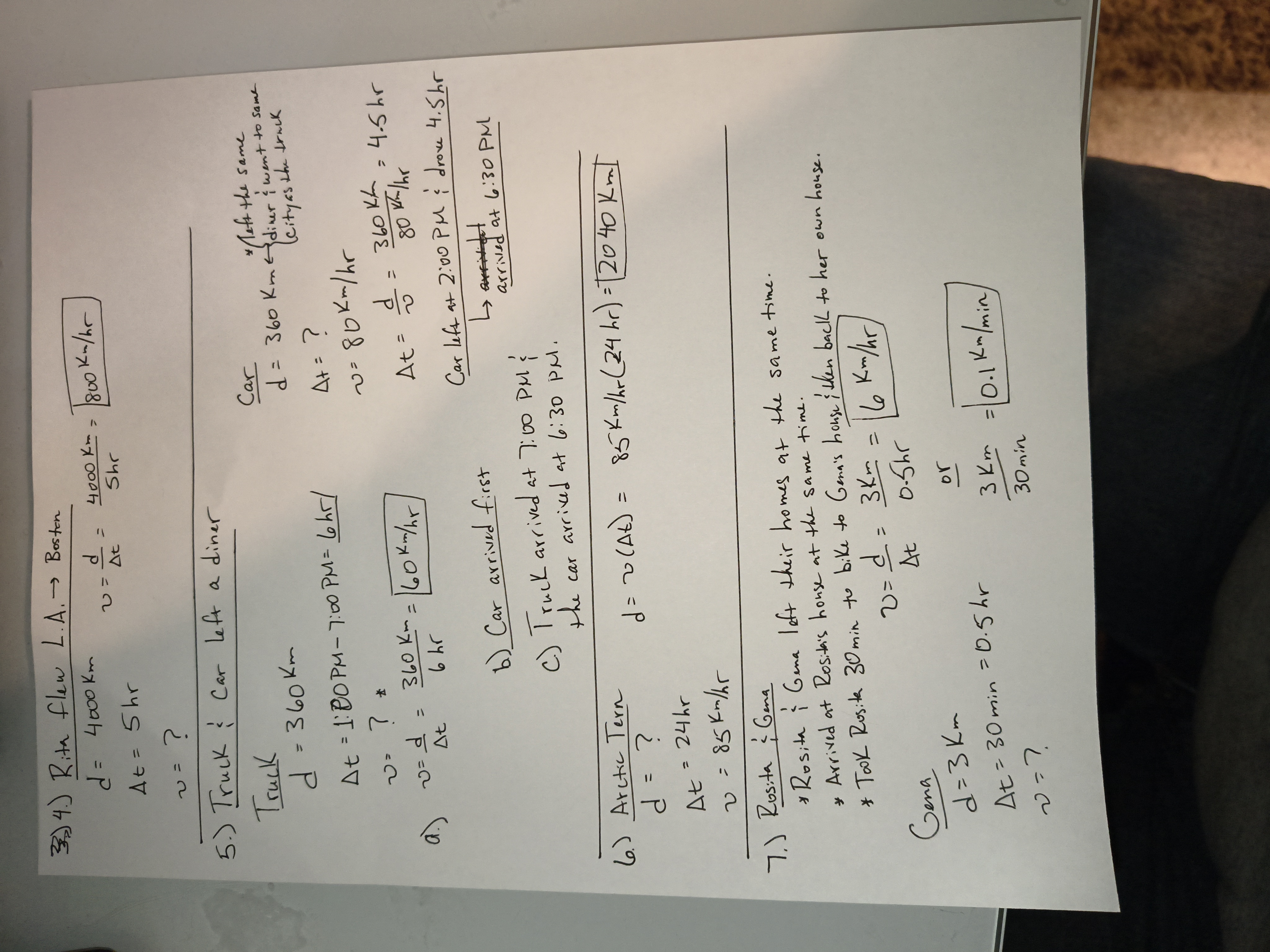
Rita flew from Los Angeles to Boston to visit her aunt, a distance of 4000 km. The trip took 5 hours (hr). What was the average speed of the jet?
Rita voló de Los Ángeles a Boston para visitar a su tía, una distancia de 4000 km. El viaje tomó 5 horas. ¿Cuál fue la velocidad promedio del jet?
A truck left a diner at 1:00 PM and drove 360 km to Jersey City. The truck arrived at 7:00 PM. A car left the same diner at 2:00 PM and drove to Jersey City at an average speed of 80 km/hr.
Un camión salió de un restaurante a la 1:00 PM y condujo 360 km hasta Jersey City. El camión llegó a las 7:00 PM. Un automóvil salió del mismo restaurante a las 2:00 PM y condujo a Jersey City a una velocidad promedio de 80 km/h.
a.) How fast did the truck travel? (¿Qué tan rápido viajó el camión?)
b.) Which vehicle reached Jersey City first? (¿Qué vehículo llegó a Jersey City primero?)
c.) How do you know the answer to b? (¿Cómo sabes la respuesta a la b?)
An Arctic Tern can fly 85 km/hr for 24 hours without stopping. How far can it fly before landing?
Un chorlito ártico puede volar a 85 km/h durante 24 horas sin parar. ¿Cuán lejos puede volar antes de aterrizar?
a.) What are you solving for? (¿Qué estás resolviendo?)
b.) How far does it fly? (¿Cuán lejos vuela?)
Rosita started riding her bike 3 km to her friend Gena's place at exactly the same time Gena started skating to Rosita's house. Gena, of course wasn't home, so Rosita rode back home. The two girls arrived at Rosita's house at the same time. It took Rosita 30 minutes to ride to Gena's and back. How fast did Gena skate in km/hr?
Rosita comenzó a montar su bicicleta 3 km a casa de su amiga Gena exactamente al mismo tiempo que Gena comenzó a patinar hacia la casa de Rosita. Gena, por supuesto, no estaba en casa, así que Rosita regresó a casa. Las dos chicas llegaron a la casa de Rosita al mismo tiempo. A Rosita le tomó 30 minutos ir a casa de Gena y volver. ¿Qué tan rápido patinó Gena en km/h?
 Gena's time interval (Intervalo de tiempo de Gena)
Gena's speed (Velocidad de Gena)
Take an image of your paper with all of the math for questions 1-7 worked out.
Toma una imagen de tu papel con todos los cálculos para las preguntas 1-7 resueltas.
If you used two sheets of paper or two sides to your paper, put side 2 here.
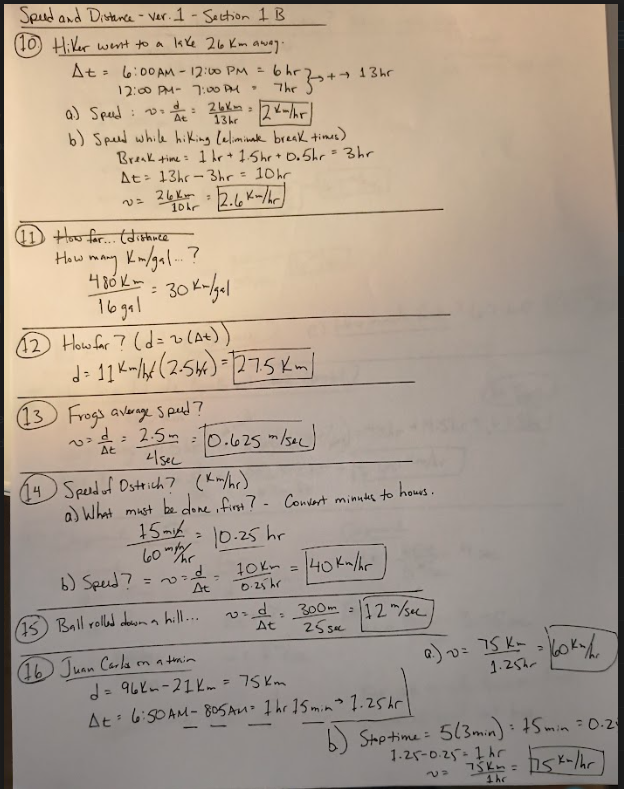
A hiker wanted to hike to a lake 26 km from the end of the road.
Una excursionista quería caminar hasta un lago que está a 26 km del final del camino.
She began walking at 6:00 AM and continued until 9:00 AM. She stopped for a 1 hour rest and then continued until stopping for 1.5 hour to have lunch. She took one more rest for 0.5 hour in the afternoon. At 7:00 PM, the hiker finally arrived at the lake.
Comenzó a caminar a las 6:00 AM y continuó hasta las 9:00 AM. Se detuvo por una hora de descanso y luego continuó hasta detenerse por 1.5 horas para almorzar. Tomó un descanso más de 0.5 horas en la tarde. A las 7:00 PM, la excursionista finalmente llegó al lago.
a.) What was her average speed from the end of the road to the lake?
a.) ¿Cuál fue su velocidad promedio desde el final del camino hasta el lago?
b.) What was her average speed while she was actually hiking?
b.) ¿Cuál fue su velocidad promedio mientras realmente estaba caminando?
Joachim put 16 gallons (gal) of gas in his truck and reset the odometer to 0 km. He drove until he ran out of gas. The odometer read 480 km. How many kilometers per gallon does Ron's truck get?
Joachim puso 16 galones de gasolina en su camión y reinició el odómetro a 0 km. Condujo hasta que se quedó sin gasolina. El odómetro marcaba 480 km. ¿Cuántos kilómetros por galón obtiene el camión de Ron?
Isabel's scooter is able to travel 11 km/hr. How far can she go in 2.5 hours of driving the scooter?
El scooter de Isabel puede viajar a 11 km/h. ¿Cuán lejos puede ir en 2.5 horas conduciendo el scooter?
A grand champion jumping frog can jump 2.5 m every 4 seconds. What is the frog's average speed?
Una rana saltadora campeona puede saltar 2.5 m cada 4 segundos. ¿Cuál es la velocidad promedio de la rana?
An ostrich can run 10 kilometers in 15 minutes. What is the speed of the ostrich in km/hr?
Un avestruz puede correr 10 kilómetros en 15 minutos. ¿Cuál es la velocidad del avestruz en km/h?
a.) What must you do before you can calculate speed?
¿Qué debes hacer antes de poder calcular la velocidad?
b.) Speed (Velocidad)
A ball rolled 300 m down a hill in 25 sec. What was the average speed of the ball as it rolled down the hill?
Una pelota rodó 300 m cuesta abajo en 25 s. ¿Cuál fue la velocidad promedio de la pelota mientras rodaba cuesta abajo?
Juan Carlos got on a train at Oakdale station at 6:50 AM. He got off at the Metro Station at 8:05 AM. The train made five stops of 3 minutes, each, along the way. Oakdale Station is 21 km from the end of the line and Metro Station is 96 km from the end of the line.
Juan Carlos se subió a un tren en la estación de Oakdale a las 6:50 AM. Se bajó en la estación de Metro a las 8:05 AM. El tren hizo cinco paradas de 3 minutos cada una en el camino. La estación de Oakdale está a 21 km del final de la línea y la estación de Metro está a 96 km del final de la línea.

a.) What was Juan Carlos' average speed while on the train?
a.) ¿Cuál fue la velocidad promedio de Juan Carlos mientras estaba en el tren?
b.) What was the train's average speed while it was actually moving?
b.) ¿Cuál fue la velocidad promedio del tren mientras estaba realmente en movimiento?
Take an image of your paper with all of the math for questions 9-15 worked out.
Toma una imagen de tu papel con todos los cálculos para las preguntas 9-15 resueltas.
If you used two sheets of paper or two sides to your paper, put side 2 here.