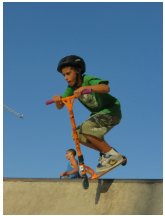
Jean has been riding a scooter for almost as long as he can remember. As you can see, he’s really good at it. He can even do tricks in the air. It takes a lot of practice to be able to control a scooter like this. Jean automatically applies just the right forces to control his scooter.
Force is defined as a push or pull acting on an object. There are several fundamental forces in the universe, including the force of gravity, electromagnetic force, and weak and strong nuclear forces. When it comes to the motion of everyday objects, however, the forces of interest include mainly gravity, friction, and applied force. Applied force is force that a person or thing applies to an object.
Q: What forces act on Jean’s scooter?
A: Gravity, friction, and applied forces all act on Jean’s scooter.
Gravity keeps pulling both Jean and the scooter toward the ground. Friction between the wheels of the scooter and the ground prevent the scooter from sliding but also slow it down. In addition, Jean applies force to his scooter to control its speed and direction.
Define, force.
List the fundamental forces in the universe.
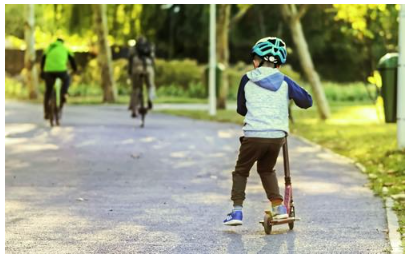
Forces cause all motions. Every time the motion of an object changes, it’s because a force has been applied to it. Force can cause a stationary object to start moving or a moving object to change its speed or direction or both. A change in the speed or direction of an object is called acceleration. Look at Jean’s brother Gordon in the Figure below. He’s getting his scooter started by pushing off with his foot. The force he applies to the ground with his foot starts the scooter moving in the opposite direction. The harder he pushes against the ground, the faster the scooter will go.

How much an object accelerates when a force is applied to it depends not only on the strength of the force but also on the object’s mass. For example, a heavier scooter would be harder to accelerate. Gordon would have to push with more force to start it moving and move it faster.
Q: What units do you think are used to measure force?
A: The SI unit for force is the Newton (N).
A Newton is the force needed to cause a mass of 1 kilogram to accelerate at 1
, so a Newton equals . The Newton was named for the scientist Sir Isaac Newton, who is famous for his laws of motion and gravity.How do forces influence the motion of objects, and what term is used to describe changes in speed or direction?
How does the mass of an object affect changing something's speed or direction?
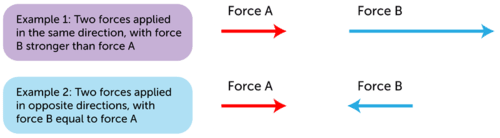
Force is a vector, or a measure that has both size and direction. For example, Gordon pushes on the ground in the opposite direction that the scooter moves, so that’s the direction of the force he is applying. He can give the scooter a strong push or a weak push. That’s the size of the force. Like other vectors, a force can be represented with an arrow. You can see some examples in the Figure below. The length of each arrow represents the strength of the force, and the way the arrow points represents the direction of the force.

Q: How could you use arrows to represent the forces that start Gordon’s scooter moving?
A: Gordon pushes against the ground behind him (to the right in the Figure above). The ground pushes back with equal force to the left, causing the scooter to move in that direction. Force arrows A and B (in example 2 in the Figure above) could represent these forces.
What does it mean for force to be a vector, and how can its size and direction be represented?
In a tug of war competition, two teams are pulling the rope in opposite directions. Which team do you think will win? It depends on which side pulls on the rope with the greatest force. As this example shows, more than one force may act on an object at the same time. Would it surprise you to learn that at least two different forces are acting on you as you read this article? Can you guess what they are?
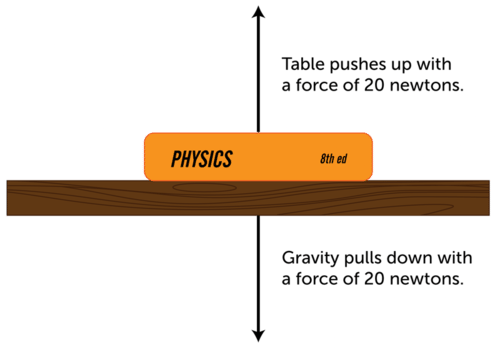
One force acting on you—and all the other objects on Earth—is gravity. Look at the physics book in the Figure below. Gravity pulls the book downward with a force of 20 Newtons. Why doesn’t the book fall to the ground? The table pushes upward on the book with the same amount of force. The combined force, or net force, acting on the book is 0 Newtons. That’s because upward and downward forces are balanced, so they cancel out.

What determines which team will win in a tug of war?
Why doesn’t the book in the example above fall to the ground?
In general, whenever forces act on an object in opposite directions—like the book on the table—the net force is equal to the difference between the two forces. In other words, one force is subtracted from the other to calculate the net force. If the opposing forces are equal, or balanced, the net force is zero, as it is for the book. That’s why the book doesn’t fall to the ground but instead remains resting on the table. However, if the opposing forces are unbalanced, the net force is greater than zero, although it will be less than either of the individual forces. In this case, the object will move in the same direction as the net force.
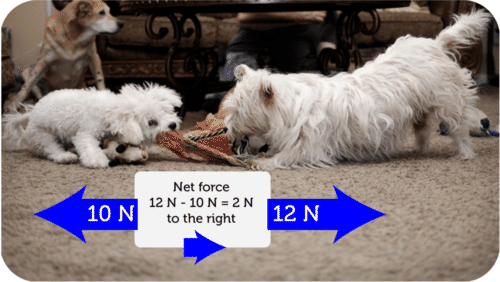
Look at the dogs playing tug-of-war in the Figure below. The dogs are pulling the rope in opposite directions, but one dog is pulling with more force than the other. The net force acting on the rope is 2 Newtons to the right, so the rope will move to the right.

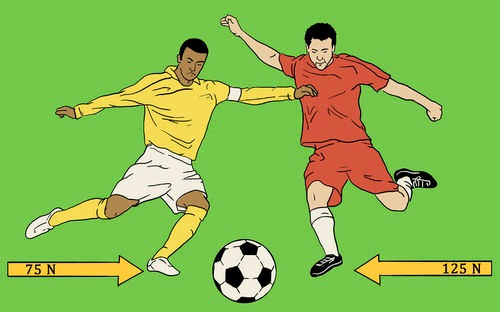
Q: The boys in the Figure below are about to kick the soccer ball in opposite directions. What will be the net force on the ball? In which direction will the ball move?

A: The net force on the ball will be 50 N to the left (125 N – 75 N = 50 N), so the ball will move to the left.
How is the net force calculated when multiple forces are acting on an object in opposite directions?
If a soccer ball is kicked 100 N to the right and 101 N to the left, which way will the ball go (show you calculation)?
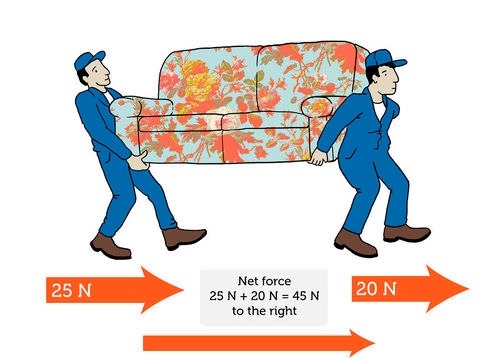
If two forces act on an object in the same direction, the net force is equal to the sum of the two forces. This always results in a stronger force than either of the individual forces alone. In the Figure below, after the man on the left picks up the couch, he will push the couch to the right with a force of 25 Newtons, and the man on the right will pull the couch to the right with a force of 20 Newtons. The net force on the couch is 45 Newtons to the right, so that’s the way the couch will move.

When two forces act on an object in the same direction, how is the net force calculated?
Did you ever rub your hands together to warm them up, like the young man in the opening image? Why does this make your hands warmer? The answer is friction.
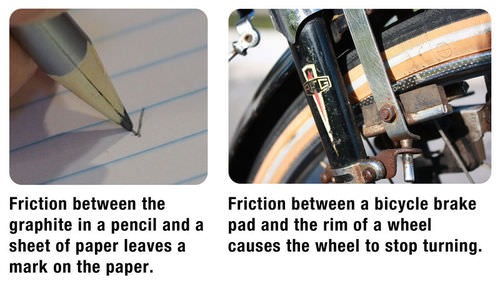
Friction is a force that opposes motion between any surfaces that are touching. Friction can work for or against us. For example, putting sand on an icy sidewalk increases friction so you are less likely to slip. On the other hand, too much friction between moving parts in a car engine can cause the parts to wear out. Other examples of friction are illustrated in the two Figures below.

What is friction?
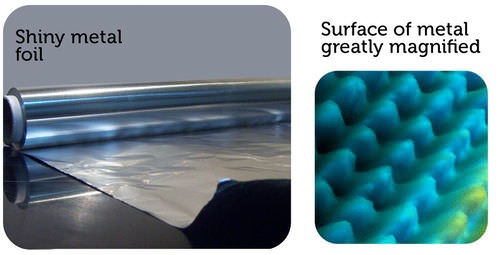
Friction occurs because no surface is perfectly smooth. Even surfaces that look smooth to the unaided eye may look rough or bumpy when viewed under a microscope. Look at the metal surfaces in the Figure below. The aluminum foil is so smooth that it's shiny. However, when highly magnified, the surface of metal appears to be very bumpy. All those mountains and valleys catch and grab the mountains and valleys of any other surface that contacts the metal. This creates friction.

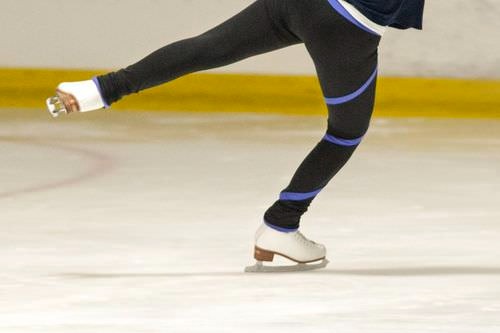
Friction is affected by the roughness of surfaces and the strength of the force pushing them together. Rougher surfaces have more friction between them than smoother surfaces. That's why we put sand on icy sidewalks and roads. You can't slide as far across ice with shoes as you can on the blades of skates (see Figure below). The rougher surface of the soles of the shoes causes more friction and slows you down. Friction can be reduced by making the surfaces smoother; for example, if the surfaces are rough wood, then sanding the surfaces can make them smoother. Using an oily or greasy substance called a lubricant between surfaces can reduce friction as it creates a smoother layer between the surfaces

Q: Heavier objects also have more friction. Can you explain why?
A: Heavier objects press together with greater force, and this causes greater friction between them. Have you ever tried to push furniture across the floor? It's harder to overcome friction between a heavier piece of furniture and the floor than between lighter pieces and the floor.
How do the roughness of surfaces and the weight of an object affect the amount of friction experienced?