Přejít k hlavnímu obsahu
Přihlásit se
Sign up for FREE
arrow_back
Knihovna

Copy of 1.) Introduction to Thermal Energy (5/28/2026)

star
star
star
star
star
Poslední aktualizace about 1 month ago
15 Dotazy
Poznámka od autora:

This is an introduction into thermal energy.

  • It's a mix of short pieces of readings and very short videos.

  • All questions are answered in the reading or in the videos.

There is audio of each section of reading at either the bottom or top of each section (I couldn't get it to move after formative posted it).

  • If you use it, follow along with the reading.

La Lectura en Español - https://docs.google.com/document/d/1HDm47ObHFnJ-IhmK_iVka1CRjPcnnH82QPHeQjFauZ8/edit?usp=sharing

This is an introduction into thermal energy.

  • It's a mix of short pieces of readings and very short videos.

  • All questions are answered in the reading or in the videos.

There is audio of each section of reading at either the bottom or top of each section (I couldn't get it to move after formative posted it).

  • If you use it, follow along with the reading.

La Lectura en Español - https://docs.google.com/document/d/1HDm47ObHFnJ-IhmK_iVka1CRjPcnnH82QPHeQjFauZ8/edit?usp=sharing

Thermal Energy

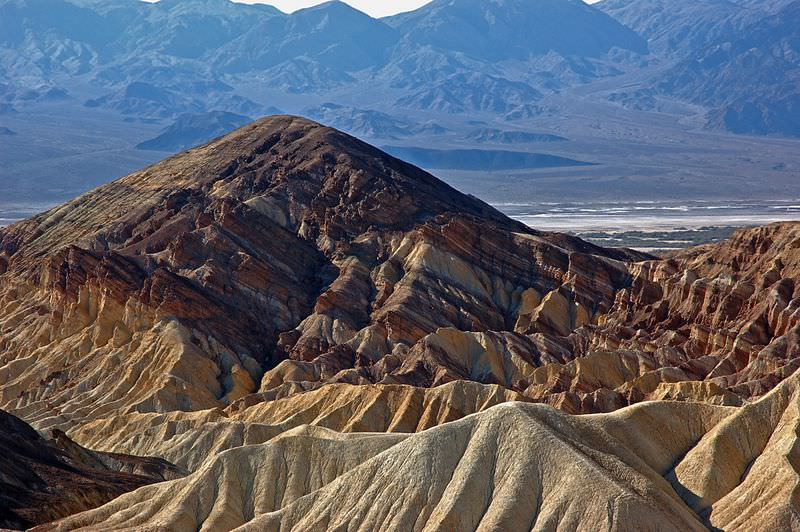
This unusual landscape is found in the hottest place in the U.S. — Death Valley, California. The temperature of the air near the ground can be as high as 57 °C (134 °F) — and that’s in the shade (if you can find any)! The temperature of the sand in the baking sun can be much higher. If you were to walk barefoot on the hot sand, it would burn your feet. The air and sand in Death Valley have a lot of thermal energy.

What Is Thermal Energy?

Why do the air and sand of Death Valley feel so hot? It’s because their particles are moving very rapidly. Anything that is moving has kinetic energy, and the faster it is moving, the more kinetic energy it has. The total kinetic energy of moving particles of matter is called thermal energy. It’s not just hot things such as the air and sand of Death Valley that have thermal energy. All matter has thermal energy, even matter that feels cold. That’s because the particles of all matter are in constant motion and have kinetic energy.


1
Otázka 1a
1a.

Thermal energy is related to another form of energy, the that is found in moving particles.

1
Otázka 1b
1b.

Thermal energy is found in all , because its particles are constantly in even when it is cold.

Thermal Energy, Temperature, and Mass

Thermal energy and temperature are closely related. Both reflect the kinetic energy of moving particles of matter. However, temperature is the average kinetic energy of particles of matter, whereas thermal energy is the total kinetic energy of particles of matter. Does this mean that matter with a lower temperature has less thermal energy than matter with a higher temperature? Not necessarily. Another factor also affects thermal energy, that is mass.

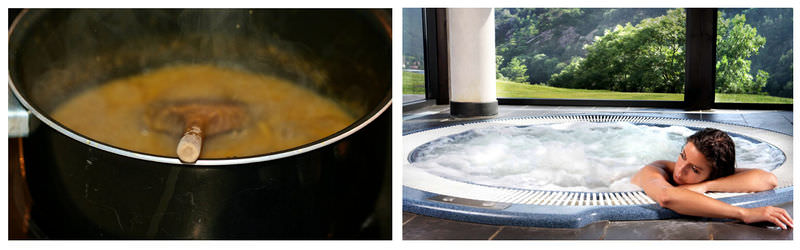
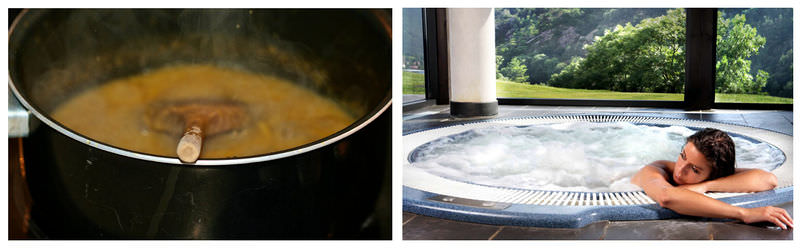
Look at the pot of soup and the tub of water in the Figure below. Which do you think has greater thermal energy? The soup is boiling hot and has a temperature of 100 °C, whereas the water in the tub is just comfortably warm, with a temperature of about 38 °C. Although the water in the tub has a much lower temperature, it has greater thermal energy.


1
Otázka 2a
2a.

What factors impact thermal energy?

1
Otázka 2b
2b.

What is the primary difference between temperature and thermal energy?

The particles of soup have greater average kinetic energy than the particles of water in the tub, explaining why the soup has a higher temperature. However, the mass of the water in the tub is much greater than the mass of the soup in the pot. This means that there are many more particles of water than soup. All those moving particles give the water in the tub greater total kinetic energy, even though their average kinetic energy is less. Therefore, the water in the tub has greater thermal energy than the soup. 

Could a block of ice have more thermal energy than a pot of boiling water? Yes, the block of ice could have more thermal energy if its mass was much greater than the mass of the boiling water.


1
Otázka 3a
3a.

Which of the following would have greater temperature?

1
Otázka 3b
3b.

Briefly explain why your answer to 3a is true.

I must grade this, do your best on it and then move on.

Question 4
01:42
keyboard_arrow_down
5
Otázka 4
4.

Use the short video to help you answer these questions:

a.) Even though mountains are icy and cold, their molecules still have .

b.) Even cold things will have , although it may be very low.

c.) Which has more heat energy: a burning match or an ice sculpture? . Why is this this so? The ice sculpture has more than the match, meaning it has more mass.

d.) More molecules (more mass) =

Temperature

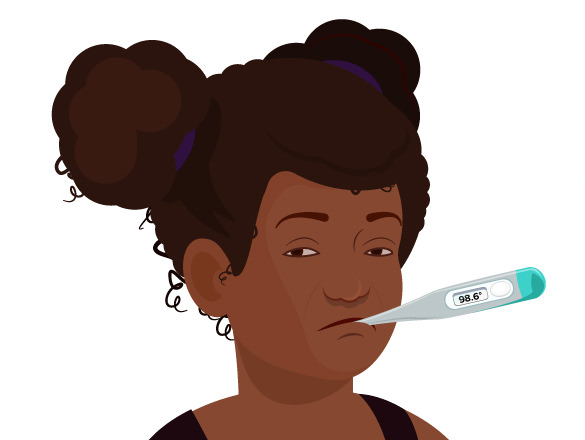
This girl has a fever, and it makes her feel miserable. She feels achy and really tired. She also feels hot because her temperature is higher than normal. She has a thermometer in her mouth to measure her temperature.

What Is Temperature?

No doubt you already have a good idea of what temperature is. You might say that it’s how warm or cool something feels. In physics, temperature is defined as the average kinetic energy of the particles of matter. When particles of matter move more quickly, they have more kinetic energy, so the temperature of the matter is higher. With a higher temperature, matter feels warmer. When particles move more slowly, they have less kinetic energy on average, so the temperature of the matter is lower. With a lower temperature, matter feels cooler.

1
Otázka 5a
5a.

The average kinetic energy of molecules (particles) in motion is known as .

2
Otázka 5b
5b.

As the temperature increases, the also increases; as the average kinetic energy decreases, the also decreases.

1
Otázka 5c
5c.

When particles move with more speed, they will have temperature; when they move with less speed, they will have temperature.

How Thermometers Measure Temperature

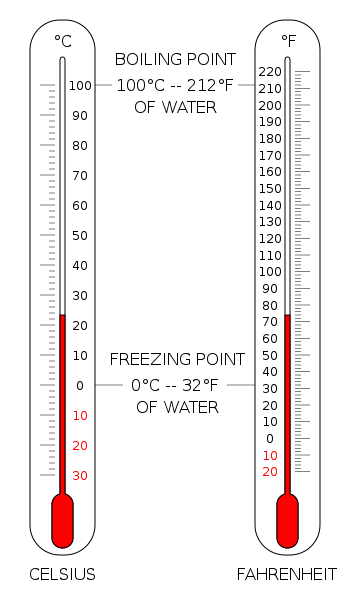
Many thermometers measure temperature with a liquid that expands when it gets warmer and contracts when it gets cooler. Look at the common household thermometer pictured in the Figure below. The red liquid rises or falls in the glass tube as the temperature changes. Temperature is read off the scale at the height of the liquid in the tube.

Why does the liquid in the thermometer expand and contract when temperature changes? When the temperature is higher, particles of the liquid have greater kinetic energy, so they move about more and spread apart. This causes the liquid to expand. The opposite happens when the temperature is lower and particles of liquid have less kinetic energy. The particles move less and crowd closer together, causing the liquid to contract.

1
Otázka 6a
6a.

What causes the fluid in a thermometer to move upward as the temperature increases?

I must grade this, do your best on it and then move on.

Temperature Scales

The thermometer pictured in the Figure above measures temperature on two different scales: Celsius (C) and Fahrenheit (F). Although some scientists use the Celsius scale, the SI scale for measuring temperature is the Kelvin scale. If you live in the U.S., you are probably most familiar with the Fahrenheit scale. The Table below compares all three temperature scales. Each scale uses as reference points the freezing and boiling points of water. Notice that temperatures on the Kelvin scale are not given in degrees (°).

Scale

Freezing Point of Water

Boiling Point of Water

Kelvin

273 K

373 K

Celsius

0 °C

100 °C

Fahrenheit

32 °F

212 °F

Because all three temperature scales are frequently used, it’s useful to know how to convert temperatures from one scale to another. It’s easy to convert temperatures between the Kelvin and Celsius scales. Each 1-degree change on the Kelvin scale is equal to a 1-degree change on the Celsius scale. Therefore, to convert a temperature from Celsius to Kelvin, just add 273 to the Celsius temperature or subtract 273 from the Kelvin scale. For example, 10 °C equals 283 Kelvin.


1
Otázka 7a
7a.

Which of the following is a unit for measuring temperature?

Question 8
01:38
keyboard_arrow_down
6
Otázka 8
8.

Use the video to answer the following:

a.) Within science, the most common temperature scale is .

b.) In the US, the most common temperature scale is .

c.) Boiling point of water is oC or oF.

d.) -273oC is known as.

e.) The lowest measurement on the Kelvin scale is K.

Take Notes on the Conversion Formula and the Examples:

Q: How would you convert a temperature from Kelvin to Celsius?

A: You would subtract 273 from the Kelvin temperature. For example, a temperature of 300 Kelvin equals 27 °C.

Converting between Celsius and Fahrenheit is more complicated. The following conversion factors can be used:

Celsius → Fahrenheit: (°C × 1.8) + 32 = °F

Fahrenheit → Celsius: (°F - 32) ÷ 1.8 = °C

For example, to convert 10 °C to Fahrenheit, use the first conversion factor:

10 °C → °F = (10 °C × 1.8) + 32 = 50 °F

Q: The weather forecaster predicts a high temperature today of 86 °F. What will the temperature be in Celsius?

A: To convert 86 °F to Celsius, use the second conversion factor:

86 °F → °C = (86 °F – 32) ÷ 1.8 = 30 °C


1
Otázka 9a
9a.

Using the steps above, convert 68oF to Celsius. oC

1
Otázka 9b
9b.

Using the steps above, convert 25oC to Fahrenheit. oF