Přejít k hlavnímu obsahu
Přihlásit se
Sign up for FREE
arrow_back
Knihovna

Copy of 4.) Specific Heat Virtual Lab (5/28/2026)

star
star
star
star
star
Poslední aktualizace about 1 month ago
11 Dotazy
Part 1 - Definitions and Data
Part 2 - Discussion
15
Otázka 2
2.

Discussion

The discussion is where you analyze and interpret your results.

Required elements for a perfect score - must be in your own words (just do your best).

  • Restate your hypothesis, summarize what your experiment was about, and the most important findings.

  • Explain how your results relate to hypothesis. If your results contradict what you hypothesized, try to explain why. Use data in your explanations.

    • Do not alter your hypothesis to match what the data reveals - be honest - you do not lose points if your hypothesis was incorrect, but you will lose points if you change your hypothesis.

  • Describe the relationship you observed between your independent and dependent variables.

This must be in your own words - just do your best - but please discuss all that is required.

We will talk about this, as a class, once we collect all the data. But you must do your own work.

Things you should discuss:

  1. Talk about what specific heat is - redefine it and explain practically what that might mean when comparing two different substances of the same volume being heated the same way.

  2. Talk about the specific heat of water and olive oil and then talk about how much time, on average, it took each to reach 100 degrees C.

  3. Apply what specific heat is to the data in #2 (just above) - how are they related?

  4. Discuss how your hypothesis was or was not accurate? Why were you accurate or why were you inaccurate?

  5. Discuss the variables - discuss why it was important for the volumes to be equal - how does mass impact thermal energy?

  6. Conclusion - summarize the data, the data's relationship to your hypothesis and specific heat.

Post-Lab Work
0
1
Otázka 1a
1a.

Define: Thermal Energy

1
1
1
1
5
Otázka 1f
1f.
2
3
5
Otázka 3
3.

After the lab, I will be working on:

Otázka 1b
1b.

Define: Temperature

Otázka 1c
1c.

Define: Heat

Otázka 1d
1d.

Define: Specific Heat

Otázka 1e
1e.

Explain the mathematical process to determine the mean of a set of numerical values.

Do an internet search to find this information for each substance.

Before you move on the next section - I must ensure your responses are accurate - I will tell you in the feedback when I have verified them or what you need to change.

Substance

Specific Heat

(J/goC)

Density

(g/cm3)

Boiling Point

(oC)

Water(l)

Olive Oil

Otázka 1g
1g.

Research Question - Will olive oil or liquid water heat faster? (Do not look this up; use the information in the data table above to assist you.)

Hypothesis: Type out a one-sentence statement regarding which liquid you believe will heat the fastest. (Do not look this up.)

Use this form: "When equal volumes of olive oil and liquid water are heated at the same rate, _____ will heat faster than _____."

After the first section of the lab is complete, do not change this.

Otázka 1h
1h.

Defining Variables for the Research Question (Will olive oil or liquid water heat faster?)

  • Independent Variable (what is changed)

  • Dependent Variable (what is being measured)

  • Controls (what will remain constant)

Simulation Directions

  1. Click the "Intro" icon to begin the simulation.

  2. Place the water and olive oil beakers on the stands by clicking and dragging them there.

  3. Click "Link Heaters" in the upper-right blue box - this will make sure that each heat source delivers the same amount of energy per second.

  4. Click and drag the thermometer (upper-left corner blue box) into the beaker of water and olive oil - if the left-facing arrow changes into the same color as the substance, then it is placed correctly.

  5. You will be timing how many seconds it takes to heat each substance to 100oC; we will perform three trials of this, averaging (mean) the time for each substance.

  6. Use the stopwatch below the simulation to track the time. Click "start" when you begin a trial, when the first substance reaches 100oC, click "Lap" and that time will be saved as "Lap 1" but the timer will continue, when the second substance reaches 100oC click "Stop" and record each time in the data table under the stopwatch.
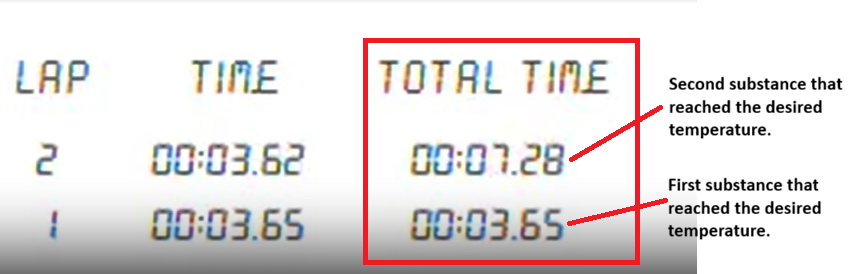
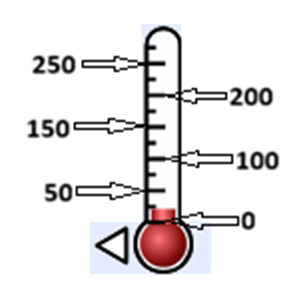
  7. Each major tic-mark on the thermometer is equivalent to 50oC (see below image).

  8. Apply heat by clicking and dragging one of the controls on one of the linked heaters to "Heat".

  9. Record all data in the table below the simulation.

  10. Click the reset button in the bottom-right between each trial.

  11. Repeat the above instructions to set-up each new trial and collect the data.

  12. When three trials have been completed and the data has been recorded, use the calculator to the right to find the mean time to reach 100oC in seconds for each substance.
    How to calculate mean - https://www.mathsisfun.com/mean.html

Otázka 1i
1i.

Table 1 - Time in seconds for olive oil and water to reach 100°C in the simulator.

Transfer the specific heat of each from 1a (very top of this).

Specific Heat

(J/g°C)

Trial 1

Time (sec)

Trial 2

Time (sec)

Trial 3

Time (sec)

Mean Time

(sec)

Water(l)

Olive Oil