If you are doing this as late work, any correct answers provided on your first attempt (if there was a first attempt) will be saved on your second attempt.

A lightning bolt is like the spark that gives you a shock when you touch a metal doorknob. Of course, the lightning bolt is on a much larger scale. But both the lightning bolt and spark are a sudden transfer of electric charge.
Introducing Electric Charge
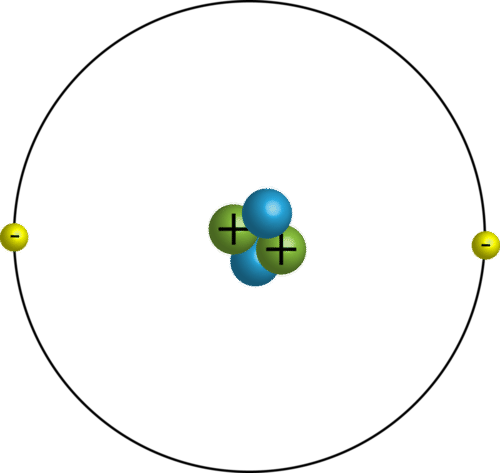
Electric charge is a physical property of particles or objects that causes them to attract or repel each other without touching. All electric charge is based on the protons and electrons in atoms. A proton has a positive electric charge, and an electron has a negative electric charge. In the Figure below, you can see that positively charged protons (+) are located in the nucleus of the atom, while negatively charged electrons (-) move around the nucleus.
Electric Force
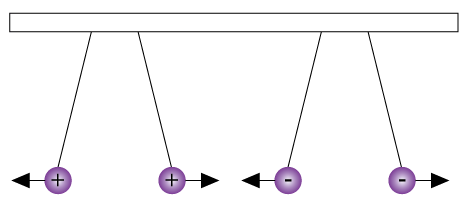
When it comes to electric charges, opposites attract, so positive and negative particles attract each other. You can see this in the Figure below. This attraction explains why negative electrons keep moving around the positive nucleus of the atom. Like charges, on the other hand, repel each other, so two positive or two negative charges push apart. This is also shown in the diagram. The attraction or repulsion between charged particles is called electric force. The strength of electric force depends on the amount of electric charge on the particles and the distance between them. Larger charges or shorter distances result in greater force.
What is a lightning bolt?
Must particles touch to attract or repel?
What are electric charges based on?

Electric force is...
What Is an Electric Field?
An electric field is a space around a charged particle where the particle exerts electric force on other charged particles. Because of their force fields, charged particles can exert force on each other without actually touching. Electric fields are generally represented by arrows, as you can see in the Figure below. The arrows show the direction of electric force around a positive particle and a negative particle. The field lines point away from a positive charge, and towards a negative charge.

Interacting Electric Fields
When charged particles are close enough to exert force on each other, their electric fields interact. This is illustrated in the Figure below. The lines of force bend together when particles with different charges attract each other. The lines bend apart when particles with like charges repel each other.

An electric field is...
What is used to represent an electric field?
A positive charge is shown as
A negative charge is show as
When do charge particles either attract or repel one another?
Interacting electric forces that attract or repel are shown with
a.) When they are shown bent away from each other, charges are
b.) When they are shown bent toward one another, charges are

Why is this girl's hair standing straight up? She is touching a device called a van de Graaff generator. The dome on top of the device has a negative electric charge. When the girl places her hand on the dome, she becomes negatively charged as well—right down to the tip of each hair!
Q: What causes the hair to stand on end?
A: All of the hairs have all become negatively charged, and like charges repel each other. Therefore, the hairs are pushing away from each other, causing them to stand on end.
Transferring Electrons
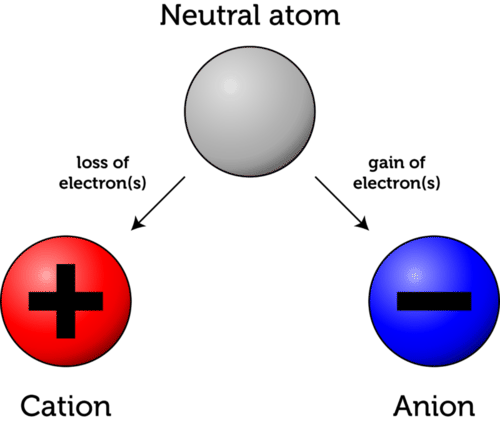
The girl pictured above became negatively charged because electrons flowed from the van de Graaff generator to her. Whenever electrons are transferred between objects, neutral matter becomes charged. This occurs even with individual atoms. Atoms are neutral in electric charge because they have the same number of negative electrons as positive protons. However, if atoms lose or gain electrons, they become charged particles called ions. You can see how this happens in the Figure below. When an atom loses electrons, it becomes a positively charged ion, or cation. When an atom gains electrons, it becomes a negative charged ion, or anion.

Conservation of Charge
Like the formation of ions, the formation of charged matter in general depends on the transfer of electrons, either between two materials or within a material. Three ways this can occur are referred to as conduction, polarization, and friction. All three ways are described later. However, regardless of how electrons are transferred, the total charge always remains the same. Electrons move, but they aren’t destroyed. This is the law of conservation of charge.
What makes something neutral and what happens to neutral material when electrons are transferred?
What is formed when electrons are gained or lost through the transfer of particles?
The law of the conservation of charge states that total charge
Conduction
The transfer of electrons from the van de Graaff generator to the man is an example of conduction. Conduction occurs when there is direct contact between materials that differ in their ability to give up or accept electrons. A van de Graaff generator produces a negative charge on its dome, so it tends to give up electrons. Human hands are positively charged, so they tend to accept electrons. Therefore, electrons flow from the dome to the person’s hand when they are in contact.
You don’t need a van de Graaff generator for conduction to take place. It may occur when you walk across a wool carpet in rubber-soled shoes. Wool tends to give up electrons and rubber tends to accept them. Therefore, the carpet transfers electrons to your shoes each time you put down your foot. The transfer of electrons results in you becoming negatively charged and the carpet becoming positively charged.
Polarization
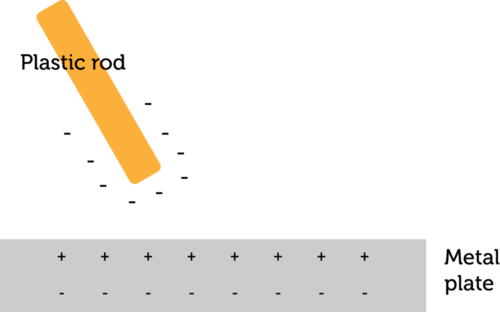
Assume that you have walked across a wool carpet in rubber-soled shoes and become negatively charged. If you then reach out to touch a metal doorknob, electrons in the neutral metal will be repelled and move away from your hand before you even touch the knob. In this way, one end of the doorknob becomes positively charged and the other end becomes negatively charged. This is called polarization. Polarization occurs whenever electrons within a neutral object move because of the electric field of a nearby charged object. It occurs without direct contact between the two objects. The figure below models how polarization occurs.

When the negatively charged plastic rod in the diagram above is placed close to the neutral metal plate electrons in the plate are repelled by the negative charges in the rod. The electrons move away from the rod, causing one side of the plate to become positively charged and the other side to become negatively charged.
Friction
Did you ever rub an inflated balloon against your hair? You can see what happens in the figure below. Friction between the balloon and hair cause electrons from the hair to “rub off” on the balloon. That’s because a balloon attracts electrons more strongly than hair does. After the transfer of electrons, the balloon becomes negatively charged and the hair becomes positively charged. The individual hairs push away from each other and stand on end because like charges repel each other. The balloon and the hair attract each other because opposite charges attract.

If a negatively-charged object is moved close to a neutral object, why does the neutral object become polarized?
After sliding down a plastic slide, a child becomes negatively charged. When they reach out to touch a nearby metal fence, what phenomenon occurs?
Which of the following would have the greatest electric force?