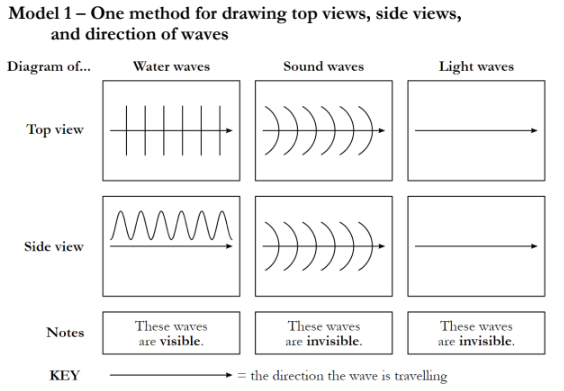
Moving from left to right, what are the three types of waves in the model?

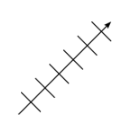
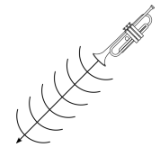
Examine the above diagram and use the model to the left to identify the type of wave: and the view:

Examine the above diagram and use the model to the left to identify the type of wave: and the view:
Using the drawing tools, draw a side view diagram of a light wave leaving the flashlight (look in their right hand).
The image is an island.
Using the drawing tools, draw a top view diagram of a water wave a approaching, but not hitting, the shore of the island.

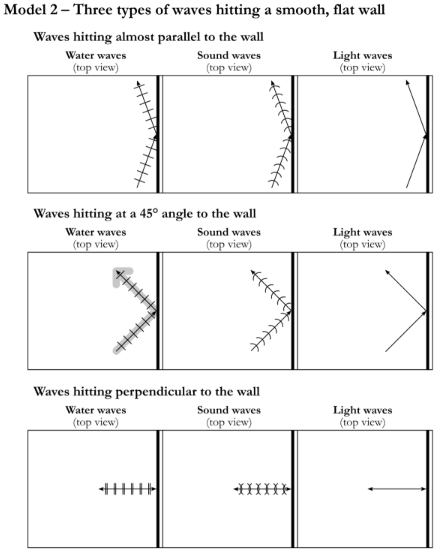
According to the title of the model, to the left, how many different types of waves are in model 2?
The waves are approaching the wall from more than one angle.
Examine the models and determine which different angles are included.
Choose all the answers that are correct.
a.) Circle a sound wave colliding a smooth and flat wall at a 45-degree angle.
b.) Use the highlight tool to trace the path of each of the nine waves in the model. Start at the beginning of each wave then dray one arrowhead at the end of the path of the wave. One wave has been highlighted as an example for you.
Hightlight tool instructions:
click the line, either in the far left or at the very top of tool bar
change the color
increase the thickness
change the opacity so you can still see the diagram you draw over

Examine the diagram of the sound wave above. Notice the arrowheads and the waves on the line.
Why is there only one line to show the direction of the wave? Does the sound wave change direction?
Briefly explain what is happening when a sound wave hits a wall as shown above.
Complete each of the three wave diagrams to display how each incoming wave changes direction when it hits and reflects off of the wall.
Examine the arrows on each wave type. Which directions are the waves travelling in the model?
What is the single piece of information that the arrows found in model 1 display?