Trial 2 - How Environmental Conditions Affect Enzyme Activity
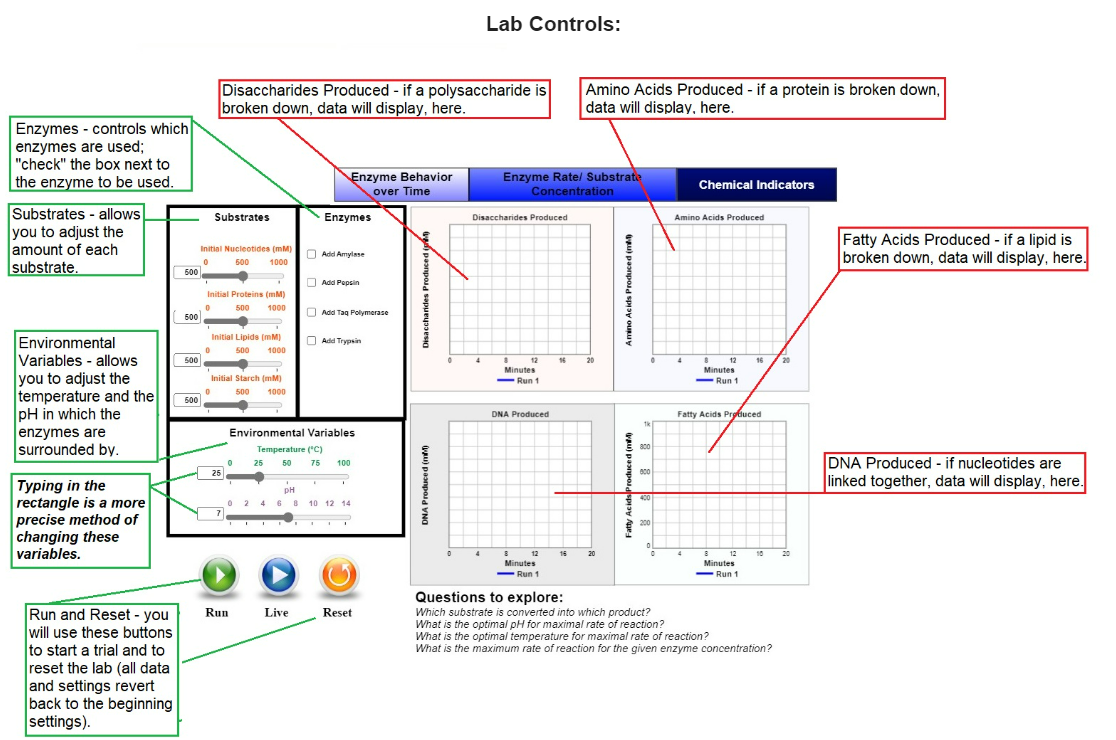
In this section, you will determine which temperature and pH conditions are optimal for the activity of each enzyme type. By this point, you should know which enzyme will act on which substrate, so there will be no need to test all four substrates with each enzyme. First, we will test how changing temperature affects the activity of each enzyme, then we test pH (how acidic or basic) changes.
Part 1: Temperature - the first part of trial 2 will be for seeing how temperature (measured in Celsius) impacts three of the four enzymes (we will not test trypsin in this section).
Amylase
Select “Add Amylase” and set the substrates to these settings:
Nucleotides - 0 mM
Proteins - 0 mM
Lipids - 0 mM
Starch - 500 mM
Ensure that the pH is set to 7 and you will set the temperature to 0o C.
Click, “Run” and record the disaccharides produced in the data table for trial 2 under Amylase; click “Reset” after you have recorded the data from the graph onto your data table.
Increase the temperature to 10o C, click “Run”, and record your data.
Continue increasing the temperature by factors of 10o C until the disaccharides produced is 0 mM or until you reach the highest temperature setting (100o C).
Once you have recorded all of the data (Trial 2 data table for temperature) for this section, you may click “Reset”.
Pepsin
Select “Add Pepsin” and set the substrates to these settings:
Nucleotides - 0 mM
Proteins - 500 mM
Lipids - 0 mM
Starch - 0 mM
Ensure that the pH is set to 2 and you will set the temperature to 0o C.
Click, “Run” and record the amino acids produced in the data table for trial 2 under Pepsin; click “Reset” after you have recorded the data from the graph onto your data table.
Increase the temperature to 10o C, click “Run”, and record your data.
Continue increasing the temperature by factors of 10o C until the amino acids produced is 0 mM or until you reach the highest temperature setting (100o C).
Once you have recorded all of the data (Trial 2 data table for temperature) for this section, you may click “Reset”.
Taq Polymerase
Select “Add Taq Polymerase” and set the substrates to these settings:
Nucleotides - 500 mM
Proteins - 0 mM
Lipids - 0 mM
Starch - 0 mM
Ensure that the pH is set to 7 and you will set the temperature to 40o C.
Click, “Run” and record the amino acids produced in the data table for trial 2 under Taq Polymerase; click “Reset” after you have recorded the data from the graph onto your data table.
Increase the temperature to 10o C, click “Run”, and record your data.
Continue increasing the temperature by factors of 10o C until the DNA produced is 0 mM or until you reach the highest temperature setting (100o C).
Once you have recorded all of the data (Trial 2 data table for temperature) for this section, you may click “Reset”.
Part 2: pH - the second part of trial 2 will be to test how pH impacts the activity of the three enzymes.
Amylase
Select “Add Amylase” and set the substrates to these settings:
Nucleotides - 0 mM
Proteins - 0 mM
Lipids - 0 mM
Starch - 500 mM
Ensure that the temperature to 25o C and that the pH is set to 0.
Click, “Run” and record the disaccharides produced in the data table for trial 2 under Amylase; click “Reset” after you have recorded the data from the graph onto your data table.
Increase the pH to 0, click “Run”, and record your data.
Continue increasing the pH by factors of 1 until the disaccharides produced reads 0 mM or until you hit the highest pH setting (14).
Once you have recorded all of the data (Trial 2 Data Table for pH) for this section, you may click “Reset”.
Pepsin
Select “Add Pepsin” and set the substrates to these settings:
Nucleotides - 0 mM
Proteins - 500 mM
Lipids - 0 mM
Starch - 0 mM
Ensure that the temperature is set to 25o C and that the pH is set to 0.
Click, “Run” and record the amino acids produced in the data table for trial 2 under Amylase; click “Reset” after you have recorded the data from the graph onto your data table.
Increase the pH to 5, click “Run”, and record your data.
Continue increasing the pH by factors of 1 until the amino acids produced reads 0 mM or until you hit the highest pH setting (14).
Once you have recorded all of the data (Trial 2 Data Table for pH) for this section, you may click “Reset”.
Taq Polymerase
Select “Add Taq Polymerase” and set the substrates to these settings:
Nucleotides - 500 mM
Proteins - 0 mM
Lipids - 0 mM
Starch - 0 mM
Ensure that the temperature to 80o C and that the pH is set to 0.
Click, “Run” and record the amino acids produced in the data table for trial 2 under Amylase; click “Reset” after you have recorded the data from the graph onto your data table.
Increase the pH to 5, click “Run”, and record your data.
Continue increasing the pH by factors of 1 until the DNA produced reads 0 mM or until you hit the highest pH setting (14).
Once you have recorded all of the data (Trial 2 Data Table for pH) for this section, you may click “Reset”.