[Figure1]
There are many different types of cells. For example, in you there are blood cells and skin cells and bone cells, and even bacteria. Here we have drawings of bacteria and animal cells. Can you tell which depicts various types of bacteria? However, all cells - whether from bacteria, human, or any other organism - will be one of two general types. In fact, all cells other than bacteria will be one type, and bacterial cells will be the other. And it all depends on how the cell stores its DNA.
There is a basic cell structure that is present in many but not all living cells: the nucleus. The nucleus of a cell is a structure in the cytoplasm that is surrounded by a membrane (the nuclear membrane) and contains, and protects, most of the cell's DNA. Based on whether they have a nucleus, there are two basic types of cells: prokaryotic cells and eukaryotic cells.
What are the two main classifications of cells based on the presence of a nucleus?
Provide a list of different types of eukaryotic cells (not plant and animal, but a more specific list).
There is a basic cell structure that is present in many but not all living cells: the nucleus. The nucleus of a cell is a structure in the cytoplasm that is surrounded by a membrane (the nuclear membrane) and contains, and protects, most of the cell's DNA. Based on whether they have a nucleus, there are two basic types of cells: prokaryotic cells and eukaryotic cells.
Eukaryotic cells are cells that contain a nucleus. Eukaryotic cells are usually larger than prokaryotic cells, and they are found mainly in multicellular organisms. Organisms with eukaryotic cells are called eukaryotes, and include fungi, animals, protists, and plants.
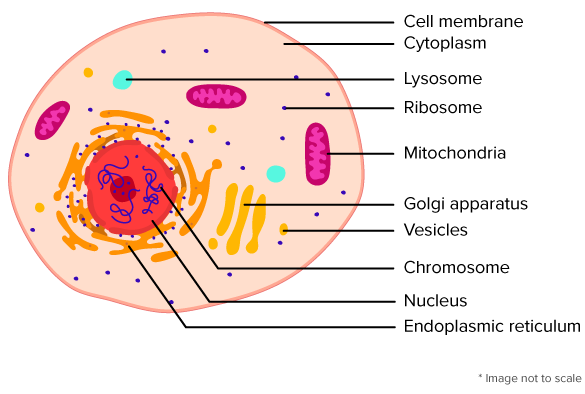
Eukaryotic cells also contain other organelles besides the nucleus. An organelle is a structure within the cytoplasm that performs a specific job in the cell. Organelles called mitochondria, for example, provide energy to the cell, and organelles called vacuoles store substances in the cell. Organelles allow eukaryotic cells to carry out more functions than prokaryotic cells can. This allows eukaryotic cells to have greater cell specificity than prokaryotic cells. Ribosomes, the cellular structures where proteins are made, are found in both eukaryotic and prokaryotic cells.
In some ways, a cell resembles a plastic bag full of Jell-O. Its basic structure is a cell membrane filled with cytoplasm. Like Jell-O containing mixed fruit, the cytoplasm of the cell also contains various structures, such as a nucleus and other membrane-bound organelles, that enable eukaryotes to perform many other specialized functions (more than prokaryotes).
What is the primary thing that distinguishes eukaryotic cells from prokaryotic cells?
Name two types of organelles found in eukaryotic cells and their functions.
Prokaryotic cells are cells without a nucleus. The DNA in prokaryotic cells is in the cytoplasm rather than enclosed within a nuclear membrane. Prokaryotic cells are found in single-celled organisms, such as bacteria. Organisms with prokaryotic cells are called prokaryotes. They are extremely simplistic, yet very robust cells, many are capable of surviving in rather extreme environments and conditions and are able to metabolize substances, form proteins, and carry out other essential cellular functions.
Prokaryotes have the ability to survive as a population in a very unique way — if there is enough resources (food) and if the conditions (temperature, pH, and moisture) are just right, many bacterial species can produce offspring every 10-15 minutes causing rapid exponential growth of the population, which leads it to grow by over one-billion bacterial cells in just 10 hours. In the oral cavity of humans (our mouth), bacteria that exist on our teeth and gums can reproduce every 20-30 minutes, and this time frame is shortened when they are exposed to sugars. As these bacteria grow, they form a biofilm on our teeth and gumlines, that accelerate tooth decay and dental disease.
What type of organisms are composed of prokaryotic cells?
Briefly discuss prokaryotic cells reproduction, and what is the potential growth rate under optimal conditions?
What structure(s) are found in both eukaryotes and prokaryotes?
Which organisms can by multicellular (made-up of more than one cell).
Which are found in prokaryotes.
Which of this list are components of eukaryotic cells?
Which organelle(s) do eukaryotes have that prokaryotes do not have?
Prokaryotic and eukaryotic cells both have which of the following characteristics?
What is the general term for structures within the cytoplasm that performs a specific function within the cell?
If it is true that prokaryotes do not have a nucleus, where would their DNA be found?
Which of these would eukaryotes have that prokaryotes do not?
Which characteristics define ONLY prokaryotes?
What allows eukaryotes to carry out more specialized functions than prokaryotes?