1
According to the diagram, photosystem II is a
Light-Dependent Reactions
Photosynthesis is the biochemical process by which sunlight, oxygen, and water are converted into energy contained in chemical bonds of carbohydrates. Photosynthetic organisms include green plants, algae, and certain species of bacteria. These organisms are key elements in the cycles of life on Earth, since all atmospheric oxygen and a large quantity of food come from photosynthesis.
The two main processes of photosynthesis involve a series of energy-fixing (light) reactions and a series of carbon-fixing (dark) reactions. In light reactions, energy from sunlight is trapped in the chemical bonds of ATP, while in the second process, this ATP is used to form carbohydrate molecules. The dark reactions are the subject of the next article.
Photosynthesis has
The main processes of photosynthesis involve a series of reactions; one is a series of
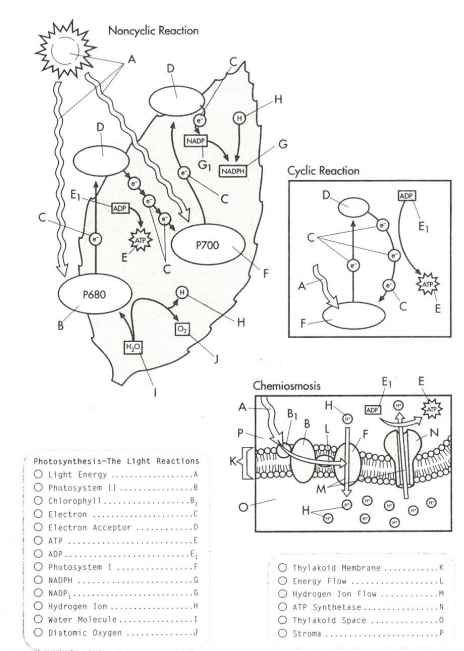
Photosynthesis takes place inside chloroplasts in specialized membranes called thylakoids. The process of photosynthesis begins with the sun's light energy. This energy enters leaf cells and is absorbed and transferred to a series of chlorophyll molecules within a complex cluster called a photosystem. The first photosystem involved in this transfer is photosystem II, and this photosystem contains chlorophyll molecules that absorb light that has a wavelength of 680 nanometers (nm).
Photosynthesis occurs within membranes called
The first system of chlorophyll molecules involved in the transfer of light energy is
Chlorophyll molecules in photosytem II only absorb light that has a wavelength of
When the complex in photosystem II is activated by light energy, it gives up electrons, which are then absorbed by an electron acceptor. This electron acceptor is part of what is called an energy transfer system, through which the electrons move until they reach photosystem I. During these transfers, hydrogen ions are pumped from the stroma into the interior of the thylakoid. As hydrogen ions lead back across the membrane through special carrier proteins called ATPases, ADP is phosphorylated, forming ATP (ADP → ATP).
When light activates photosytem II, the complex of chlorophyll molecules
Electrons from photosystem II are transferred to an electron acceptor, which is part of the
As electrons are transferred,
Now photosynthesis continues. Light energy is absorbed by photosystem I, which chlorophyll pigments absorb light energy that measures 700 nm. Once again, energy is transmitted by the chlorophyll in the complex, and an electron is given off to an electron acceptor, ferredoxin.
The electron acceptor then transfers the electrons to a molecule of nicotinamide adenine dinucleotide phosphate, or NADP, which takes on a hydrogen ion to become NADPH (NADP + H → NADPH). NADPH is used in carbon fixation, discussed in the next article.
Chlorophyll molecules in photosystem I absorb light of the wavelength
When light energy is absorbed by photosystem I
When photosystem I absorbs light energy, electrons are transferred to
Electrons that are given off of photosystem I are transferred by the electron acceptor (from the previous question) to a molecule of
When the answer to the previous question accepts the electron, it also picks up a
We complete the process of photosynthesis by referring back to the original P680 molecule, which has lost an electron that must be replaced. A water molecule breaks down, forming free hydrogen ions (H+) and diatomic oxygen (O2), and contributing an electron to the P680 complex. The oxygen is released to the atmosphere.
Photosynthesis produces oxygen gas, as a by-product, and releases it into the atmosphere. This oxygen is taken from
Chemiosmosis is the mechanism through which ATP is produced in the chloroplast of the plant cell. Light energy enters a specific chlorophyll molecule of photosystem II, and then we see energy flow as this energy moves into photosystem I. All of this takes place within the thylakoid membrane. During this transferal of energy, there is hydrogen ion (H+) flow across the membrane, from the stroma into the thylakoid space.
ATP can be produced in the chloropast through a process called
According to the diagram, photosystem II is a
As hydrogen ions (H+) move back into the stroma, they travel through an enzyme called ATP synthetase (also called ATP synthase). The hydrogen ion flow coincides with teh formation of molecules of ATP from ADP. The ATP formed in chemiosmosis is an essential factor in the carbon-fixing reactions of photosynthesis.
According to the reading, the products of chemiosmosis (ATP) are sent to begin the