Log in
Sign up for FREE
arrow_back
Library

Copy of 6.) Cellular Respiration Introduction (5/28/2026)

star
star
star
star
star
Last updated about 2 hours ago
26 questions
Learning Goals
ATP
Reaction of Cellular Respiration
Glycolysis
Krebs Cycle
ETC
Mini-Quiz
1
1
1
1
1
Question 1
01:21
keyboard_arrow_down
1
Question 2
01:31
keyboard_arrow_down
1
Question 3
01:49
keyboard_arrow_down
1
Question 4
02:10
keyboard_arrow_down
1
Question 5
02:24
keyboard_arrow_down
1
Question 6
01:38
keyboard_arrow_down
1
Question 7
01:48
keyboard_arrow_down
1
Question 8
02:06
keyboard_arrow_down
1
Question 9
02:20
keyboard_arrow_down
1
Question 10
03:13
keyboard_arrow_down
1
Question 11
03:21
keyboard_arrow_down
1
Question 12
03:31
keyboard_arrow_down
1
Question 13
04:22
keyboard_arrow_down
1
Question 14
04:34
keyboard_arrow_down
1
Question 14
14.
Text
00:00
keyboard_arrow_down
Question 15
03:44
keyboard_arrow_down
1
Question 16
04:02
keyboard_arrow_down
1
Question 17
05:01
keyboard_arrow_down
1
Question 18
05:11
keyboard_arrow_down
1
Question 19
05:48
keyboard_arrow_down
1
Question 20
06:14
keyboard_arrow_down
1
Question 21
07:24
keyboard_arrow_down
1
Question 22
22.

Question 23
23.

Question 24
24.

Question 25
25.

Question 26
26.

If you are complete with this and there is time in class, take this time to work on anything you have not turned in or are incomplete in Biology.

Check PowerSchool - anything with a blue or orange mark may be made-up.
All links are located on BB in the Photosynthesis-Cell Respiration folder.

Send me an email that contains the name(s) of anything you have updated.
Question 1
1.

Question 2
2.
Identify the three parts of ATP:
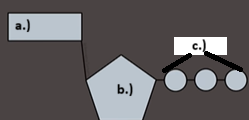

a.) _______
b.) _______
c.) _______
Question 3
3.

Question 4
4.
Aerobic respiration _______ oxygen.
Anaerobic respiration _______ oxygen
Question 5
5.
_______ is the process that cells use to make ATP.
Question 6
6.
Much of the process of cellular respiration occurs in the _______ .
Question 7
7.
Equation of Aerobic Cellular Respiration (if the video lacks a number in front of one of these, put a "1" in the blank):

_______ C6H12O6 + _______ O2 → _______ CO2 +_______ H2O + _______
Question 8
8.
Many of the reactants of cellular respiration are the _______ of photosynthesis.

The reactants of photosynthesis are similar to the _______ of cellular respiration.
Question 9
9.
In _______ plants make _______ ; in cellular respiration glucose is _______to make _______.
Question 10
10.
Glycolysis takes place in the _______ ; but it _______ oxygen.
Question 11
11.
Glycolysis converts glucose into _______
Question 12
12.
Glycolysis will produce (yield):
_______
_______
_______
Question 13
13.

Other than carbon dioxide, the other outputs of Krebs Cycle are (quantities):
  • _______ ATP
  • _______ NADH
  • _______ FADH2
I will not ask you any questions about the first 3 minutes and 30 seconds of the video.0

I want you to watch it so you can get an idea of how complex the process is.

We will not be talking about each of these steps in class - you can thank me later.
Question 15
15.
One round of the Krebs cycle results in (don't forget the quantities with each product):
_______
_______
1 GTP
_______
Question 16
16.
The following products are the result of _______ being broken down in the Krebs cycle.
  • 6 NADH
  • 2 FADH2
  • 6 CO2
How many rounds of Krebs are there for each glucose? _______
Question 17
17.
The ETC takes place in the _______ of the mitochondria.

The ETC is a _______ process, meaning it uses oxygen.
Question 18
18.
Electrons that are passed along through electron carriers in the ETC are given off by _______ and _______ .
Question 19
19.
H+ travel through _______ to make _______ by attaching a phosphate to _______ .
Question 20
20.
Oxygen is used to accept _______ and then to bind with hydrogens which will make _______ .
Question 21
21.
When we total the ATP produced in the three steps of cellular respiration, there is a range of _______ to _______ ATPs formed from one molecule of _______ .

However, most of the ATP is formed in the _______ of cellular respiration.
Glycolysis occurs _____.
in the mitochondria
just outside of the mitochondria
in the matrix
in the inner membrane
just inside of the mitochondria
The purpose of _____ is to produce NADH and FADH2.
glycolysis
cell respiration
electron transport chain
Krebs cycle
The following processes will produce carbon dioxide: (Select all that apply.)
Glycolysis
Electron transport chain
Krebs cycle
Cell respiration
Which of the following processes will occur in the absence of oxygen?
Electron Transport Chain
Krebs Cycle
Glycolysis
Photosynthesis
The purpose of _____ is to produce ATP.
Glycolysis
Electron Transport Chain
Krebs Cycle
Photosynthesis
ATP is considered a...
nucleic acid
lipid
protein/amino acid
carbohydrate (energy source)
ATP stands for "adenosine triphosphate".
What does the "tri" mean; ATP has...
three bases
three adenines
three phosphates
three sugars
Krebs Cycle is a ___ process, because some of its steps require ___.
aerobic; ATP
aerobic; oxygen
aerobic; carbon dioxide
anaerobic; oxygen