Copy of Aerobic vs. Anaerobic Respiration (5/28/2026)
star
star
star
star
star
Last updated about 2 hours ago
22 questions
Reading and Questions
Self-Reflection Exit Ticket
0
0
1
1
1
1
1
1
1
1
1
1
Summary
Cellular respiration always begins with glycolysis, which can occur either in the absence or presence of oxygen.
Cellular respiration that proceeds in the absence of oxygen is anaerobic respiration.
Cellular respiration that proceeds in the presence of oxygen is aerobic respiration.
Anaerobic respiration evolved prior to aerobic respiration.
Aerobic respiration produces much more ATP than anaerobic respiration.
Anaerobic respiration occurs more quickly than aerobic respiration.
1
1
1
1
1
1
1
1
Alcohol Fermentation
In alcohol fermentation, pyruvate changes to alcohol and carbon dioxide. This is shown in the Figure below. NAD+ also forms from NADH, allowing glycolysis to continue making ATP. Yeasts and some bacteria carry out this type of fermentation. It is used to make bread, wine, and biofuels.
Alcoholic fermentation produces ethanol and NAD+. The NAD+ allows glycolysis to continue making ATP.
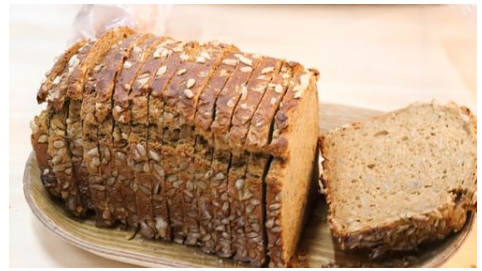
Have your parents ever put corn in the gas tank of their car? They did if they used gas containing ethanol. Ethanol is produced by alcoholic fermentation of the glucose in corn or other plants. This type of fermentation also explains why bread dough rises. Yeasts in bread dough use alcoholic fermentation and produce carbon dioxide gas. The gas forms bubbles in the dough, which causes the dough to rise and expand. The bubbles also leave small holes in the bread after it bakes, making it light and fluffy. Do you see the small holes in the slice of bread in the Figure below?
Bubbles of carbon dioxide gas form the small holes in bread. The gas was produced by alcoholic fermentation carried out by yeast.
1
1
Did you Know?
During the 1850s, the renowned French microbiologist Louis Pasteur was the first person to describe the role of microorganisms in starting the fermentation process.
Summary
Fermentation makes ATP without oxygen, which involves glycolysis only.
Fermentation recycles NAD+ and produces 2 ATPs.
In lactic acid fermentation, pyruvate from glycolysis changes to lactic acid. This type of fermentation is carried out by the bacteria in yogurt and your muscle cells.
In alcoholic fermentation, pyruvate changes to alcohol and carbon dioxide. Yeasts and some bacteria carry out this type of fermentation.
Question 21
21.
Exit Ticket: 🤔 How can you connect today's lesson to your life?
Question 22
22.
Oxygen
Oxygen is the final electron acceptor at the end of cell respiration's electron transport chain (ETC). In the absence of oxygen, only a few ATP are produced from a single glucose molecule. In the presence of oxygen, many more ATP molecules are made.
The Presence of Oxygen
There are two types of cellular respiration: aerobic respiration and anaerobic respiration. One occurs in the presence of oxygen (aerobic), and one occurs in the absence of oxygen (anaerobic). Both begin with glycolysis - "the splitting of glucose".
Glycolysis is an anaerobic process - it does not need oxygen to proceed. This process produces a minimal amount of ATP. The Krebs cycle and the electron transport chain need oxygen to proceed, and they will not occur in anaerobic conditions. However, Krebs and the ETC produce much more ATP than glycolysis alone in the presence of oxygen. Cellular respiration that proceeds without oxygen is called anaerobic respiration.
Most organisms make most of their ATP in the presence of oxygen. They follow glycolysis with the Krebs cycle and the ETC to make more ATP than glycolysis alone. Cellular respiration that proceeds in the presence of oxygen is called aerobic respiration.
Question 1
1.
Cellular respiration that occurs in the presence of oxygen is called - _______.
Question 2
2.
Cell respiration that occurs without the presence of oxygen is called - _______.
Question 3
3.
Glycolysis is an _______ process.
Question 4
4.
Glycolysis means, "the _______".
Question 5
5.
Which form of respiration produces the least amount of ATP? _______
Aerobic vs. Anaerobic Respiration: A Comparison
Aerobic respiration takes place in the presence of oxygen. This type of respiration is useful today because the atmosphere comprises 21% oxygen. However, some anaerobic organisms (different forms of some bacteria that live in environments that are very low to absent of oxygen) utilize anaerobic respiration, which certainly has its advantages.
Advantages of Aerobic Respiration
A major advantage of aerobic respiration is the amount of energy it releases. Without oxygen, organisms can split glucose into just two molecules of pyruvate. This releases only enough energy to make two (2) ATP molecules. With oxygen, organisms can break down glucose all the way to carbon dioxide. This releases enough energy to produce up to thirty-eight (38) ATP molecules. Thus, aerobic respiration releases much more energy than anaerobic respiration. It releases approximately 19x more ATP than anaerobic respiration.
Advantages of Anaerobic Respiration
One advantage of anaerobic respiration, also known as fermentation, is obvious. It lets organisms live in places where there is little or no oxygen. Such places include deep water, soil, and the digestive tracts of animals such as humans (see the Figure below).
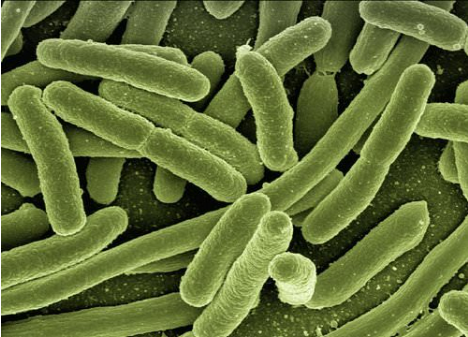
Another advantage of anaerobic respiration is its speed. It produces ATP very quickly. For example, it lets your muscles get the energy they need for short bursts of intense activity (see the Figure below). Aerobic respiration, on the other hand, produces ATP more slowly.

Question 6
6.
An anaerobic organism would include _______.
Question 7
7.
The primary advantage of aerobic respiration is that it produces approximately _______ times more ATP than anaerobic respiration.
Question 8
8.
The primary advantage of anaerobic respiration is that it permits organisms to _______.

Question 9
9.
Secondarily, anaerobic respiration is able to produce ATP _______.
Question 10
10.
Another name for anerobic respiration is _______.
When you combine grapes and yeast, what have you begun to make?
Wine. It may be slightly more complicated, but you must start with grapes and yeast and allow a natural fermentation process. Essentially, this is respiration without oxygen.
Anaerobic Respiration: Fermentation
Today, most living things use oxygen to make ATP from glucose. However, many living things can also make ATP without oxygen. This is true of fungi and also of many bacteria. These organisms use aerobic respiration when oxygen is present, but when oxygen is in short supply, they use anaerobic respiration instead. Certain bacteria can only use anaerobic respiration. They may not be able to survive at all in the presence of oxygen.
An important way of making ATP without oxygen is called fermentation. It involves and begins with glycolysis but not the other two stages of aerobic respiration. Many bacteria and yeasts carry out fermentation. People use these organisms to make yogurt, bread, wine, and biofuels. Human muscle cells also use fermentation (lactic acid). This occurs when muscle cells cannot get oxygen fast enough to meet their energy needs through aerobic respiration.
There are two types of fermentation: lactic acid fermentation and alcoholic fermentation. Both types of fermentation are described below.
Question 11
11.
Two organisms that can perform anaerobic respiration are _______ and _______.
Question 12
12.
A method of deriving ATP from glucose in the absence of oxygen is _______.
Question 13
13.
All forms of fermentation always begin with _______, which breaks down glucose.
Question 14
14.
It is not only bacteria and yeast that can perform fermentation, _______ can also use fermentation when they cannot get enough oxygen to do aerobic respiration.
Question 15
15.
There are two forms of fermentation: _______ and _______.
The form of fermentation that some of our cells use is _______.
Lactic Acid Fermentation
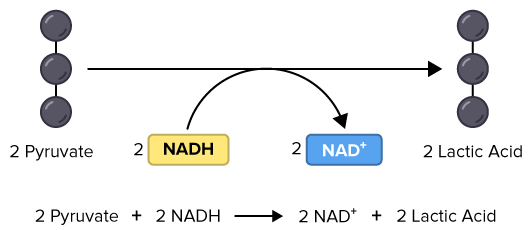
In lactic acid fermentation, pyruvate (pyruvic acid) forms in glycolysis and changes to lactic acid. This is shown in the Figure below. In the process, NAD+ forms from NADH. NAD+ (formed when NADH releases its H+), in turn, lets glycolysis continue. This results in additional molecules of ATP. This type of fermentation is carried out by the bacteria in the production of various dairy products (yeast and cheeses). It is also used by your own muscle cells when you work them hard and fast.
Lactic acid fermentation produces lactic acid and NAD+. The NAD+ cycles back to allow glycolysis to continue so more ATP is made. Each circle represents a carbon atom.
Have you ever run a race and noticed your muscles feel tired and sore afterward? This is because your muscle cells use lactic acid fermentation for energy. This causes lactic acid to build up in the muscles. The presence of lactic acid in muscle cells inhibits the absorption of oxygen into these cells. Because of this, lactic acid makes muscles feel tired and sore.
Question 16
16.
In lactic acid fermentation, after the glucose is broken down, NAD+ forms _______. Lactic acid fermentation works to convert NADH into _______, which allows glycolysis to continue.
Question 17
17.
The byproduct of this form of fermentation is _______
Question 18
18.
This form of fermenation has been used to make _______ products.
Question 19
19.
Alcohol fermentation has (how many) _______ byproducts; like lactic acid fermentation, its primary role to convert NADH into NAD+ to permit _______ to continue.
Question 20
20.
Because alcohol fermentation forms carbon dioxide gas, it is used to make _______ rise.
📚 Poll: How confident do you feel about the material we covered in today's lesson? Please select the emoji that best reflects your level of understanding.
👍 I feel very confident and understand everything well!
😊 I'm mostly confident, but there are a few areas I'm unsure about.
😐 I'm somewhat confident, but I still have some questions or uncertainties.
😕 I'm not very confident and need clarification on several points.
😩 I'm struggling to understand most of the material and need significant help.