Log in
Sign up for FREE
arrow_back
Library

Copy of 2.) Photosynthesis - Leaf Anatomy (5/28/2026)

star
star
star
star
star
Last updated about 2 hours ago
25 questions
Note from the author:
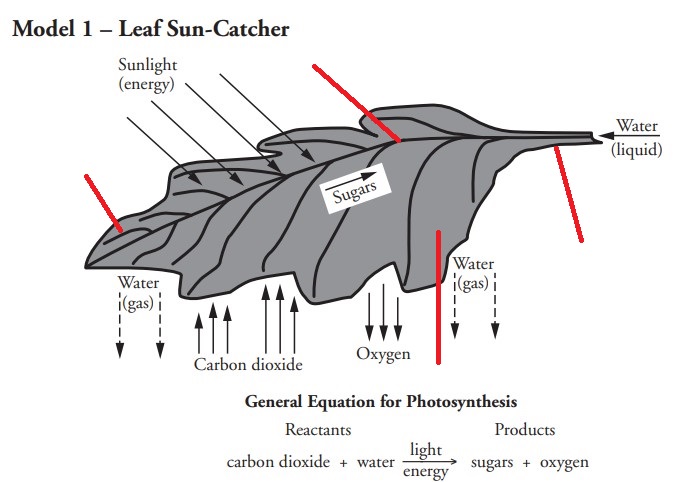
Model 1
3
3
1
1
1
4
2
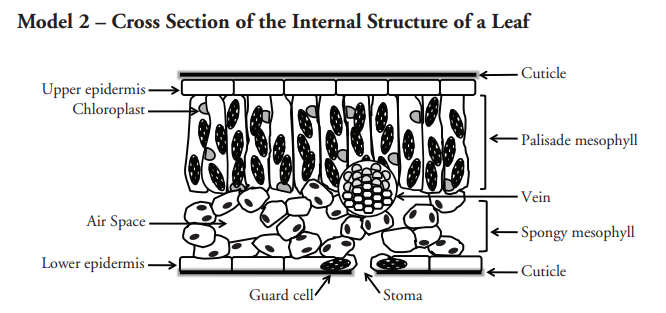
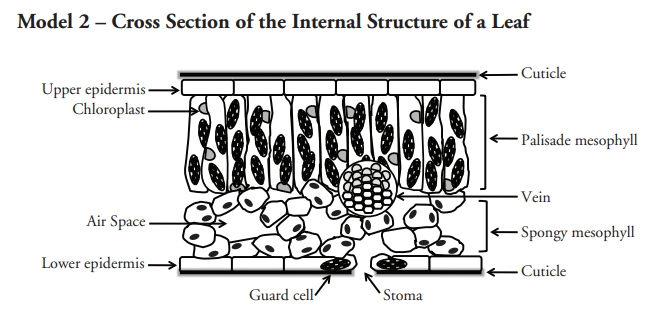
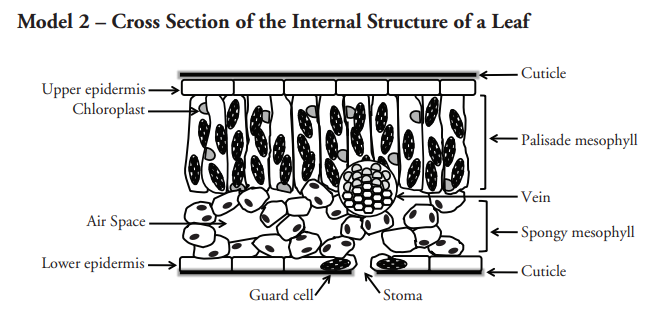
Model 2
1
1
1
1
1
1
1
1
1
2
0
0
0
0
0
0
0
0
Read This:

What would the world be like without leaves—no grass for ball fields, no beautiful landscaping? It would also mean no oxygen for animals and no food for heterotrophs. Leaves are like living machines that recycle the carbon and oxygen in our environment. This process, driven by the sun’s energy, allows for a constant supply of oxygen and food for the inhabitants of Earth.
Question 1
1.
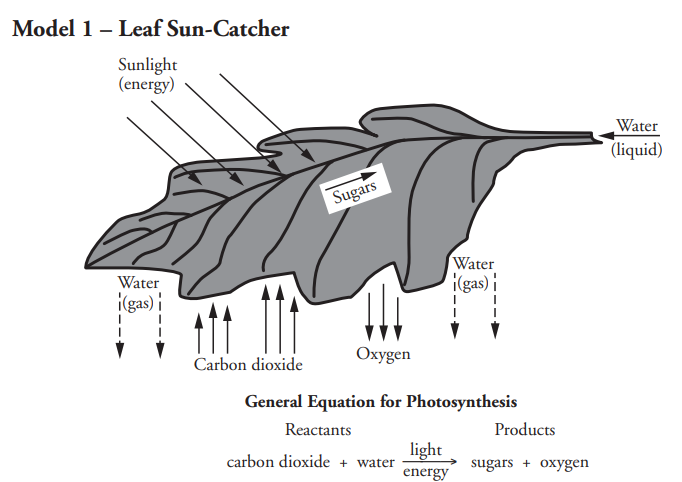
Three things entering the leaf in Model 1 are: _______, _______, and _______.
Question 2
2.
The three substances leaving the leaf are: _______, _______, and _______.
Question 3
3.
Which substance is both entering and leaving the leaf? _______
Question 4
4.

How is the substance identified in question 3 changed between its entry and exit?

Question 5
5.

Select the dot at the end of the red line that points to the central vein on the leaf diagram below.

Question 6
6.
Use Model 1 and the equation for photosynthesis to answer the following:
a.) Reactants of photosynthesis _______ and _______
b.) Products of photosynthesis _______ and _______
c.) Reactant 1 comes from: _______
d.) Reactant 2 comes from: _______
e.) Product 1 exits the leaf through the: _______
f.) Product 2 exits and enters into the: _______
Question 7
7.

Question 8
8.

Read This:
Plant veins consist of two distinct types of tissues. The xylem is responsible for transporting water and minerals from the roots of the plant to other areas of the plant. On the other hand, phloem is responsible for carrying nutrients and sugars away from the leaf to where the plant is growing or to storage areas within the plant. The stoma, which are typically located on the bottom of the leaf, is used to allow gases involved in photosynthesis (carbon dioxide and oxygen) to enter and leave the leaf. The guard cells, which surround each stoma, are used to open and close the stoma.


Question 9
9.

Describe the position of the vein in Model 1.

Question 10
10.

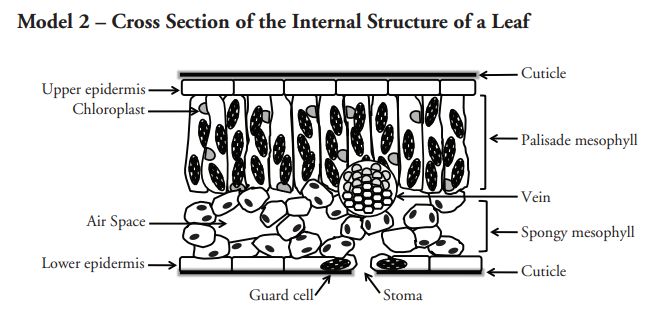
Describe the position of the vein in Model 2.

Question 11
11.

What are the functions of the veins (refer to the reading - i.e. the xylem and phloem)?

Read This:

Plant veins consist of two distinct types of tissues. The xylem is responsible for transporting water and minerals from the roots of the plant to other areas of the plant. On the other hand, phloem is responsible for carrying nutrients and sugars away from the leaf to where the plant is growing or to storage areas within the plant. The stoma, which are typically located on the bottom of the leaf, is used to allow gases involved in photosynthesis (carbon dioxide and oxygen) to enter and leave the leaf. The guard cells, which surround each stoma, are used to open and close the stoma.

Question 12
12.
Using model 2, determine which type of cells have chloroplasts in them. _______
Question 13
13.
In which part of the leaf is photosynthesis taking place? _______
Question 14
14.
The green color of chloroplasts is due to a pigment in them that absorbs light energy. Knowing this, infer which layer inside a leaf gives the whole leaf its green color._______
Question 15
15.

Explain your answer to question 14.

Question 16
16.
Through which two layer(s) does light energy travel to reach the palisade mesophyll? _______ and _______
Question 17
17.

Stop here.

  1. Make sure 1-17 of this is complete (look at the class recording from Thursday).
  2. Make sure your notes are complete - Photosyn. Notes - https://frm.tv/formatives/695c6ccefd1f730f435e3fdd

Question 18
18.

Suppose there were many chloroplasts in the cells of the upper epidermis. How would that change the amount of sunlight reaching the chloroplasts in the palisade layer?

Question 19
19.

What do you think might be the function of the epidermis?

Read This:
The cuticle covering the upper and lower epidermis of land plants is made of a waxy substance that repels water much the same way as wax on a paper cup. This waxy layer helps to prevent water from entering through the leaf or the exit through the leaf. Consider what might happen if a leaf was to lose too much water.
Question 20
20.

What would be the importance of the waxy cuticle layer of the leaf?

Question 21
21.
Refer to model 2.
a.) What structure is found between the guard cells? _______
b.) How would you describe its structure? _______
c.) How would this affect the ability of the leaf to retain water, especially in dry conditions? _______
Question 22
22.

Suggest a way in which the stoma and guard cells arrangement might work to control the amount of water that is leaving the leaf.


Question 23
23.

Refer to model 1. What gases might you find inside the air spaces that are shown in model 2?

Question 24
24.

When stomata (the plural of stoma) are closed, gases cannot enter or leave. Explain how this would affect the plant’s ability to do photosynthesis.

Question 25
25.

In grammatically correct sentences, trace the path of the reactants for photosynthesis as they enter the leaf.

Categorize all of the components of photosynthesis as either matter or energy.
Carbon dioxide
Sugar
Sunlight
Water
Oxygen
Matter
Energy
Sequence all of the layers of the leaf starting at the upper cuticle and finishing at the lower cuticle. Examine model 2 - place these structures in a top-to-bottom order.
Upper Epidermis
Palisade Mesophyll
Spongy Mesophyll
Lower Epidermis
Using model 2, place each description as either belonging to palisade mesophyll cells or to the other cells in the leaf.
Cylindrical
Irregular shaped
Many Chloroplasts
No Chloroplasts
Loosely packed
Tightly packed together
Palisade Mesophyll
Spongy Mesophyll and Other cells