Copy of 3.) Photosynthesis - Light-Dependent and Light-Independent Rxns (5/28/2026)
star
star
star
star
star
Last updated about 2 hours ago
22 questions
Note from the author:
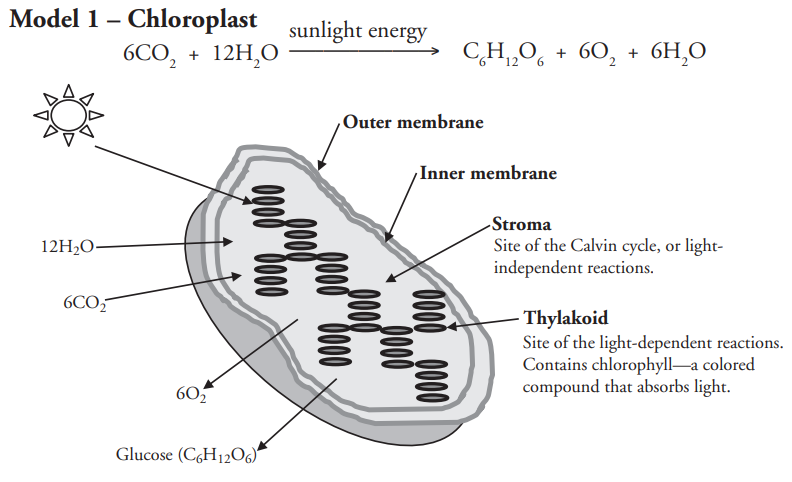
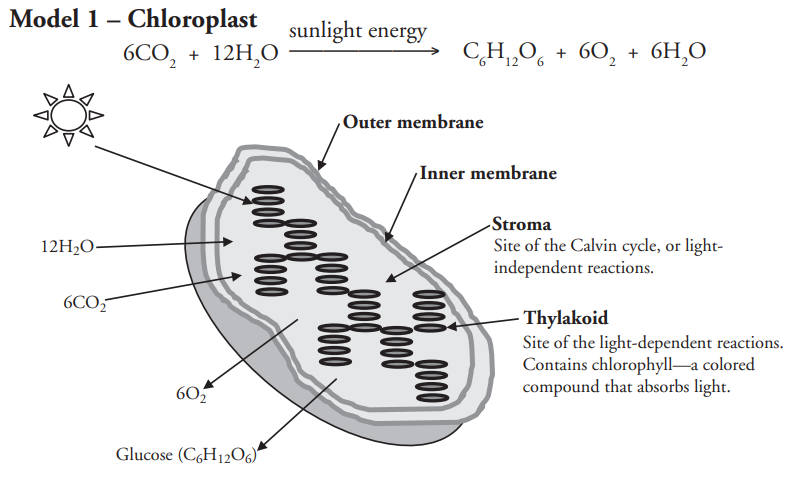
Model 1 - Chloroplast
2
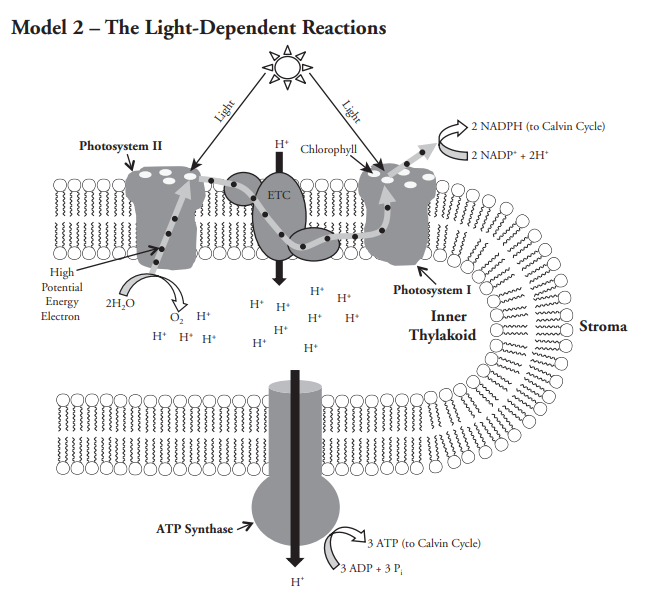
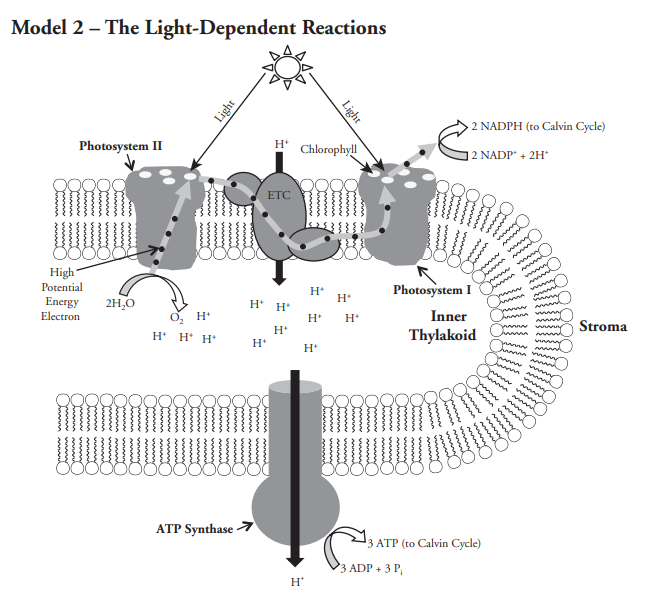
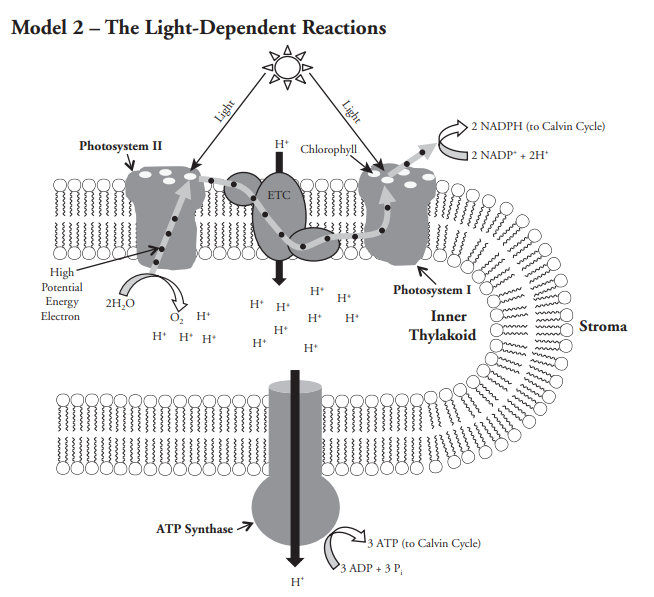
Model 2 - Light-Dependent Reactions
1
1
1
1.5
6
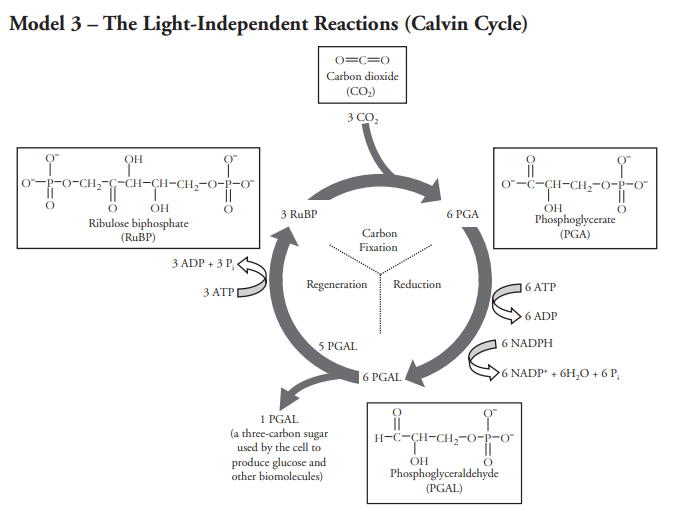
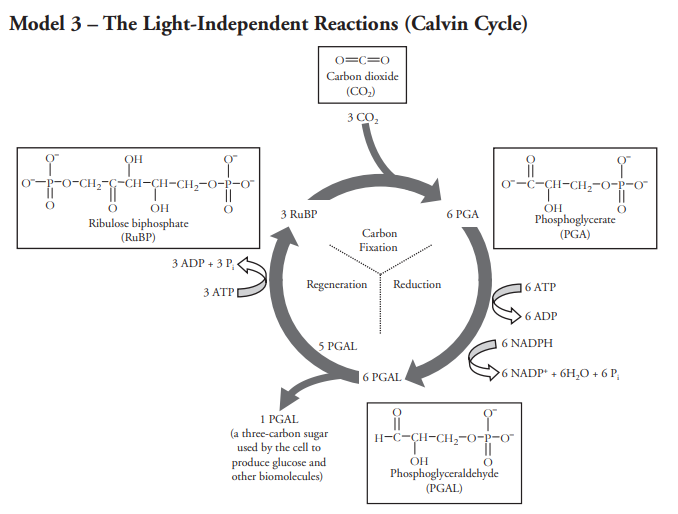
Model 3 - Light-Independent Reactions
1.5
1
3
1
1
1
2
5
0
0
0
Plants are the original solar panels. Through photosynthesis a plant is able to convert electromagnetic (light) energy into chemical energy. This energy is used not only to keep the plant alive, but also to sustain all creatures that rely on the plant for food and shelter. Plants and photosynthetic algae are also the source of all oxygen on Earth, allowing the inhabitants of Earth to benefit from our most plentiful renewable energy resource.
1.5
Question 1
1.
1.5
Question 2
2.
2
Question 3
3.
Question 4
4.
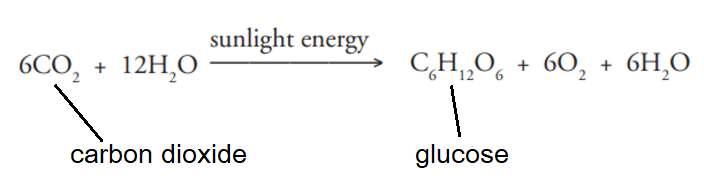
Examine the photosynthesis reaction above. Count the number of each atom (carbon - C; hydrogen - H; oxygen - O) on the reactant (left) and product (right) side of the reaction; pay especial attention to carbon dioxide and glucose.
Why is it necessary to have six CO2 entering the chloroplast for each single photosynthesis reaction?
*ETC - electron transport chain
3.5
Question 5
5.
Read this:
The light-dependent reactions of photosynthesis include three major steps:
Excited electrons leave chlorophyll and converts NADP+ into NADPH.
Excited electrons moving through the electron transport chain provide the free energy needed to pump hydrogen ions (H+) into the inner thylakoid.
Hydrogen ions flowing out of the thylakoid via a protein channel provide the free energy needed to convert ADP to ATP.
Question 6
6.
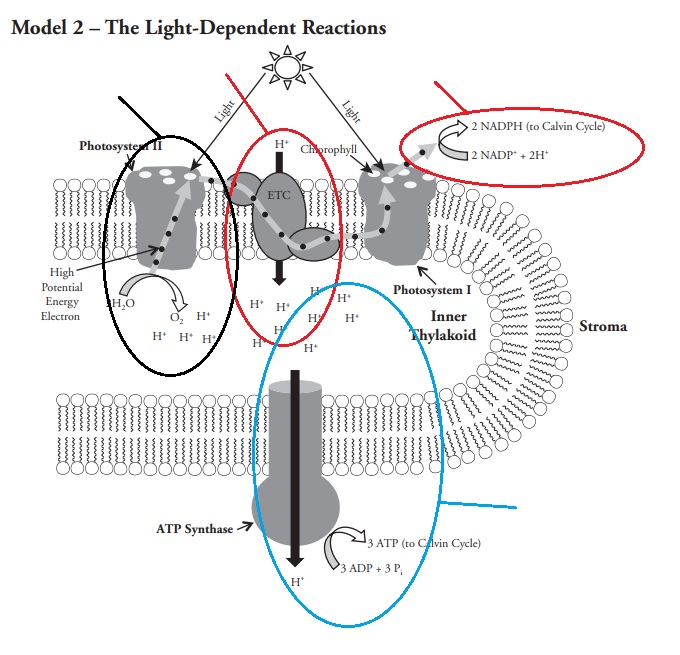
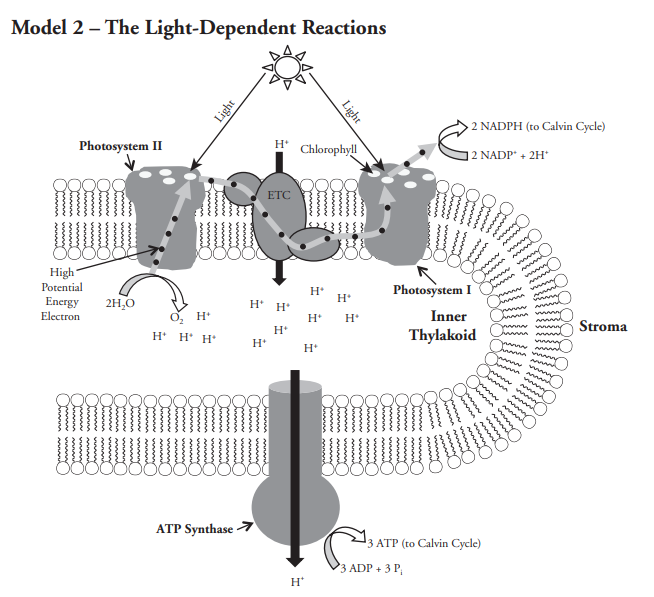
Below is model 2 that has four locations circled with a line extended off of each circle. Three of these are where the three major steps of the light-dependent reactions take place (see below for a description of all three).
The light-dependent reactions of photosynthesis include three major steps:
Excited electrons leave chlorophyll and converts NADP+ into NADPH.
Excited electrons moving through the electron transport chain provide the free energy needed to pump hydrogen ions (H+) into the inner thylakoid.
Hydrogen ions flowing out of the thylakoid via a protein channel provide the free energy needed to convert ADP to ATP.
Identify where step 2 takes place at (select the shaded circle at the end of the line that indicates the correct location).
Question 7
7.
Below is model 2 that has four locations circled with a line extended off of each circle. Three of these are where the three major steps of the light-dependent reactions take place (see below for a description of all three).
The light-dependent reactions of photosynthesis include three major steps:
Excited electrons leave chlorophyll and converts NADP+ into NADPH.
Excited electrons moving through the electron transport chain provide the free energy needed to pump hydrogen ions (H+) into the inner thylakoid.
Hydrogen ions flowing out of the thylakoid via a protein channel provide the free energy needed to convert ADP to ATP.
Identify where step 1 takes place at (select the shaded circle at the end of the line that indicates the correct location).
Question 8
8.
Below is model 2 that has four locations circled with a line extended off of each circle. Three of these are where the three major steps of the light-dependent reactions take place (see below for a description of all three).
The light-dependent reactions of photosynthesis include three major steps:
Excited electrons leave chlorophyll and converts NADP+ into NADPH.
Excited electrons moving through the electron transport chain provide the free energy needed to pump hydrogen ions (H+) into the inner thylakoid.
Hydrogen ions flowing out of the thylakoid via a protein channel provide the free energy needed to convert ADP to ATP.
Identify where step 3 takes place at (select the shaded circle at the end of the line that indicates the correct location).
1.5
Question 9
9.
Question 10
10.
Once a chlorophyll molecule has released electrons that specific chlorophyll molecule is no longer useful until its electrons are replaced from a different source.
a. What is the likely source of replacement electrons for those lost in photosystem I? _______
b. What is the likely source of replacement electrons for those lost in photosystem II? _______
c. Is CO2 (carbon dioxide) involved in light-dependent reactions? _______
Question 11
11.
You're going to have to do a little multiplication on this question.
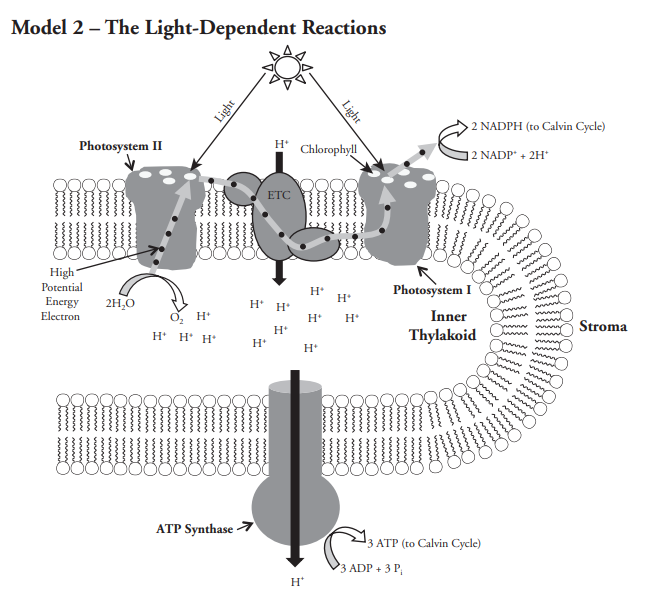
Examine the quantities of water, oxygen, NADPH, and ATP that are used or produced in one round of light-dependent reactions in model 2.
a. Fill in the quantities used for each in Model 2.
b. If six (6) water molecules were used, how many NADPH, ATP, and O2 would be formed?
_______ NADPH
_______ ATP
_______ O2
c. If twelve (12) water molecules were used, how many NADPH, ATP, and O2 would be formed?
_______ NADPH
_______ ATP
_______ O2
d. Where do the ATP and NADPH go after they are produced? _______
e. What location in the chloroplast will the reactions from 'd' occur at? _______
Question 12
12.
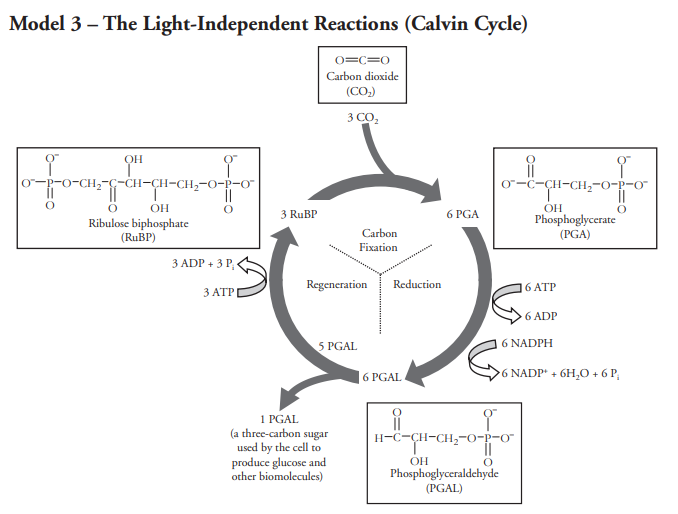
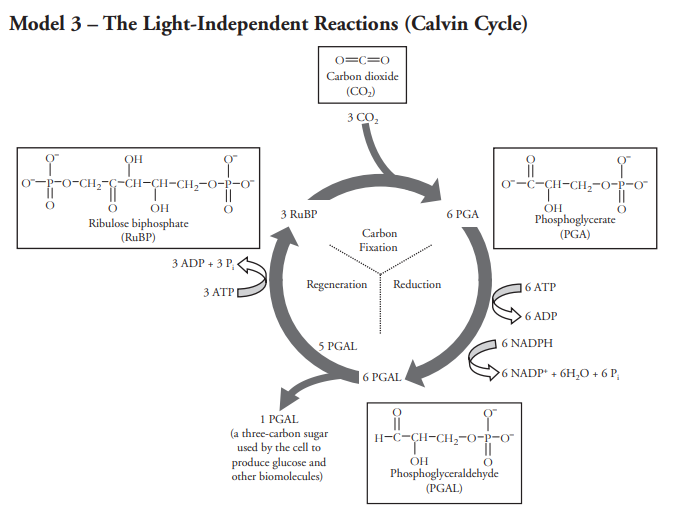
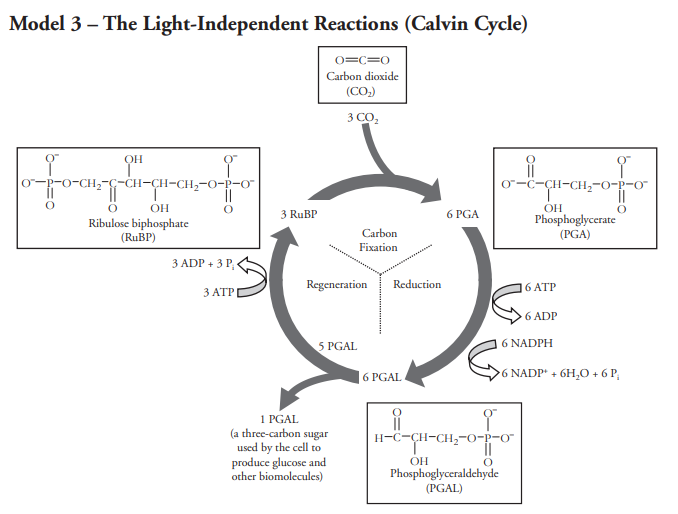
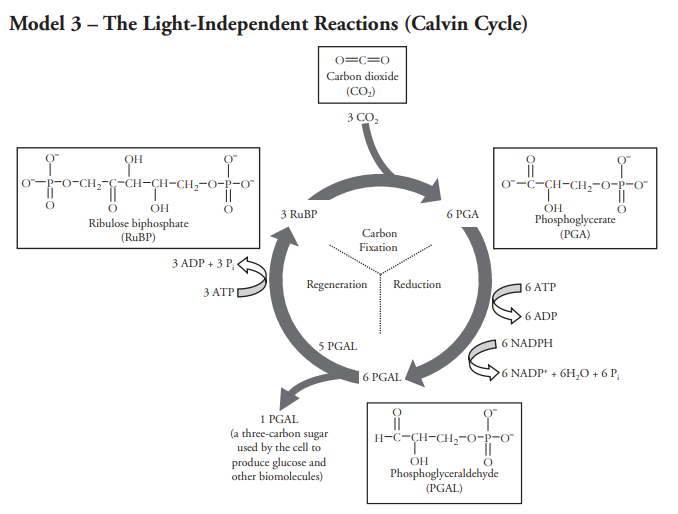
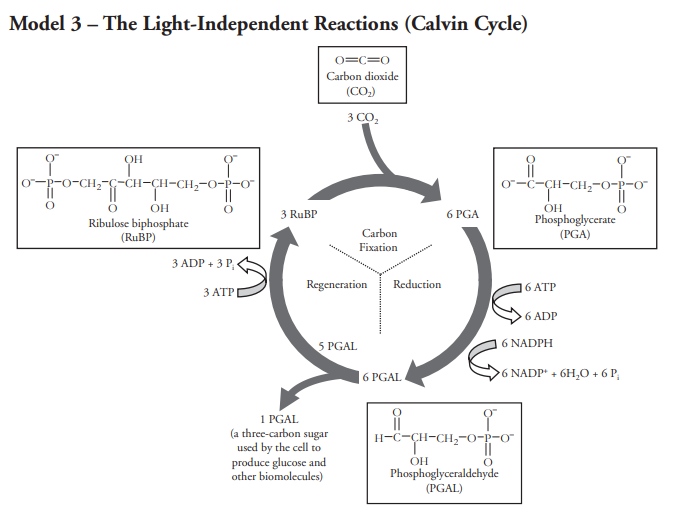
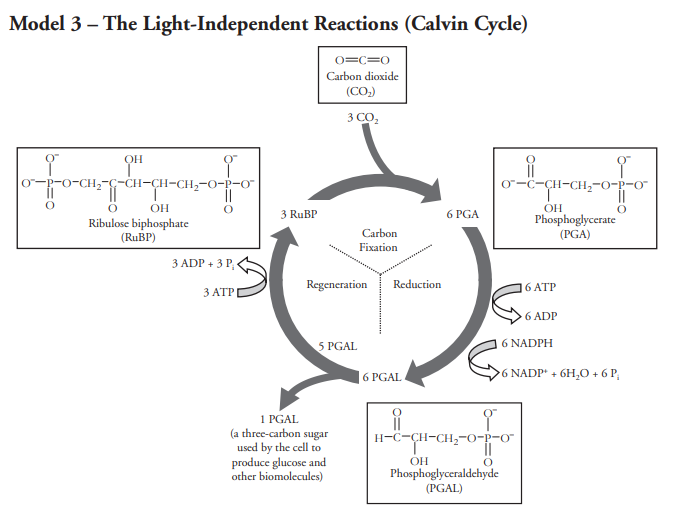
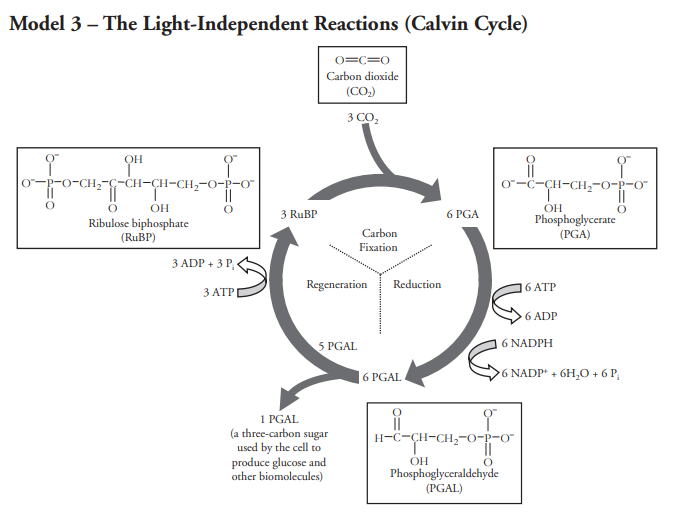
a. What are the three parts of the Calvin cycle? _______ , _______, and _______
Question 13
13.
Locate ribulose biphosphate (RuBP) in model 3.
a. How many molecules of RuBP are used in one cycle (one turn) of the Calvin cycle? _______
b. How many carbon atoms are there in one RuBP? _______
c. What is the total number of carbon atoms in all of the RuBP molecules used in one cycle (one turn) of the Calvin cycle? _______
Question 14
14.
Ribulose biphosphate (RuBP) combines with carbon dioxide (CO2 ) to form phosphoglycerate (PGA) during the carbon fixation phase of the Calvin cycle.
a. How many CO2 molecules are used in one turn of the Calvin cycle? _______
b. How many PGA molecules are made in one turn of the Calvin cycle? _______
c. How many carbon atoms are in each CO2? _______
d. Calculate how many total carbon atoms enter one round of the Calvin cycle through CO2 _______
e. How many carbon atoms are in each PGA molecule? _______
d. Calculate the total number of carbon atoms represented in all of the PGA molecules used in one turn of the Calvin cycle. _______
Question 15
15.
Examine model 3, begin with the entrance of the carbon dioxide molecules and stop when the one product of the Calvin Cycle is made.
Try to explain what happens to the carbons introduced into the Calvin cycle by the three carbon dioxides.
Question 16
16.
Model 3 is a simplified version of the Calvin cycle.
Each of the three phases in the cycle consist of multiple reactions that are catalyzed by enzymes specific to that reaction.
These enzymes have names like RuBisCo, phosphoglycerate kinase, and PGAL hydrogenase.
a. What molecule does the PGA molecule turn into during this phase of the Calvin cycle? _______
b. How the structures of the two molecules (PGA and the answer to 'a') in part 'a' are different. _______
Question 17
17.
Is the total number of carbon atoms present in the Calvin cycle changed during the reduction phase? Support your answer with information from model 3.
Question 18
18.
a. How many PGAL molecules continue on to the regeneration phase of the Calvin cycle? _______
b. Identify the types and numbers of molecules that provide the energy necessary for the regeneration of these molecules. _______
c. How many total carbon atoms remain in the Calvin cycle at this point?
_______
d. What molecule(s) are “regenerated” in this phase of the cycle?_______
e. How many total carbon atoms leave the Calvin cycle before the regeneration phase? _______
f. What happens to the PGAL molecule that does not continue on in the Calvin cycle? _______
Question 19
19.
The Calvin Cycle does not use light to power its many reactions. Instead, two high-energy molecules are used — NADPH and ATP.
Consider where these two molecules are made during photosynthesis.
a. 1 PGAL has _______ carbon atoms; 1 glucose has _______ carbon atoms (click 'hint'); therefore, it will take _______ turns of the Calvin cycle to make one glucose molecule.
b. In one round of the Calvin cycle _______ ATP and _______ NADPH are used; therefore, to make 1 glucose molecule, it will take _______ ATP molecules and _______ NADPH molecules (consider how many turns of the Calvin is needed to make 1 glucose).
c. In what set of reactions are the NADPH and ATP produced (see the hint)? _______
d. After the NADPH and ATP are used in the Calvin cycle they will form _______ and _______ ; consider your answer to 'c', and identify the structural location in the chloroplast where these two molecules will travel to — _______.
We Stopped Here
Do not go past this point, I won't grade it.
Question 20
20.
Examine model 2 and 3 and look for molecules that are found in both light-dependent and light-independent reactions.
Based upon this, explain how the two reaction types of photosynthesis (light-dependent and light-independent) rely on each other.
Question 21
21.
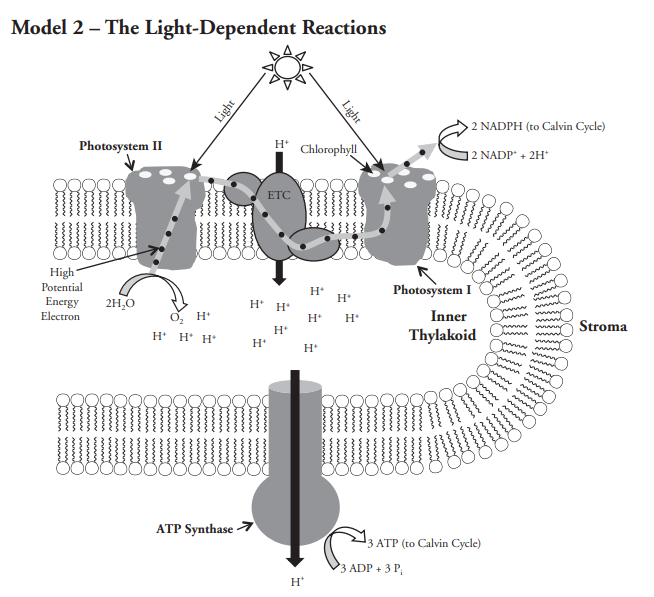
Using model 2, identify which of the the following is either used or produced in the light-dependent reactions.
Question 22
22.
Using model 3, identify which of the the following is either used or produced in the light-dependent reactions.
Examine model 1 very closely; look at the diagram, interpret the arrows, read the labels and all text.
a. What is the name of the organelle in model 1? _______
b. Would this be found in animal cells, plant cells, or both? _______
c. The stacked flat discs are thylakoids; what substance is contained within them that is necessary for photosynthesis? _______
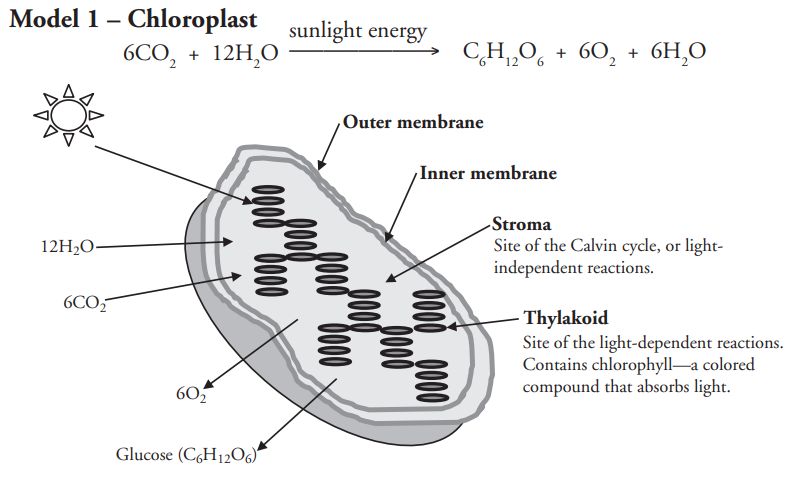
Examine the chemical reaction for photosynthesis at the top of model1.
a. What are the reactants in photosynthesis? _______
b. Where in the organelle would these reactants be stored before they are used in photosynthesis? _______
c. What is the primary energy source for photosynthesis? _______
Photosynthesis occurs in two parts — light-dependent reactions and light-independent reactions.
a. What is another name for the light-independent reactions? _______
b. In what part of the chloroplast do the light-dependent reactions occur? _______
c. In what part of the chloroplast do the light-independent reactions occur? _______
d. What compound is best able to absorb light energy so it can be later converted into chemical energy? _______
Examine model 2 very closely. Begin with the upper-left, just inside of the thylakoid to the left of photosystem II. Trace the steps of the light-dependent reactions that occur here. Read each label and determine how everything is represented in the model.
a. What shape is used to represent a single electron? _______
b. What symbol (be specific to the color and shape) is used to represent chlorophyll? _______
c. On what two structures do we find chlorophyll? _______
d. In the light-dependent reactions electrons are released from molecules in two ways. Identify the two places in model 2 where electrons are released from chlorophyll by a photon of light coming from the sun. _______ and _______
e. Find the one place in model 2 where water is broken down to release electrons. _______
f. When water is broken down, other than electrons, what else is formed/released from water? _______
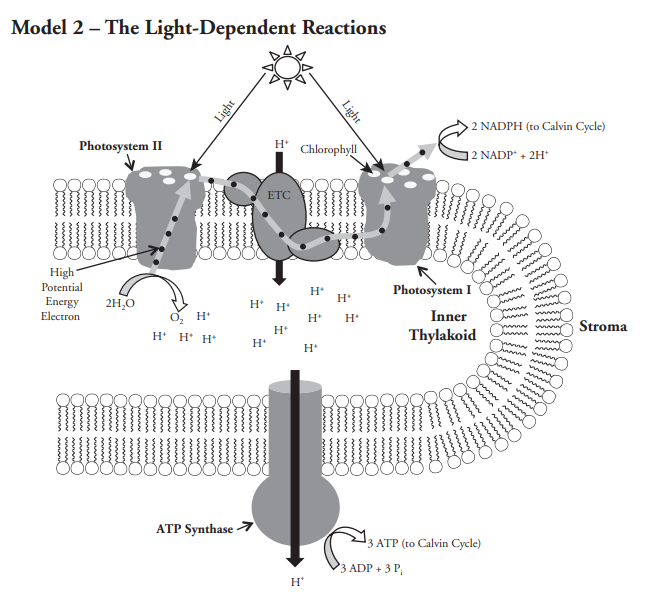
According to Model 2:
a. What is the embedded protein in the thylakoid membrane that uses excited electrons to convert NADP+ into NADPH? _______
b. What is the embedded protein in the thylakoid membrane that provides excited electrons to the ETC (electron transport chain)? _______
c. What is the embedded protein in the thylakoid membrane that that converts ADP into ATP using energy from the flow of hydrogen ions (H+)? _______