Copy of Reading - Intro to RNA and Transcription (5/28/2026)
star
star
star
star
star
Last updated about 2 hours ago
8 questions
3
3
2
3
Learning Goals:
How is RNA different from DNA?
What are the types of RNA and their functions?
What is transcription?
What are the steps in the process of transcription?
How is transcribed mRNA processed in eukaryotes?
6
Question 1
1.
1
Question 3
3.
Other Answer Choices:
Double Stranded
Single Stranded
Question 4
4.
5
Question 5
5.
a.) _______ is as summarization of some of the information in DNA.
b.) In eukaryotic cells transcription occurs in the _______ .
c.) A strand of mRNA is made during transcription that is _______ to a piece of DNA.
d.) The enzyme that is involved in the initial step of constructing an mRNA is known as _______ .
e.) The stage of transcription in which complementarity is used is referred to as _______ .
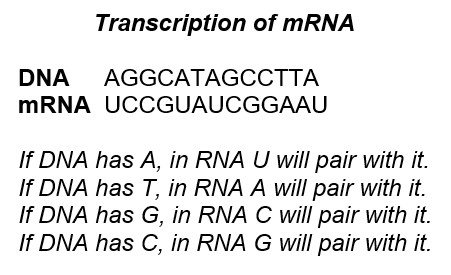
The information to the left models the complementary nature of the nucleotides of RNA with the nucleotides of DNA. Look carefully to see the base-pairing pattern between them. Also not the difference between some of the types of nitrogen bases that RNA and DNA has.
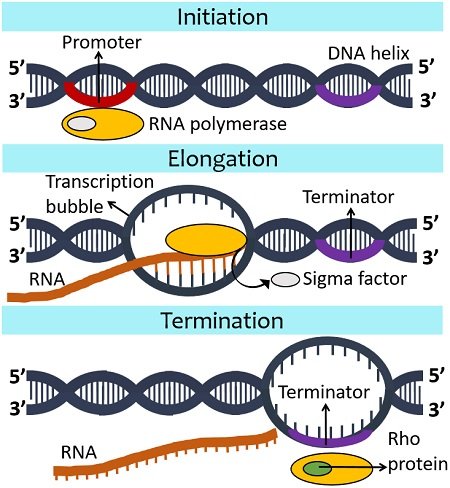
The image to the left illustrates the process of transcription, which involves synthesizing RNA from a DNA template. It is divided into three main stages:
Initiation: RNA polymerase binds to a specific region called the promoter on the DNA helix, signaling the start of transcription.
Elongation: The RNA polymerase moves along the DNA, unwinding the double helix and synthesizing a complementary RNA strand. This stage includes the formation of a transcription bubble where the DNA strands are separated.
Termination: The process concludes when RNA polymerase reaches a terminator sequence on the DNA, signaling the end of transcription. This stage may involve additional factors, such as the Rho protein, to help release the newly formed RNA strand.
Question 6
6.
DNA to RNA complementarity.
If DNA has C, RNA will have ______ .
If DNA has T, RNA will have ______ .
If DNA has G, RNA will have ______ .
If DNA has A, RNA will have ______ .
Other Answer Choices:
A
C
U
T
G
Question 7
7.
Processing mRNA after Transcription
In eukaryotes, the new mRNA is not yet ready for translation. It must go through additional processing before it leaves the nucleus. This may include splicing, editing, and polyadenylation. These processes modify the mRNA in various ways. Such modifications allow a single gene to be used to make more than one protein.
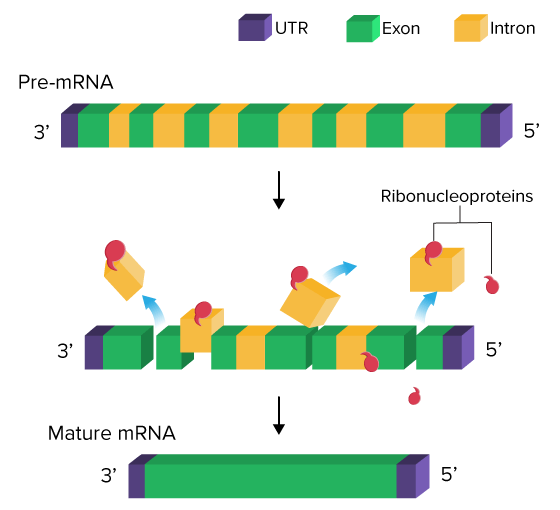
Splicing removes introns from mRNA (see the Figure below). Introns are regions that do not code for proteins. The remaining mRNA consists only of regions that do code for proteins, which are called exons. Ribonucleoproteins are nucleoproteins that contain RNA. Small nuclear ribonucleoproteins are involved in pre-mRNA splicing.
Editing changes some of the nucleotides in mRNA. For example, the human protein APOB, which helps transport lipids in the blood, has two different forms because of editing. One form is smaller than the other because editing adds a premature stop signal in the mRNA.
Polyadenylation adds a string of nucleotides to the mRNA strand's end, consisting of a string of As (adenine bases). It signals the end of mRNA. It is also involved in exporting mRNA from the nucleus. In addition, the tail protects mRNA from enzymes that might break it down. This nucleotide string is often called a poly-A tail because "poly" refers to "many."
2
Text
00:00
keyboard_arrow_down
The video to the left is a 3D animation of transcription. As you watch the animation, think about how the above reading and models has described the three stages of transcription (initiation, elongation, and termination).
Summary
Transcription is the DNA → RNA part of the central dogma of molecular biology.
Transcription occurs in the nucleus of eukaryotic cells.
During transcription, a copy of mRNA is made that is complementary to a strand of DNA. In eukaryotes, mRNA may be modified before it leaves the nucleus of eukaryotic cells.
RNA
How does the information move from the nucleus, where the DNA is located, to the cytoplasm, where the ribosomes are?
RNA, the other nucleic acid, that's how. Specifically mRNA. RNA, the middle player in the central dogma. This image is an abstract representation of tRNA. Without tRNA, mRNA, and rRNA, proteins cannot be made.
RNA
DNA alone cannot ‘‘tell’’ your cells how to make proteins. It needs the help of RNA, ribonucleic acid, the other main player in the central dogma of molecular biology. Remember, DNA ‘‘lives’’ in the nucleus, but proteins are made on the ribosomes in the cytoplasm. How does the genetic information get from the nucleus to the cytoplasm? RNA is the answer.
RNA vs. DNA
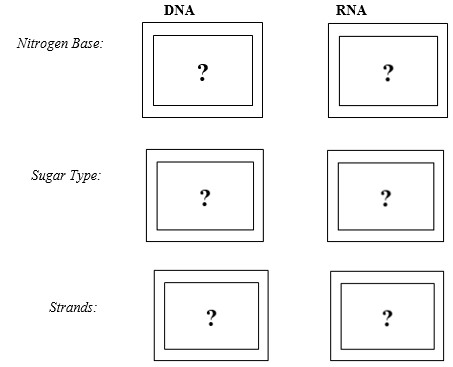
RNA, like DNA, is a nucleic acid. However, RNA differs from DNA in several ways. In addition to being smaller than DNA, RNA also
consists of one nucleotide chain instead of two,
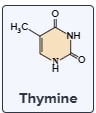
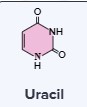
contains the nitrogen base uracil (U) instead of thymine,
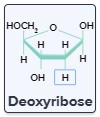
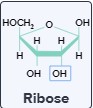
contains the sugar ribose instead of deoxyribose.
Types of RNA
There are three main types of RNA, all of which are involved in making proteins.
Messenger RNA (mRNA) copies the genetic instructions from DNA in the nucleus, and carries the instructions to the cytoplasm.
Ribosomal RNA (rRNA) helps form ribosomes, the organelle where proteins are assembled.
Transfer RNA (tRNA) brings amino acids to ribosomes, where they are joined together to form proteins.
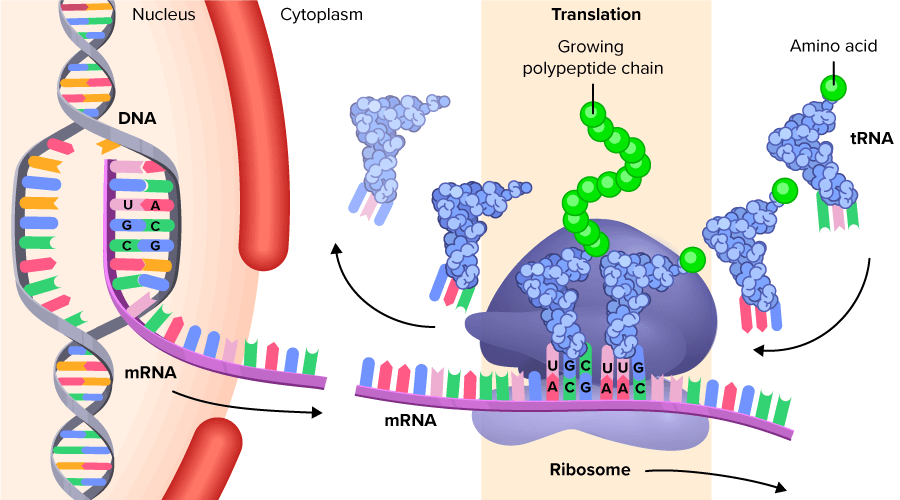
Shown are the three types of RNA and their roles: (1) mRNA contains the genetic message, (2) tRNA transfers the amino acids to the ribosome, (3) rRNA is the main component of the ribosome.
a.) What does the cell use to move genetic information from the DNA into the cytoplasm? _______
b.) RNA and DNA differ in many ways; one of those ways is that RNA has _______ nucleotide chain, while DNA has two nucleotide chains (double-stranded).
c.) Another difference between these two nucleic acids is one of the types of bases. While both RNA and DNA will have A, G, and C, DNA will have _______while RNA has _______.
d.) There are three different forms of RNA, each has their own specific role. For example, _______ is used to carry genetic instructions from DNA to the cytoplasm.
e.) There are two other types of RNA. The form that brings aminos to the ribosome is called: _______.
Question 2
2.
How does DNA differ from RNA? Drag and drop each feature that belongs to each nucleic acid type where applicable.
Match each description to the form of RNA that it belongs to (two will be used more than once).
Makes up the ribosome
Nucleic acid
Involved in making protein
Carries amino acids
Genetic message
messenger RNA
transfer RNA
ribosomal RNA
Transcription
How does a cell use the information in its DNA?
To transcribe means ‘‘to paraphrase or summarize in writing’’. The information in DNA is transcribed - or summarized - into a smaller version - RNA - that can be used by the cell. This process is called transcription.
Transcription
The process in which cells make proteins is called protein synthesis. It actually consists of two processes: transcription and translation. Transcription takes place in the nucleus of the eukaryotic cells. It uses DNA as a template to make an RNA molecule. RNA then leaves the nucleus and goes to a ribosome in the cytoplasm, where translation occurs. Translation reads the genetic code in mRNA and makes a protein.
Transcription is the first part of the central dogma of molecular biology: DNA → RNA. It is the transfer of genetic instructions in DNA to messenger RNA (mRNA). During transcription, a strand of mRNA is made that is complementary to a strand of DNA.
The concept of complementarity is related to the base-pairing rules discussed during the unit on DNA. In DNA, complementarity can be described as, adenine binds with thymine and guanine binds with cytosine. However, RNA does not contain thymine but is "replaced" with uracil (U). Uracil behaves in a similar fashion to thymine, meaning that it will also bind with adenine. Therefore, in RNA, complementarity can be described as, adenine binds with uracil and guanine binds with cytosine.
Steps of Transcription
Transcription takes place in three steps: initiation, elongation, and termination. The steps are illustrated in the Figure below.
Initiation is the beginning of transcription. It occurs when the enzyme RNA polymerase binds to a region of a gene called the promoter. This signals the DNA to unwind so the enzyme can ‘‘read’’ the bases in one of the DNA strands. The enzyme is now ready to make a strand of mRNA with a complementary sequence of bases.
Elongation is the addition of nucleotides to the mRNA strand. RNA polymerase reads the unwound DNA strand and builds the mRNA molecule using complementary base pairs. There is a brief time during this process when the newly formed RNA is bound to the unwound DNA. During this process, adenine (A) in the DNA binds to uracil (U) in the RNA.
Termination is the ending of transcription and occurs when RNA polymerase crosses a stop (termination) sequence in the gene. The mRNA strand is complete, and it detaches from DNA.
Match each description with the stage of transcription that it belongs in.
RNA detaches from DNA.
Uses a stop sequence.
RNA polymerase reads DNA.
Begins at a promoter.
Lays down bases using complementarity.
Binding of RNA polymerase.
Initiation
Elongation
Termination
Question 8
8.
a.) Messenger RNA has two regions, one that remains in the mRNA and another that is removed from the mRNA during processing. The section that is removed is known as _______ .
b.) During processing, something is added to the end of mRNA that may protect it; it is known as a _______ .