Copy of Translation of Amino Acids cloned 1/26/2023 (5/28/2026)
star
star
star
star
star
Last updated about 2 hours ago
11 questions
Untitled Section
5
5
6
3
3
3
Organism Protein Identification
4
4
DNA vs. RNA Review
1
3
3
How to Determine mRNA from DNA and tRNA from mRNA
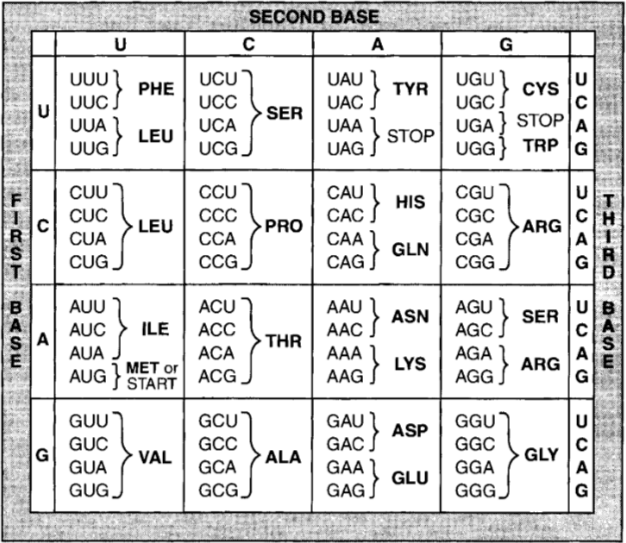
How to Determine the Amino Acids from mRNA codons:
Question 1
1.
Transcribe the following DNA into an mRNA strand:
DNA: ATA TAC CCC GGG CAC ATT
mRNA (codons): _______
DNA→mRNA: A→U, T→A, C→G, G→C
Translate the mRNA strand that you transcribed into tRNA anticodons.
tRNA (anticodons): _______
mRNA→tRNA: A→U, U→A, C→G, G→C
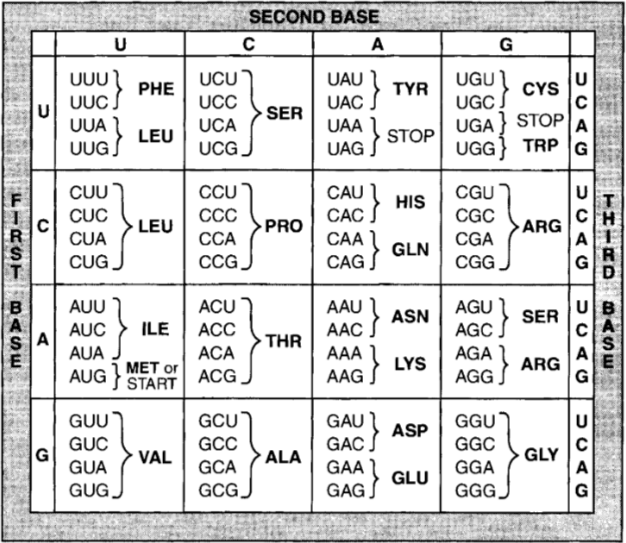
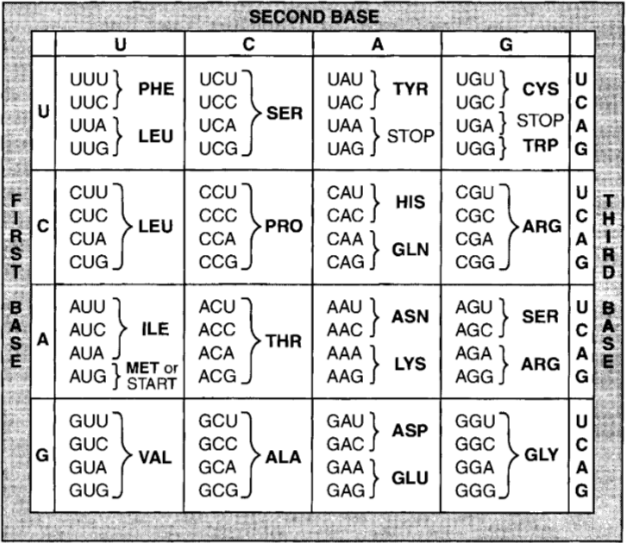
Using the codon key, above, identify the amino acids that would be added (use the mRNA codons).
Start adding aminos at the start codon (AUG) and stop adding them at a stop codon.
Place a single space between each amino acid.
Aminos: _______
Question 2
2.
Transcribe the following DNA into an mRNA strand:
TAC AAA ATA GCG GTG ATC
mRNA (codons): _______
Translate the mRNA strand that you transcribed into tRNA anticodons.
tRNA (anticodons): _______
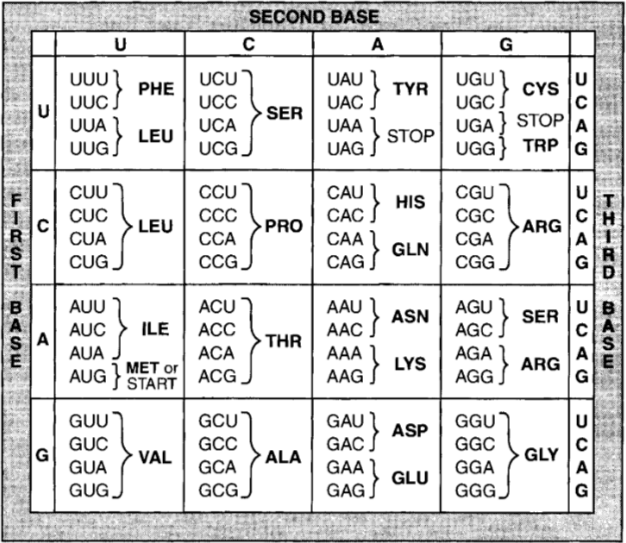
Using the codon key, above, identify the amino acids that would be added (use the mRNA codons).
Start adding aminos at the start codon and stop adding them at a stop codon.
Place a single space between each amino acid.
Aminos: _______
Question 3
3.
Transcribe the following DNA into an mRNA strand:
DNA: AAA CGC TAC GAT CCA ACT
mRNA (codons): _______
Translate the mRNA strand that you transcribed into tRNA anticodons.
tRNA (anticodons): _______
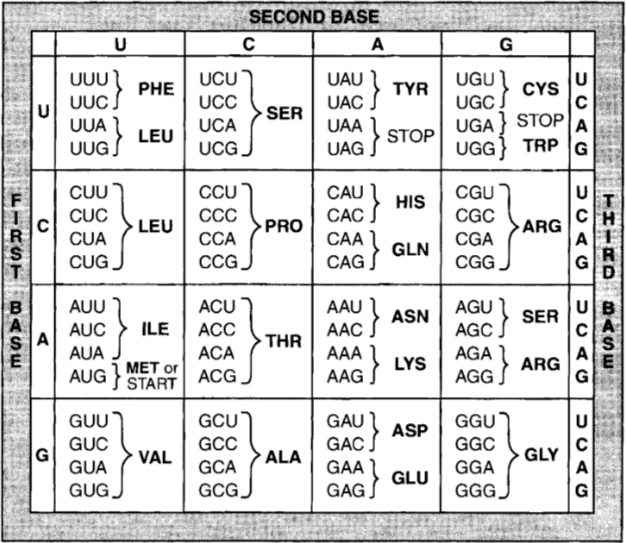
Using the codon key, above, identify the amino acids that would be added (use the mRNA codons).
Start adding aminos at the start codon and stop adding them at a stop codon.
Place a single space between each amino acid.
Aminos: _______
Question 4
4.
Complete the mRNA codons, the tRNA anticodons, and the set of amino acids from the following DNA sequence.
Start adding aminos at the start codon and stop adding them at a stop codon.
Place a single space between each amino acid.
DNA: TAC TGA TCG ACC CCC ATA ATG AAA ATC
mRNA: _______
tRNA: _______
Aminos: _______
Question 5
5.
Complete the mRNA codons, the tRNA anticodons, and the set of amino acids from the following DNA sequence.
Begin adding aminos at the start codon and stop adding them at a stop codon.
Place a single space between each amino acid.
DNA: ACG TAC TCC GCC GTC GAC AAT ACC ACT AAA
mRNA: _______
tRNA: _______
Aminos: _______
Question 6
6.
Complete the mRNA codons, the tRNA anticodons, and the set of amino acids from the following DNA sequence.
Begin adding aminos at the start codon and stop adding them at a stop codon.
Place a single space between each amino acid.
DNA: TAG ACG TAC ACG TCC CTC ATT AAT ACC ACT AAA TAT CGC ATA
mRNA: _______
tRNA: _______
Aminos: _______
Procedure:
Examine the three strands of DNA provided.
Transcription: from the DNA strand create the mRNA codons.
Translation: using the mRNA codons, identify which tRNA anticodons would pair with each codon.
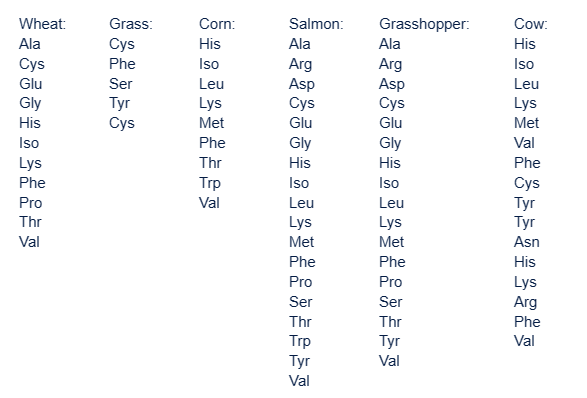
Amino Acid Chains: Using the codon chart, fill in the amino acids for each mRNA strand. Remember to start this at the start codon and stop when you reach a stop codon. Place a space between each amino acid.
Organisms: compare each amino acid chain with that of each organism (see chart to the right) and attempt to identify the organism that the protein originated from. Each amino acid chain is a fragment of a larger protein. You must find the protein that your amino acid chain most closely resembles.
Question 7
7.
DNA: CGA AAG GAG TAC AAA UCG ATG ATT GTG CAG
mRNA: _______
tRNA: _______
Aminos: _______
Organism: _______
Question 8
8.
DNA: GGA TAG CAG TAC CAC AAA ACA ATG ATA TTA GTA TTC TCC ACT AAA
mRNA: _______
tRNA: _______
Aminos: _______
Organism: _______
Types of RNA and its Comparison to DNA
DNA vs. RNA 1
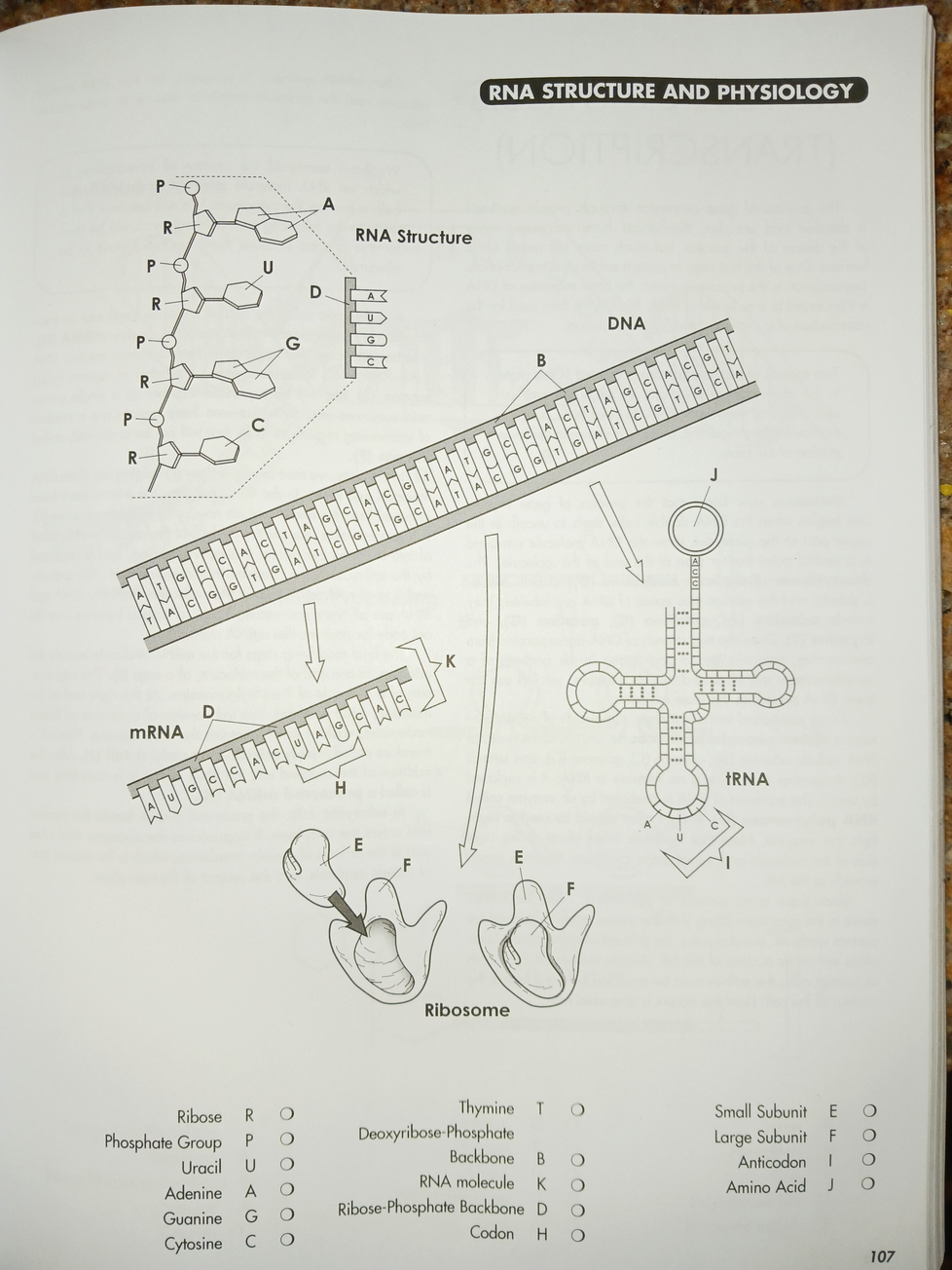
RNA is an important intermediary in gene expression. Although closely related to DNA, RNA differs in three important ways. In the diagram of RNA structure, we see that the sugar is made up of ribose instead of deoxyribose that is found in DNA. Phosphate groups link the ribose molecules in RNA in the same way that they link the deoxyribose molecules in DNA.
DNA vs. RNA 2
The second important difference is the presence of the nitrogenous base uracil (abbreviated 'U'). Uracil does not exist in DNA. Like DNA, RNA contains cytosine (C), guanine (G), and adenine (A); however, in RNA, uracil (U) takes the place of thymine (T) that exists in DNA. Uracil will act in a similar way to thymine in that it can bind to adenine. The four nitrogenous bases of DNA are A, T, C, and G; while in RNA they are A, U, C, and G.
DNA vs. RNA 3
A third important difference is that RNA is single-stranded while DNA is double-stranded. In the diagram, we can see the single molecule of RNA with its ribose-phosphate backbone and the four nitrogenous bases attached to it. It is because of the many similarities between DNA and RNA that scientists believed that this molecule could receive a genetic message from DNA to use in protein synthesis.
Types of RNA 1
Biochemists soon discovered three types of RNA that participate in the process of protein synthesis. The diagram shows a molecule of DNA with its deoxyribose-phosphate backbone and hydrogen-bonded nitrogenous bases. Note the presence of thymine (T) in DNA and that DNA is double-stranded.
The first type of RNA is messenger RNA (mRNA). This molecule initially copies the code on a single gene from DNA. Notice in the diagram that mRNA is single-stranded and the set of nitrogenous bases on mRNA. Also notice that three of these nitrogenous bases have been bracketed and labeled 'H'. These three bases represent a single codon. The sequence of codons in a strand of mRNA determines the identity of the protein that is created. Notice that the bases of the mRNA complement the lower strand of bases of the DNA molecule just above it on the diagram.
Types of RNA 2
The second type of RNA that functions in gene expression is ribosomal RNA (rRNA). rRNA makes up the ribosomes of the cell. Each ribosome is constructed of two parts - a small subunit and a large subunit. Ribosomes are ultramicroscopic bodies found either on the surface of the rough endoplasmic reticulum (rough ER) or freely "floating" in the cytoplasm of the cell. Ribosomes are often known as the "workbenches" of the cell because they are the location of protein synthesis.
Types of RNA 3
The third type of RNA that is involved in gene expression is transfer RNA (tRNA). There are dozens of different types of tRNA floating around the cell's cytoplasm. They link with specific amino acids and carry them to the ribosome so that they can be link with other amino acids during protein synthesis. The tRNA often has the shape of a cloverleaf. In the model, the amino acid is located in the upper end of the tRNA and is labeled with a "J". This specific tRNA is bound to the amino acid serine.
Question 9
9.
What are three differences between DNA and RNA, structurally?
Question 10
10.
Where is DNA located in the cell? _______
What is the two locations in the cell in which RNA can be found? _______ and _______