Twa kɔ nsɛm atitiriw so
Log in
Sign up for FREE
arrow_back
Laabri

Copy of DNA Replication: Meselson-Stahl and Replication Fork (5/28/2026)

star
star
star
star
star
Last updated about 1 month ago
15 Nsɛmmisa
Models of Replication and Meselson-Stahl

Meselson-Stahl Experiment

Pay attention to the video and answer the questions from the information revealed in the video. If you need to watch it more than once, then do so, as it's only 6 minutes long.

Replication Fork

Models of Replication

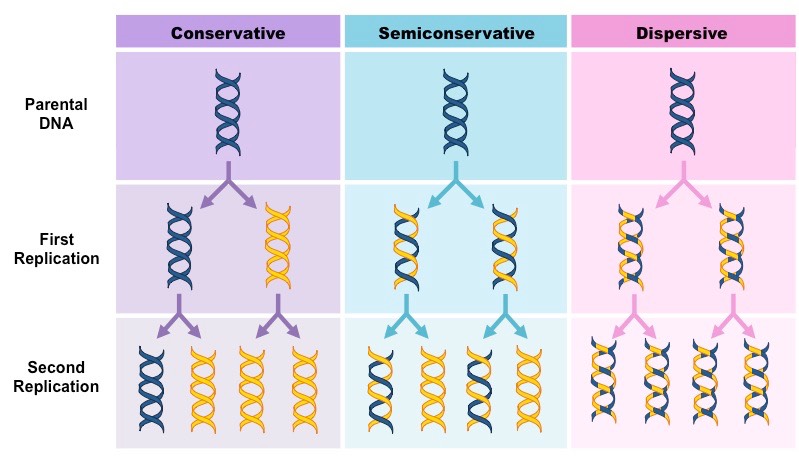
Three replication models were considered possible: conservative, semi-conservative, and dispersive.

In conservative replication, the two original DNA strands, known as the parental strands, would re-basepair with each other after being used as templates to synthesize new strands, and the two newly synthesized strands, known as the daughter strands, would also base pair with each other; one of the two DNA molecules after replication would be “all-old,” and the other would be “all-new.”

In semi-conservative replication, the two parental DNA strands would act as a template for new DNA strands to be synthesized. Still, after replication, each parental DNA strand would base pair with the complementary newly synthesized strand just synthesized. Both double-stranded DNAs would include one parental or “old” strand and one daughter or “new” strand.

In dispersive replication, after replication, both copies of the new DNAs would somehow have alternating segments of parental DNA and newly synthesized DNA on each of their two strands.
Two researchers, Matthew Meselson and Frank Stahl, worked together to identify the form of replication that DNA used to make copies of itself. Their experiment, the Meselson-Stahl experiment, used E. coli bacteria and two forms of nitrogen (known to exist within the nitrogenous bases of the nucleotides of DNA) — a "heavy" isotope (15N) and a "light" isotope (14N) — would settle this debate. The video below will summarize this experiment and its findings.

0.5
Asemmisa {{asɛmmisaAhyɛnsode}}
1.

In conservative replication, after replication one of the DNA molecules would be "all-old," and the other would be .

1
Asemmisa {{asɛmmisaAhyɛnsode}}
2.

In dispersive replication, after replication, both copies of DNA would have alternating segments of DNA and newly synthesized DNA on each of their strands.

1
Asemmisa {{asɛmmisaAhyɛnsode}}
3.

Semi-conservative replication involves each parental DNA strand acting as a for new DNA strands to be synthesized, such that after replication, each DNA molecule contains one parental or "old" strand and one or "new" strand.

1.5
Asemmisa {{asɛmmisaAhyɛnsode}}
4.

The Meselson-Stahl experiment used two different forms (isotopes) of . The first isotope, 15N, was the isotope and the second isotope, 14N, was the isotope.
Question 5
01:45
keyboard_arrow_down
1
Question 6
02:06
keyboard_arrow_down
0.5
Question 7
04:34
keyboard_arrow_down
3.5
Question 8
06:04
keyboard_arrow_down
1

In the prior section, you learned that new copies of DNA are made via semi-conservative replication; meaning that each new DNA molecule is made up of two strands. One strand is from the original DNA molecule (parent strand) and the other strand is a new strand (daughter strand) that uses the original strand as the template. Recall from the discussion of the base-pairing rule that nucleotides pair up according to the following pattern: adenine binds with thymine (A-T), and cytosine binds with guanine (C-G). During semi-conservative replication, new nucleotides are laid down in the new strand using these rules. This section will discuss the basic mechanisms behind this process in an area referred to as the "replication fork," which is the area on a DNA molecule where replication is occurring.

1
Asemmisa {{asɛmmisaAhyɛnsode}}
9.

New copies of DNA are made via replication, meaning each new DNA molecule is made up of two strands - one original strand and one new strand synthesized using the original strand as a .

1
Asemmisa {{asɛmmisaAhyɛnsode}}
10.

During DNA replication, new nucleotides are laid down in the new strand using the base-pairing rule of adenine binds with , and binds with guanine.

Replication Fork

When it is not being replicated, DNA is tightly coiled. Replication cannot begin unless the double helix is unwound and separated into two single strands. To do this, a complex of enzymes scans along the chromosome (which is constructed mainly of DNA with some specialized proteins) until it finds an origin of replication, which is a specific sequence of nucleotides on the DNA molecule. Once the "complex" finds one, other enzymes move on to the origin of replication.

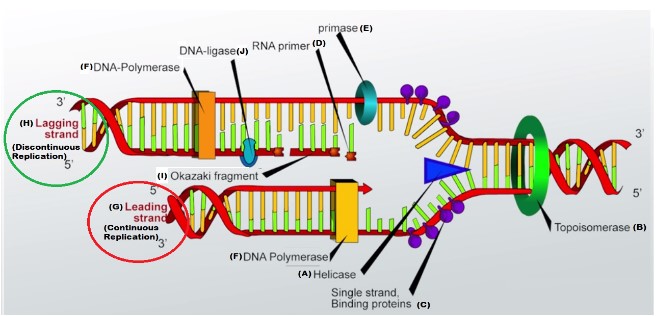
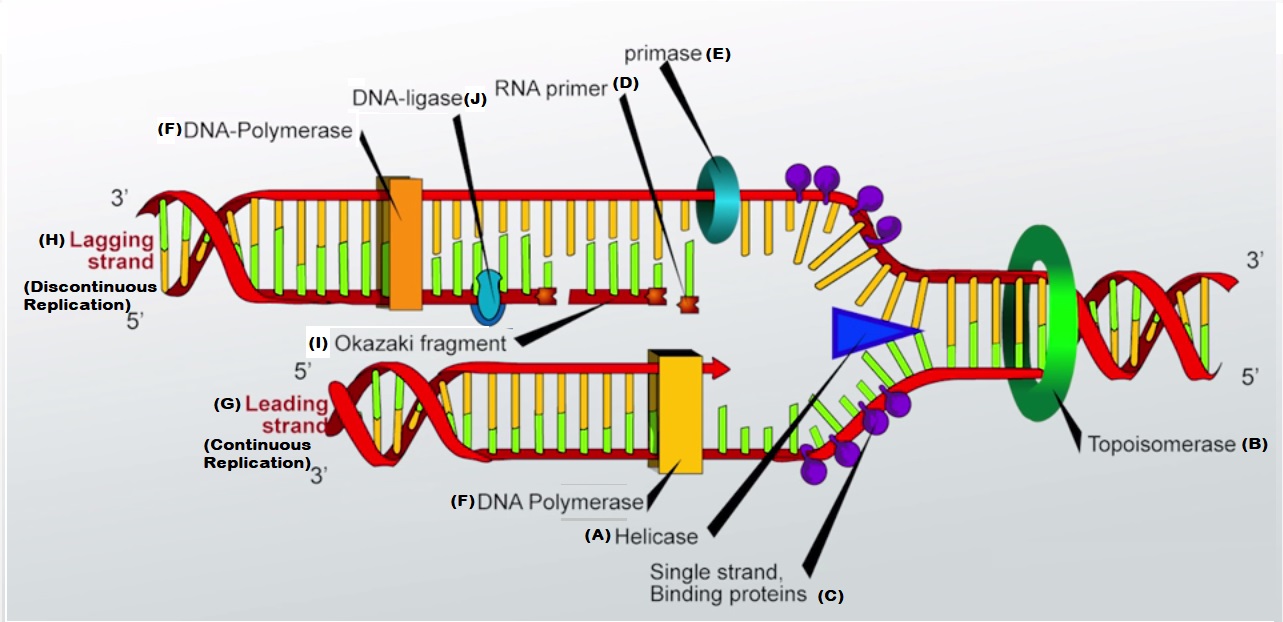
The diagram below illustrates the replication fork with the associated enzymes and proteins labeled by name. Each also includes a letter in parentheses that will be included in the text that occurs under the diagram.

1
Asemmisa {{asɛmmisaAhyɛnsode}}
11.

a.) Before replication can begin, the double helix must be and separated into two single strands.

b.) Replication begins at the which is scanned for by a complex of enzymes.

The first enzyme is called helicase (A) which breaks hydrogen bonds holding the two strands of DNA together. Once the hydrogen bonds are broken, the double-stranded DNA molecule unwinds and opens up, which will form a replication bubble. Each replication bubble has two replication forks, one on each side of the replication bubble (this section will discuss the events that occur at one of these replication forks).

When helicase unwinds the DNA helix at the origin of replication, the helix just outside of the bubble gets wound more tightly leading to tension on the DNA molecule. Topoisomerase (B) will cut one or both of the DNA strands to release this tension. A potential problem is that the replication fork will close, preventing DNA replication from occurring. Therefore, single-stranded binding proteins (C) hold the replication fork open and keep each strand of the original DNA molecule separated. At this point, replication may continue.

5
Asemmisa {{asɛmmisaAhyɛnsode}}
12.

a.) Helicase is used to holding the two DNA strands together.

b.) There are replication forks at each replication bubble.

c.) Tension builds in the DNA strand as it is unwound by the helicase; therefore, is used to cut the DNA to the extra tension.

d.) are used to prevent the replication fork from closing by keeping each DNA strand separate from each other.

Several RNA primers (D) must be synthesized for each template strand. This is accomplished by the enzyme primase (E). The synthesis of these primers is important because DNA polymerase (F) can only begin to attach new nucleotides after the RNA primers (D) are attached to the template strands. The primer is usually only 8-12 nucleotides long; DNA will later replace them.

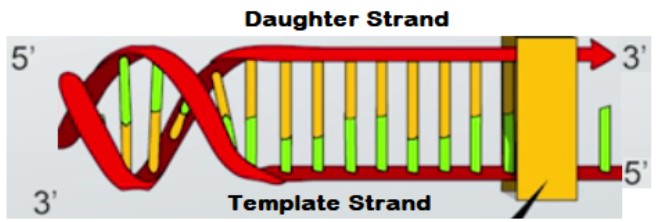
Daughter DNA (new strands) is created as a growing polymer. DNA polymerase (F) catalyzes the elongation of the daughter strand using the parent DNA (original strands) as a template, and DNA polymerase will elongate the daughter strand by adding nucleotides to the 3' end of the RNA primer. This means that the direction that DNA is built occurs is from the 5' to the 3' end of the daughter strand, and the template strand is read from 3' to 5'.

3.5
Asemmisa {{asɛmmisaAhyɛnsode}}
13.

a.) Short pieces of RNA called must be synthesized for each template strand to allow to begin attaching new nucleotides.

b.) The enzyme that creates these short pieces of RNA is called .

c.) New DNA strands (daughter strands) are laid down from to ; the template strand is read by the DNA polymerase from to .

DNA polymerase (F) can also proofread its work and correct any base pairing mistakes it may make. Rapid elongation of the daughter strand follows. Since the two template strands are antiparallel, the two primers will elongate toward opposite ends of the replication bubble, away from the origin of replication. These new DNA strands are called leading strands (G) because their synthesis leads into the replication fork (see the area circled in red in the diagram below). The leading strand can be replicated continuously (continuous replication), meaning it does not pause but continues until the new strand is synthesized on the leading strand. DNA polymerase reads the DNA code of the template DNA. It makes a new DNA strand by adding complementary base pairs: adenine pairs with thymine via two hydrogen bonds, and cytosine pairs with guanine via three hydrogen bonds.

2
Asemmisa {{asɛmmisaAhyɛnsode}}
14.

a.) Along with elongating the daughter strand of DNA, DNA polymerase can also for mistakes.

b.) The DNA strand that is replicated in a continuous fashion is referred to as the .

c.) Guanine and cytosine share hydrogen bonds; while thymine and adenine share of these bonds.

The top half of the diagram displays the lagging strand of DNA (circled in green in the diagram above and below). This section replicates differently because its synthesis does not lead into the replication fork but away from it. Recall that DNA can only be synthesized from 5' to 3'. To replicate these sections, an RNA primer (D) is laid down, and DNA polymerase builds a short section of new DNA called a lagging strand (H). DNA on the lagging strand is replicated in small fragments called Okazaki fragments (I). As the replication bubble widens, more template DNA is available for more Okazaki fragments (I) to be synthesized. There are multiple of these Okazaki fragments on the lagging strand due to the pausing that must occur as the DNA polymerase on this strand must wait for more of the template strand to be exposed as the replication fork continues to open as the helicase (A) continues to open up the parent DNA. This is referred to as discontinuous replication.

Eventually, DNA polymerase replaces all of the RNA primers with DNA, and then DNA ligase (J) connects Okazaki fragments together and also connects the leading and lagging strands. This completes DNA replication; the result is two DNA molecules, each contains one strand from the original DNA and one strand that is new (semiconservative replication).

3.5
Asemmisa {{asɛmmisaAhyɛnsode}}
15.

a.) are the multiple small fragments synthesized on the lagging strand.

b.) The lagging strand contains multiple of these fragments because the DNA polymerase must as it waits for more of the template strand to be exposed.

c.) The form of replication that occurs on the lagging strand is referred to as .

d.) RNA primers will be replaced with by DNA polymerase.

e.) On the lagging strand, the Okazaki fragments are joined together by .

f.) molecules of DNA are formed, each new molecule contains a strand from the and one new strand of DNA.

Asemmisa {{asɛmmisaAhyɛnsode}}
5.

E. coli were grown in the presence of either a heavy isotope of nitrogen, , or the ordinary light isotope, .

Asemmisa {{asɛmmisaAhyɛnsode}}
6.

The nitrogen atoms in the are labeled with either the heavy or the light forms of nitrogen.

Asemmisa {{asɛmmisaAhyɛnsode}}
7.

a.) In generation 0, % of the DNA was in the form.

b.) By generation 1, % of the DNA was in the density.

c.) By generation 2, % of the DNA was and the rest was .

Asemmisa {{asɛmmisaAhyɛnsode}}
8.

a.) Conservative replication was rejected due to the results from generation .

b.) Dispersive replication was rejected due to the results from generation .