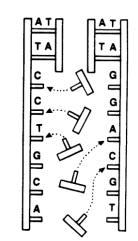
Explain what is happening to the DNA molecule and what enzymes are involved.
I will have to grade this.
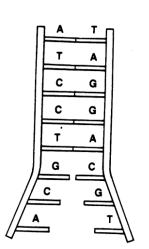
Explain what is happening to the DNA molecule and what enzymes are involved.
I will have to grade this.
Use your notes to complete the following questions.
Use your notes to complete the following questions.
Explain what is happening to the DNA molecule and what enzymes are involved.
I will have to grade this.
Explain what is happening to the DNA molecule and what enzymes are involved.
I will have to grade this.
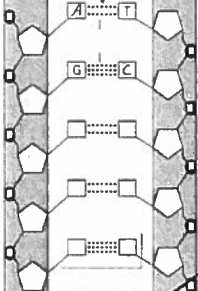
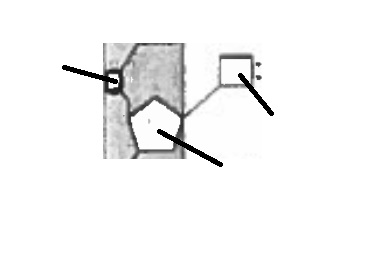
Identify a correct nucleotide in the image below.
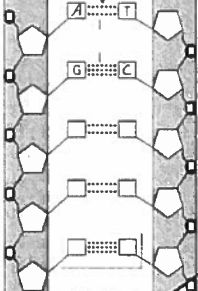
a. In a single strand of DNA, the
b. Chargaff's rules states that the DNA of any organism contains equal proportions of
c. Logical thinking using Chargaff's rules - In a strand of DNA, if the percentage of adenine was 20%, the percentage of guanine in the same strand must be
d.
Why is DNA replication called semi-conservative?
I will have to grade this.
What does it mean that the two strands of DNA are complementary?
I will have to grade this.
Reorder the following steps from beginning to end.
A complementary strand is created for each of the two strands of the original double helix.
The enzyme DNA polymerase moves along the exposed strands and adds complementary nucleotides to each nucleotide in each existing strand.
Two new identical DNA molecules have been produced.
The DNA double helix breaks or unzips down the middle between the base pairs.
Below is one-half of a DNA molecule. Create the complementary strand (USE UPPERCASE LETTERS).
A
T
G
C
A
A
A
T
T
G
C
T
C
A
C
C
G
G
G
G
A
T
C
A
G
Match each item with its correct description.
| Draggable item | arrow_right_alt | Corresponding Item |
|---|---|---|
Primase | arrow_right_alt | Unwinds and separates the double-stranded DNA |
DNA Helicase | arrow_right_alt | Adds complementary nucleotides to a growing DNA strand |
DNA Polymerase | arrow_right_alt | Joins Okazaki fragments on the lagging strand |
Topoisomerase | arrow_right_alt | Synthesizes a short RNA primer |
DNA Ligase | arrow_right_alt | Relieves torsional strain ahead of the replication fork |