Log in
Sign up for FREE
arrow_back
Library

Copy of 11.) Point Mutations - Models (5/28/2026)

star
star
star
star
star
Last updated about 2 hours ago
18 questions
Note from the author:
2
1
1
1
1
1
1
1
1
1
2
2
2
1
1
1
1
1
Use the models, what you have already learned, and information from each question (the questions "build upon" each other) to do this activity.

There have been videos posted that will help you with some of the questions.

Learning Goals:
  • What are different types of point mutations.
  • What are the effects of each type of point mutation.
  • Which types of mutations can be passed on to offspring.
Use the models, what you have already learned, and information from each question (the questions "build upon" each other) to do this activity.

There have been videos posted that will help you with some of the questions.

Learning Goals:
  • What are different types of point mutations.
  • What are the effects of each type of point mutation.
  • Which types of mutations can be passed on to offspring.
Read This!

The genes in your DNA result in the production of proteins that perform specific functions within your cells.

Various environmental factors and spontaneous events can lead to changes in genes. These changes, called mutations, can alter the structure and activity of your cells' proteins in their daily activities.

In other words, changes to a genotype (actual genes) can change a phenotype (cell activity or physical appearance). We all have mutations in most of our body cells — yet we are mostly normal and functional. How can that be?
Question 1
1.

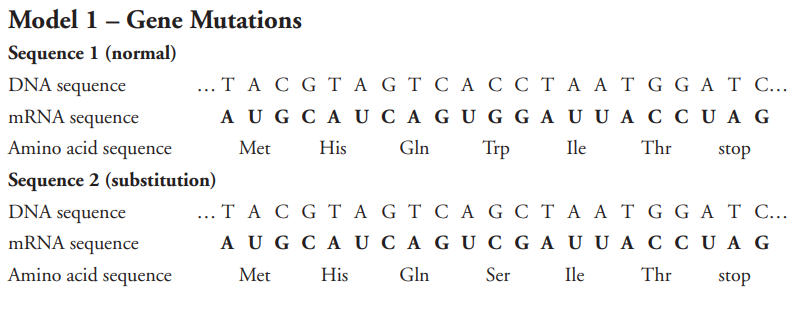
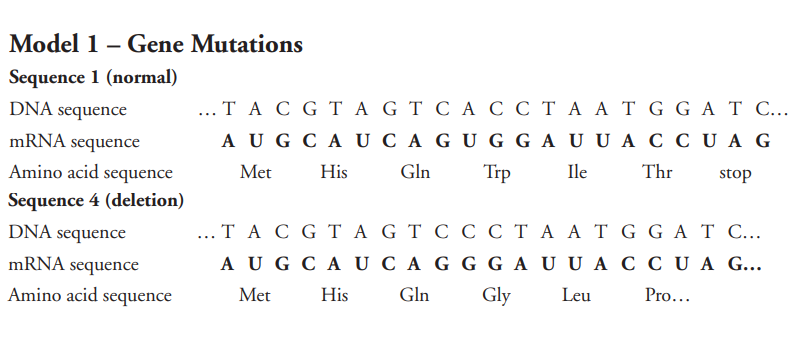
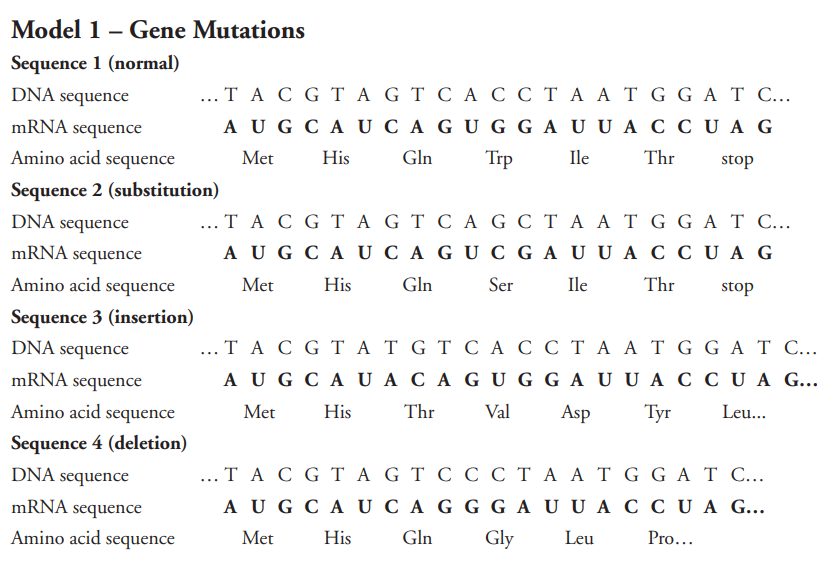
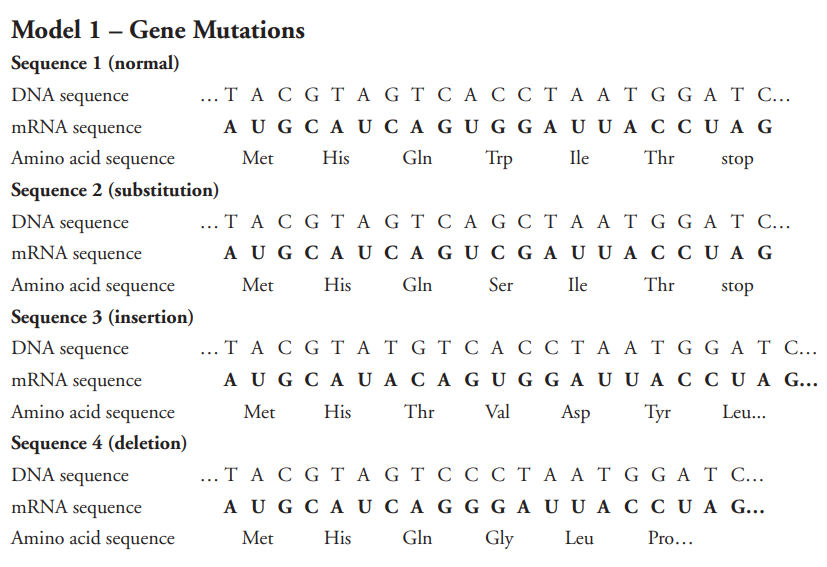
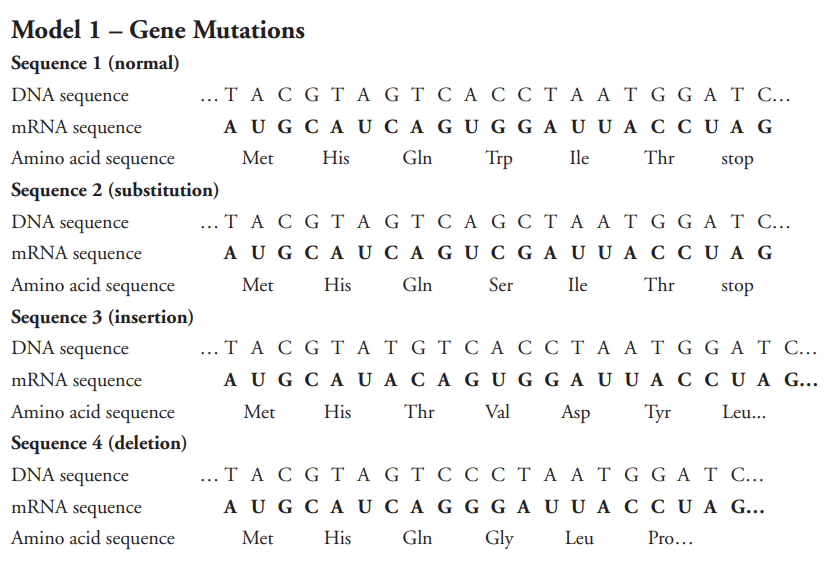
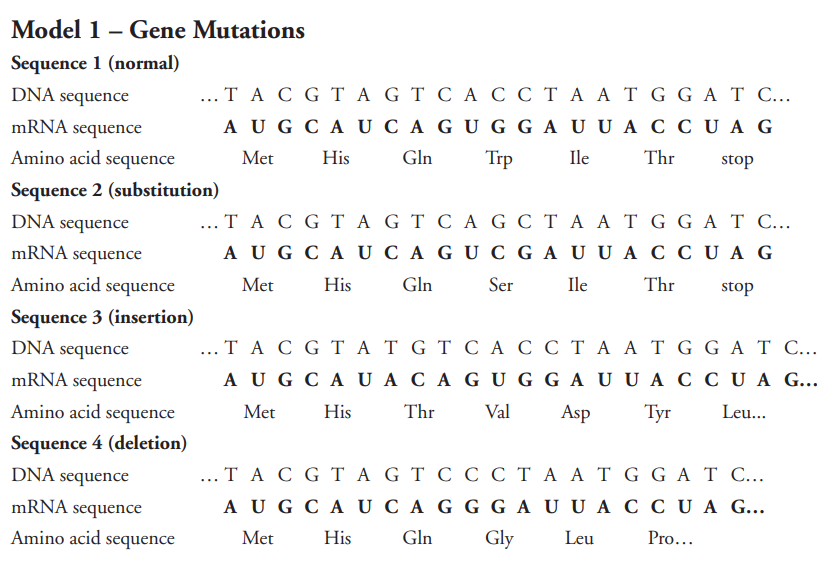
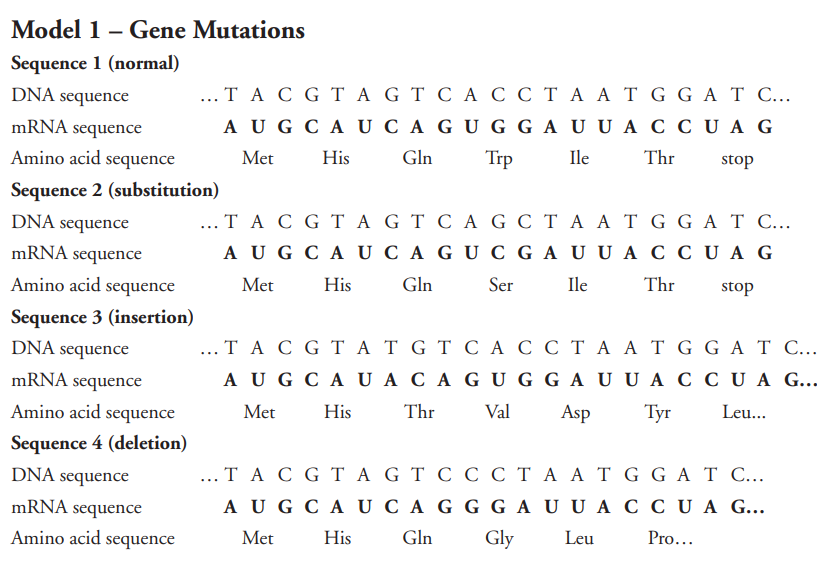
Use Model 1

a.) How many nucleotides (bases) are present in the normal DNA sequence (#1) in Model 1? _______

b.) How many codons are contained in the mRNA that is produced by the normal DNA in Model 1? _______

c.) How many amino acids will be in the polypeptide produced by the normal DNA/mRNA sequence ("stop" is not an amino acid)? _______

d.) What is the amino acid sequence of the polypeptide produced by the normal DNA sequence in Model 1 (separate the aminos with a hypen or a single space)? _______
Question 2
2.


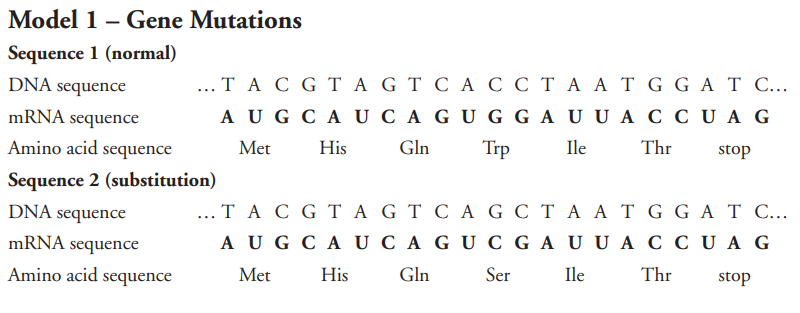
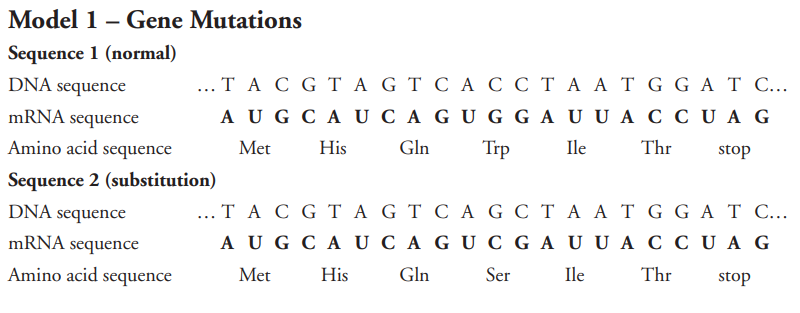
Use Model 1 - Consider DNA sequence 2 in this model. The mutation in that sequence is a substitution mutation.

Compare sequence 2 with sequence 1 and describe the mutation that has occurred on DNA and its impact on the mRNA.

Question 3
3.


Use Model 1 - Consider DNA sequence 2 in this model. The mutation in that sequence is a substitution mutation.

What is the effect of this substitution mutation on the amino acid sequence?

Question 4
4.


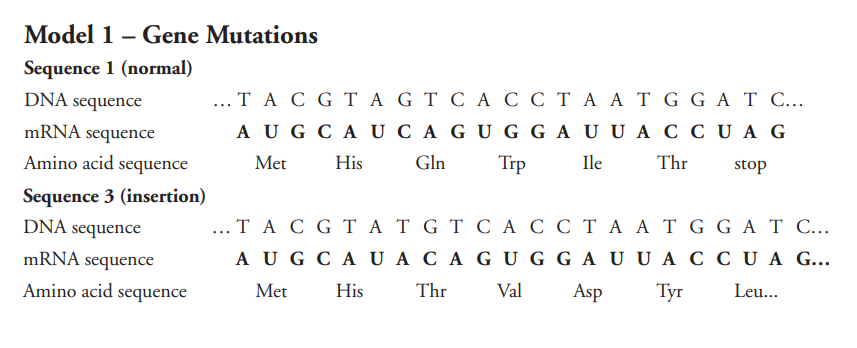
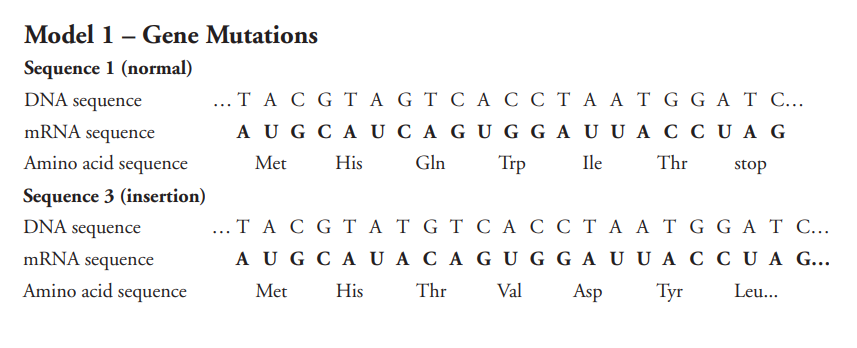
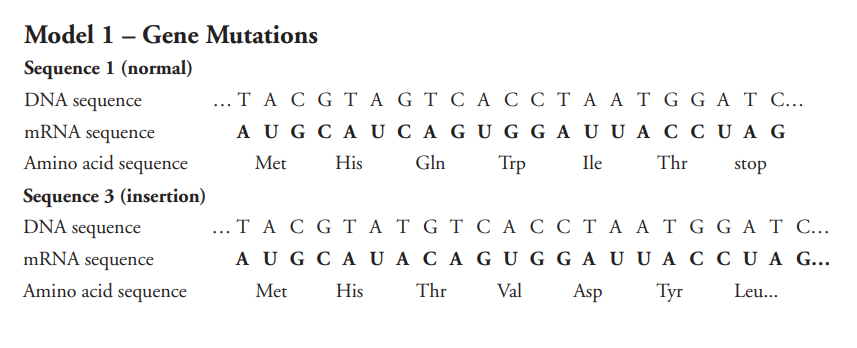
Use Model 1 - Consider DNA sequence 3. The mutation in that sequence is an insertion mutation.

Compare sequence 3 with sequence 1 and describe the mutation that has occurred on DNA and its impact on the mRNA.

Question 5
5.

What is the effect of the insertion mutation on the amino acid sequence as compared to the “normal” amino acid sequence in Model 1?

Question 6
6.


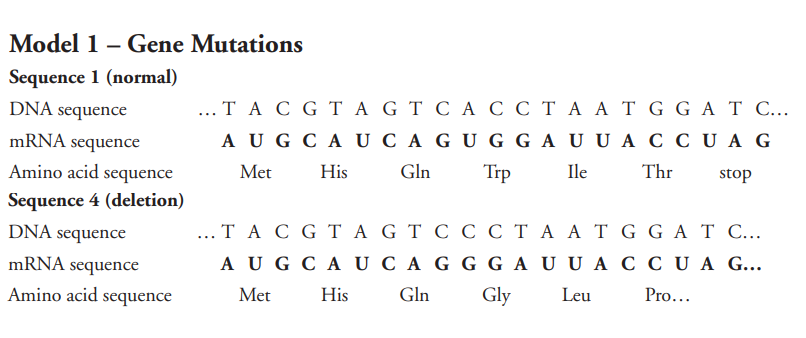
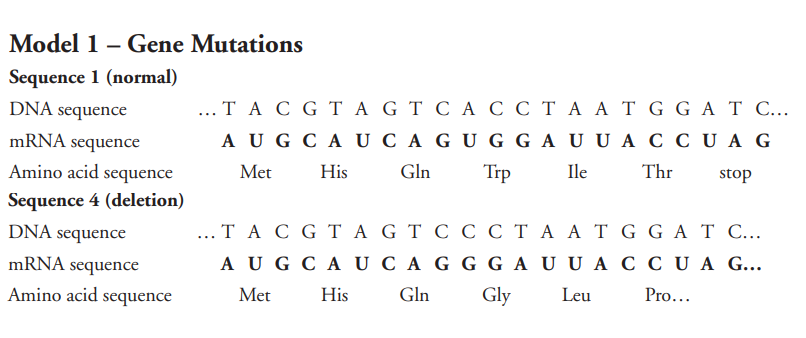
Use Model 1 - Consider DNA sequence 4. The mutation in that sequence is a deletion mutation.

Compare sequence 4 with sequence 1 and describe the mutation that has occurred.

Question 7
7.


What is the effect of the deletion mutation on the amino acid sequence as it is compared to the “normal” amino acid sequence in Model 1?

Question 8
8.


Use what you have learned to define - substitution mutation.

Question 9
9.


Use what you have learned to define - insertion mutation.

Question 10
10.


Use what you have learned to define - deletion mutation.

Question 11
11.


Consider what we have learned about codons and how they code for an amino acid, would all substitution mutations lead to a change in the amino acid sequence?

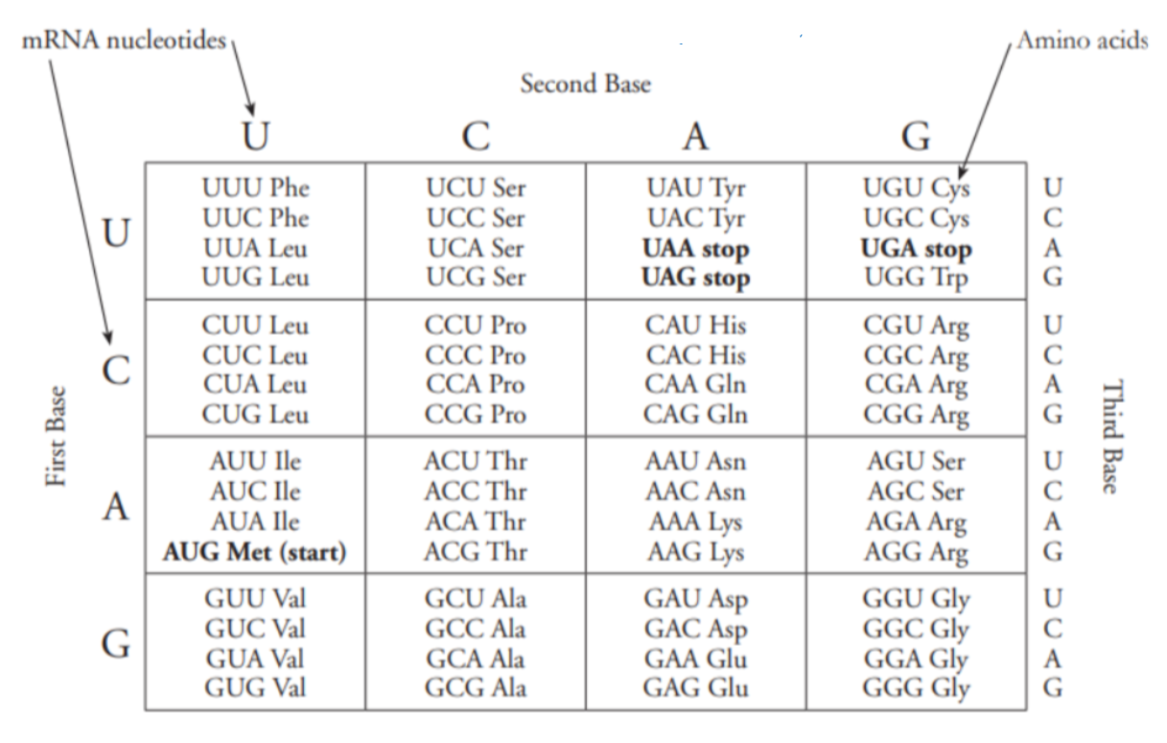
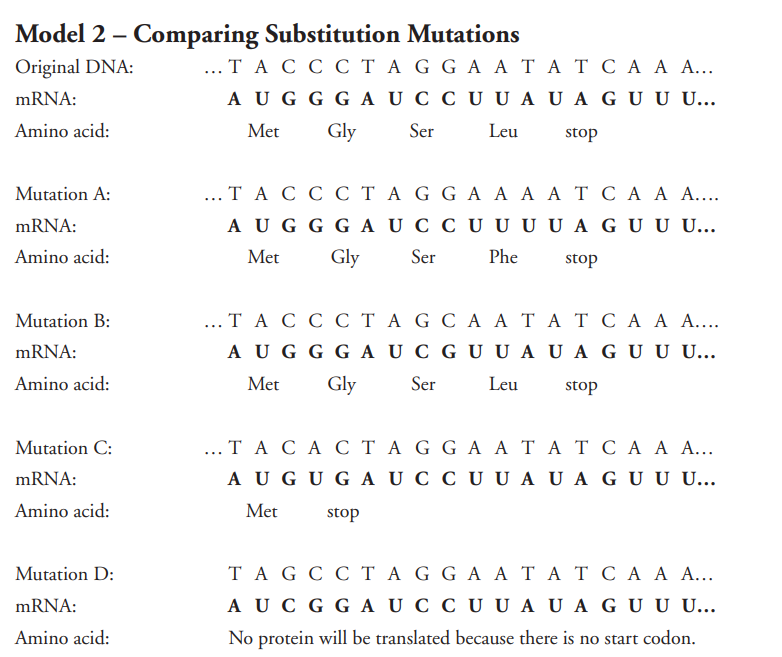
Tip - I have attached Model 1, as well as the codon chart that we used for the translation activity from last week, above this question. Review the area of the normal DNA and sequence 1 on Model 1 that had the substitution mutation and determine the amino acid that should be there. Now examine the codon chart for these amino acids and look for all of the codons that correspond to them.

Explain your reasoning.

Question 12
12.


Would all insertion or deletion mutations lead to a change in the amino acid sequence?

Explain your reasoning.

Question 13
13.


What could potentially cause more damage to an organism, a substitution mutation or an insertion mutation?

Explain your reasoning.

Question 14
14.


What could potentially cause more damage (or a greater benefit) to an organism, a deletion mutation at the beginning of a DNA sequence or at the end of a DNA sequence?

Read This!

Mutations are the source of all new alleles in nature. Variations in alleles lead to variations in organisms within a population.

Positive mutations might lead to the organism having a better chance of survival, which means the mutation may be passed on to the offspring (this would only occur if the mutation is a germline mutation - occurs in sperm or ovum). However, positive mutations rarely ever, possibly never, occur.

Negative mutations may lead to an early death — probably before the organism can produce offspring. Many mutations are inert, meaning that they do not result in any changes to the protein produced by a specific gene.
Question 15
15.


Which types of mutations, negative or neutral, are most likely to be seen in offspring several generations after the mutation occurred? Explain your reasoning.

Question 16
16.


Consider the following. State whether the mutation is likely to be passed on to the offspring of the organism. Explain your reasoning.

Remember - there are two categories of mutations - germline and somatic (the reading from Monday discussed these).

A single bacteria cell contains a positive mutation in its DNA.

Tip - bacteria reproduce by making exact copies of themselves.

Question 17
17.


Consider the following. State whether the mutation is likely to be passed on to the offspring of the organism. Explain your reasoning.

Remember - there are two categories of mutations - germline and somatic (the reading from Monday discussed these).

A skin cell on a cat contains a deletion mutation in its DNA.

Question 18
18.


Consider the following. State whether the mutation is likely to be passed on to the offspring of the organism. Explain your reasoning.

Remember - there are two categories of mutations - germline and somatic
A sperm cell in a whale contains a positive mutation in its DNA.